Skip to content

Transcription

00:07

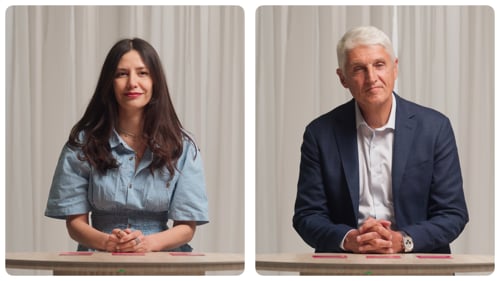
Hello, I'm Vincent Huguet, CEO and co-founder of Malt,and I'm delighted to speak with you today about the impact of artificial intelligence on the world of work.

00:15

Hello, my name is Martin Bonnefond, I'm a finance consultant at Factorial and I'm thrilled to be here with you today to talk about artificial intelligence.

00:33

Hello Vincent and Martin.On The Deck works as follows: you will first answer a question without knowing what the other person has answered.

00:40

Then, you'll have the opportunity to share your impressions and dive deeper into your answers. Let's go.

00:44

Question number 2.With 22% of non-tech jobs already impacted by AI, are all job descriptions already obsolete?

00:51

A: Yes, completely.B: No, but soon.C: That's not the point — it's the way of working that's changing.

00:58

D: The Joker.No doubt about it — that's not the point, it's the way of working that's changing.

01:04

For this one, I hesitated longer.I almost wanted to choose the Joker, but I'm going to go out on a limb a bit more and go with C.

01:11

It's not the issue — it's the way of working that's changing.

01:17

I imagine that it was...Was it a hard choice to go with C, or were you unable to answer, or did you go straight to C right away?

01:25

No, it was pretty clear.Same, you can interpret the question in many ways,but when we talk about job descriptions being obsolete, for me,it immediately brings to mind the vision of AI destroying all jobs.

01:38

That's a negative take, actually.And as I was telling you, I was in San Francisco fifteen days ago, where last year there was a whole narrative saying:AI is going to replace everything, there will be no more jobs, etc.

01:48

AI is going to be a massive transformation across certain sectors, industries, etc.

01:53

That's certain. The narrative was starting to shift.

01:56

And the new narrative was: A lot of companies laid people off and said it was because of AI — that was AI-washing.

02:03

Meaning, it was a company that wasn't doing well for various reasons or had over-hired.

02:07

That happens, and so they let people go.That wasn't necessarily an AI-related issue.

02:13

I think that on the contrary, what I've seen is that, especially when you look at AI labs, OpenAI, Anthropic, and the whole sector — their main challenge today is recruiting and finding talent.

02:23

I think this narrative is going to change.We shouldn't be naive either.

02:28

It's true that, once again, there are jobs that are going to be heavily impacted.

02:31

But I remain, despite everything, optimistic in the long run,positive, because we've seen this many times throughout history.

02:39

You could say this time, the transition will be faster.

02:41

That's true.But we've seen this historically — the industrial revolution, the arrival of digital.

02:47

And every time, we say: No, there won't be any more jobs,or this job won't exist anymore.

02:52

Yes, that's happened, but jobs change.On our end, I'd say that today, since we work particularly with a lot of small and medium-sized businesses, I'm not sure whether, consciously yet,they've shifted the type of profile they're looking for or want to hire.

03:07

I'd say it's all quite sudden and surprising for this type of company, which doesn't necessarily have the budget, nor necessarily the technology,or the knowledge to go further, or even the time, sometimes.

03:16

They're very focused on the short term.And I have the sense that it's not yet job descriptions that are evolving,but rather a person who comes in and sparks something, who suddenly thinks: Hey, yes, this needs to be a collective effort.

03:30

I think as long as they haven't seen the real impact, because for now,it's true that it's still hard to measure an economic impact,for instance, or even a process impact, because people often say: We're twice as efficient, but you still need to be able to prove it.

03:43

So my sense is that it's mainly companies that are going to integrate it more and more.

03:47

Once they can actually see the impact and tell themselves: OK,for this type of role, now this is the must-have.

03:53

We need someone who knows how to code a certain way, who knows how to do vibe coding, because we see that it's allowed us to develop three times more products in six months.

04:05

Third and final question.Freelancers are adopting AI much faster than employees.

04:09

Is that a talent problem or a company problem?