Skip to content

Transcription

00:05

we want to get involved, and I think the people at the company or The teams would like to hear that we're not going to join.

00:13

AI is going to take away your job, not your job itself.

00:16

Pau García-Milá always says this, and he’ll be joining us today and he's certainly right.

00:21

If you spend your day sifting through résumés, you’re not leading,You're just doing administrative tasks—but at a premium level.

00:28

And AI is here to pave the way to your success.At Factorial, we already use it to streamline processes such as recruitment,training or even identifying burnout before it occurs.

00:39

The goal is to look after the team, because even though the AI is doing great for detect patterns; only people can understand them.

00:47

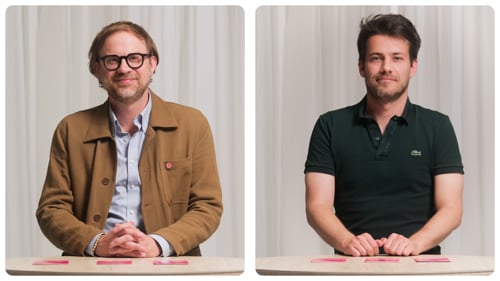
To learn how to make technology work for us, today we’re talking with Pau García-Mila and Joan Balaña.

00:53

This is On the Deck. Let's get started.

01:03

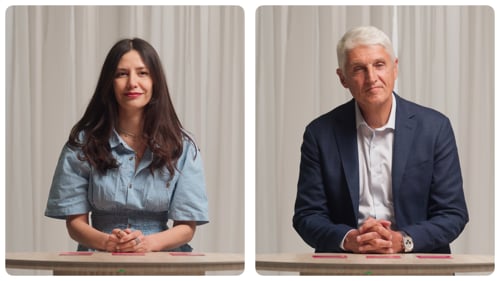
Hello, I'm Joan Balaña, Sales Director at Factorial from the Partners ecosystem, and I’m here to talk about intelligence artificial intelligence applied to human resources.

01:12

My name is Pau García-Milà. I am the CEO and co-founder of Founderz,and I have three children.

01:17

And I'm more concerned about the human resources for the next generation than for myself.

01:27

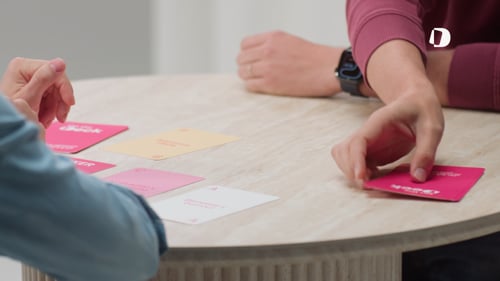
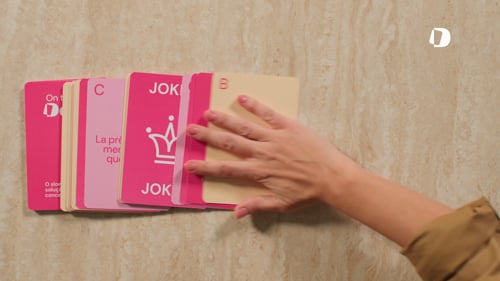
Hi, Pau and Joan!Here's how On the Deck works: First, you'll answer a question without knowing what your partner will say, and then you'll have the chance to exchange ideas and explore your answers in greater depth.

01:40

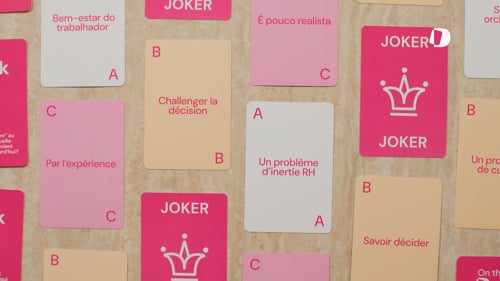
Let's get started!Question 1: Why do companies lose candidates before hiring them?

01:46

A) Offers that aren't convincing.B) You misjudge talent.

01:51

C) You filter too late.Or D) The joker.There are many nuances.

01:56

I'm going to keep the joker.I'm going to choose A.

02:09

How are you, Joan?How's it going, Pau?It's good to see you.

02:12

Me too.I've thought of the letter A.Let's say, it's like "taking the bullet," as they say in English, which is like taking the blame to the company, the other two.

02:24

Well, filtering too late is kind of like sharing the blame and misjudge talent.

02:29

It's like breaking up with someone and saying, "It's not you, it's me." I mean, wait a minute, but you're the one cutting, you know?

02:36

I know I misjudged his talent, but you're telling me that's not the case.

02:40

Exactly.You have data in Factorial; you know things.

02:44

Yeah, since I keep them all, I'd say it has a lot to do with the urgency of signing players.

02:50

In other words, we—at least in the teams that We manage this process and enjoy staying in constant contact with candidates to so that when the time comes to choose someone, having that our talent pipeline, or if we come across any talent we like It's very important to be able to justify the headcount internally and make room for it.

03:10

So why do I choose the joker?Because when we're not in a rush to hire, where we fall short is in the C,we, in filtering too late.

03:19

In other words, since it's not urgent, we're putting it on the back burner for now and not addressing it really potential talent that might be a good fit.

03:28

I don't know if you guys do this too, Pau—looking for talent constantly, whether you need to or not.

03:35

One thing I really like, and it ties in with what you're saying: they say when a company begins to move beyond the startup phase a jungle of chaos, and to grow and become a little more organized when they shift from hiring quickly and firing slowly to hiring Take your time and say goodbye quickly.

03:56

In other words, some companies end up conducting two interviews and they hire one or both of them because they have an urgent need.

04:05

And then, when there's a situation or a relationship where a person doesn't fit in In a company or on a project, it keeps dragging on.

04:13

And in the end, this is also the worst-case scenario for everyone,including the person themselves.

04:17

So, in the end, when you turn around and say, “No, I just want to take my time…” "to find the right person for the job, and I have the time to do it," In the end, there’s no way out—only a way in—because in the end you'll find the talent that's right for you.

04:33

So, in my case, misjudging talent is something which I think we can all do, even if it's a little late.

04:41

But my feeling is that AI where it will have the greatest impact on these processes The point is to increase the difficulty to find the human side, because everyone is going to come at you with the perfect resume, because AI will create it.

04:58

It's like saying, "I speak perfect English." And then: "Let's move on to English." "I don't know." What will set us apart from AI is the human element.

05:07

Sure.And do you think AI could lead us to exclude candidates who actually have that human side—but one we’re not prioritizing?

05:14

Or what would that human side mean to you?Is it more related to corporate values?

05:19

We are not currently using AI in human resources.I have to admit that, traditionally, when I was in charge of interviewing the people who were about to come in and so on, I tried to imagine,imagine what it would be like to work with that person on a day-to-day basis,rather than focusing on specific tasks not just in everyday life, but in a celebratory setting,but also about crises, and to see if they fit into the way we worked.

05:51

Sure, sure, sure.So maybe the Joker does make sense after all.

05:58

Question 2: In what areas can AI most improve employees' day-to-day work?

06:03

A) Well-being and burnout.B) Daily care.C) Motivation and growth.

06:10

Or D) The joker.Let's move on to B: daily attendance.

06:14

Okay.Watch out for these two. No, no, no.Why use AI as a psychologist?

06:19

This and that—a terribly irresponsible use.Therefore, by process of elimination, option B.

06:25

I chose option B, mainly because in terms of implementation or It's in the role of individual contributor where we make the most use of it and see the greatest return.

06:33

For example, those of us who handle a lot of business-related tasks,being able to analyze the information we gather during calls, but also the that we have in CRM, in emails, and so on.

06:44

All of that gives you the benefit of having a real-time assistant—like a coach that before you do your work or carry out your business activities,you have everything as if they were hand in hand.

06:54

At the end of the day, it adds up to hours and hours that a manager often has to spend the time you save and having it in real time.

07:01

So, in terms of return on investment, in terms of their impact,The one I've seen most often is daily attendance, which is also closely linked to with motivation and growth.

07:10

In the end, if I have that in real time, if I have that opportunity to keep improving and have personalized access to the information that helps me improve It's part of my daily professional life, and it also takes me to C.

07:20

But in the end, the main pillar would be B.Well, I chose option B by process of elimination.

07:27

Using AI for well-being is, to me, a red flag—a huge red flag.

07:32

Having an AI as a friend means that both parties are using using AI irresponsibly.

07:40

It is very dangerous for someone to become emotionally dependent on an AI.

07:44

And also if it's psychological dependence, in the sense that "he really understands me" "Well, the thing is, this AI is helping me grow." He's doing the work of a psychologist.

07:54

But for that very reason, that dependence only benefits the creator of AI and poses a danger simply by existing.

08:02

The mere fact of existing is dangerous.Therefore, it is dangerous for AI to exist and, above all, that a company hires her.

08:13

And burnout—if there had been two, Well-being split with burnout,I would have voted for the burnout too, because if the AI can detect it,Let's say someone is on the verge of saying, "It's "I'm not happy at this company." It's great not because it lets you fix it, but because it alerts you and tells you person, depending on what the AI conveys to them,It wouldn't be appropriate for the AI to explain it to the HR representative,but I could tell the person, "Look, there are solutions because there are open positions within the company.

08:43

You could, if you realize that the toxicity is coming from the team you're on,I've noticed there's an opening in another department where you won't be working alongside "Don't walk down any hallway with these people you don't like." Or when it's not an issue of that kind, but rather that the person is If used in the wrong context, the AI could trigger an alert.

09:02

Well, he asks you, “Hey, do you mind if I start actively looking?” "Active" means sharing it with people in the know people within the company. Well, go ahead and do it—see what you find.

09:11

So, I think Burnout is cool.Well-being is dangerous.

09:14

Based on what you mentioned—the burnout part—let me break it down a bit What are the main causes of burnout, and how does it develop?alert or detection of a person, a middle manager, or a role with profile X in For any company that might benefit from it, I can definitely see it as a useful tool between Human Resources and the director or middle manager to that a strategy be tailored to the person who might be affected by it.

09:38

Experts in the field—those in the know—say, “AI is going to kill the middle manager.” In other words, he goes to those movies where there are two walls,but it's kind of like you think, “They’re going to blend you up.” Well, that would be the middle manager.

09:51

And what I've seen is that I've heard, if you will, experts saying:"The thing is, AI is really stepping up the pressure." What would the position above middle manager be like?

10:00

He'd be the boss—the big boss.He's getting dragged through the mud more and more because the AI is lets you play, experiment, and more.

10:09

It's not like before, when I was just asking for things—now he actually does them too.

10:13

And suddenly, the person who just walked into the company that manages AI, works with it, and knows how to use it,He keeps stepping up more and more and saying, “The thing is, in the end,I’m the one running things here,"orchestrating," as they call it, "a whole bunch of AI, and almost as soon as I see the result" "I'll send it to the CEO or whoever." So, of course, right in the middle of it all was a person who was I used to be in charge of distributing the game, and now they say you're no longer needed.

10:42

And I don't know if this is true or not.As I understand it, what AI will do is empower that middle management layer both the necessary tools and handling all the administrative tasks and bureaucratic so that it can truly focus on the more human side That’s what we discussed in the previous question, right?

11:00

Providing coaching and follow-up so that the individual so that individual contributors don't experience burnout and can complement their innate talent with things you might not be doing so well and could improve on.

11:14

With a little more of that coaching aspect or coaching programs,not so much that he hears it, but rather that it is merely a means of transport between management and implementation.

11:26

Question 3: How do you really know what's going on in your How can AI help your business?

11:31

A) You listen to your team.B) You look in from the outside.

11:35

C) Predict who will leave.Or D) The wild card. You predict who will leave.

11:40

C.B) You look at it from the outside.I was missing a D, which was—you don't know.

11:48

I mean, but You think you know, right?Yes, the biggest problem with AI is precisely how quickly it changes.

11:54

So, with a team of five people, you might find yourselves asking every day, "Hey,Did you guys see what came out yesterday?"Here, I'm already using it." "Not me—what for?" When there are 100 of you, it's already difficult.

12:10

With 1,700 members, there are people on Factorial who are already using features that were released yesterday,that their boss doesn't know they've left.

12:17

But of course, it's awful.What's the right answer here?

12:21

Sure, that would be at the company level, or at a later stage,within the company, as subdivisions or something like that a distinction that allows for greater control, in a way, or more And control is really what you want, because there is a legal recourse and an efficient response.

12:41

How do you know what's going on in your company thanks to AI?

12:44

Sure, let's see—you listen to your team, observe from the outside, and learn who If you're leaving, I'll buy everything from you.

12:50

But legally, the only way to really see what's going on Thanks to AI, it would be like listening in or watching from the outside.

13:01

In other words, what I voted for—which is, well, basically looking at what’s happening based on anonymized data.

13:09

The moment you start trying to predict who will date AI,It means you're looking at things you shouldn't be looking at.

13:21

From a legal standpoint, the European Union’s new AI Act, which It's like every time it's about to take effect, a moratorium suddenly pops up and another year has gone by, but I think it’s still there, just lying dormant—he makes that very clear: analysis of feeling: illegal, pattern analysis.

13:36

So, in the end, predicting who's leaving Sure, what would those predicted metrics be?

13:41

It's dangerous. Internal communication channels?Sure, it's dangerous.

13:47

Well, look, if someone says to you, “Well, all I did was look the conversations that person had with the AI, and I saw that they were "looking for another job." And you say, "Oh, okay." It's illegal. And you say, "Oh, I didn't know that." And if we consider how this might affect the press releases that are issued internally, or perhaps engage a little with the various dynamics at play.

14:11

Legally speaking, where would that leave us?Is it gray? Is it clearly?

14:17

To be honest, I'm going to sound even more like an AI now, but my gut feeling—and based on what I know— regarding upcoming regulations, anything that involves predicting Behaviors is an area we don't want to get into, and where I believe to the people in the company or on the teams They'd like to hear that we're not going in.

14:35

And do you really think it's necessary to predict that?

14:38

In other words, do we have to get to the point where we're dependent?

14:40

If it's 5, maybe not. If it's 500 Sure. How did you know?

14:45

But of course, this brings me back to what we were talking about earlier regarding middle managers.

14:48

For me, their role is precisely to listen and to be able to predict that,but with those one-on-one sessions, that ongoing support he provides to the team.

14:56

In my opinion, AI doesn't really need to be involved that much there.

14:59

And that prediction comes more from listening to or truly understanding who who you have or who you work with.

15:05

Pau and Joan, thank you so much for sharing your experiences—they really help us to better understand the changes that AI is bringing about in human resources.

15:13

The discussion is over. It was a pleasure.It's a pleasure.

15:16

Pau, it's always a pleasure to learn from you.