Employees usually know what’s working and what isn’t, but most never say it out loud. Anonymous employee surveys promise a safer way to surface honest feedback, yet trust remains the core challenge. Workers worry their responses are trackable, their writing style recognisable, or that nothing will change regardless. The result? Half-truths, low response rates, and data HR can’t rely on. With this type of information, no real actionable change can happen.
Modern anonymous employee survey software is designed to close that gap. This gives UK organisations a clearer picture of engagement without compromising privacy. In a landscape shaped by hybrid work, high data expectations, and growing employee expectations around wellbeing and leadership, reliable feedback matters more than ever.
In this article, we’ll cover what anonymous survey software actually does, why it’s critical for engagement, the pitfalls that quietly kill trust, and how leading platforms — Factorial, Culture Amp, EngageSoft, and Workleap — compare for UK businesses.
What is anonymous employee survey software?
Anonymous employee survey software is a tool that allows organisations to collect feedback without tying responses to a specific person. Instead of seeing who said what, managers and HR teams see patterns, trends, and scores across teams, roles, or locations.
The goal is simple: create a safer space for honest feedback while still giving leaders enough insight to take action.
These platforms usually sit at the centre of a broader engagement strategy. You can use them to run a company-wide employee engagement survey, send short pulse surveys after a major change, or gather input before an employee engagement interview so managers are better prepared for meaningful conversations.
For hybrid and remote teams, this type of software is especially valuable. When people are not physically in the same space, it is harder to sense morale. Anonymous surveys give every employee the same opportunity to speak up, whether they are in the office, at home, or working from another country.
More than just hiding names
A good anonymous survey tool does more than remove names from a report.
Strong platforms allow HR teams to define clear privacy rules and permissions. For example:
- Results may only appear once a minimum number of employees have responded.
- Managers may see team-level summaries but not raw comments tied to small groups.
- Access to reports can be limited by role, location, or seniority.
This structure protects employees while keeping the data useful. It reduces the risk of someone trying to guess who wrote a specific comment in a small team. It also shows employees that anonymity is built into the system, not just promised in an email.
Solving the “mess” of anonymous feedback
Anonymous employee surveys can create a strange tension.
On one hand, they encourage honesty. Employees are more likely to speak openly about leadership, workload, or culture if their name is not attached. On the other hand, many employees distrust company tools. The right software can help your organisation and make a difference in how you approach feedback and change.
When employees clearly see that no emails, names, or personal IDs are attached to their responses, they trust the process more. When HR explains how the system works and shows aggregated reports instead of individual data, scepticism fades over time.
At the same time, managers do not need to sacrifice clarity. They still receive structured dashboards, grouped results, and clear engagement scores. Instead of a chaotic mix of comments and spreadsheets, they get organised insights they can actually use.
Connecting feedback to action
Anonymous feedback is powerful, but only if it leads somewhere.
Modern survey tools are designed to integrate with wider HR processes. For example, results from an employee engagement survey can highlight areas that need deeper discussion in an employee engagement interview. If communication scores are low in one department, managers can address this directly in performance conversations or team meetings.
Some platforms, like Factorial, go a step further by linking engagement data with other HR metrics such as performance trends, absenteeism, or turnover. This helps HR teams move beyond surface-level scores and identify root causes.
Instead of running surveys once a year and filing away the results, organisations can build a cycle:
- Gather anonymous feedback
- Identify key themes
- Implement specific changes
- Reassess engagement with follow-up surveys
This ongoing approach turns anonymous employee surveys into a practical management tool, not just a box-ticking exercise.
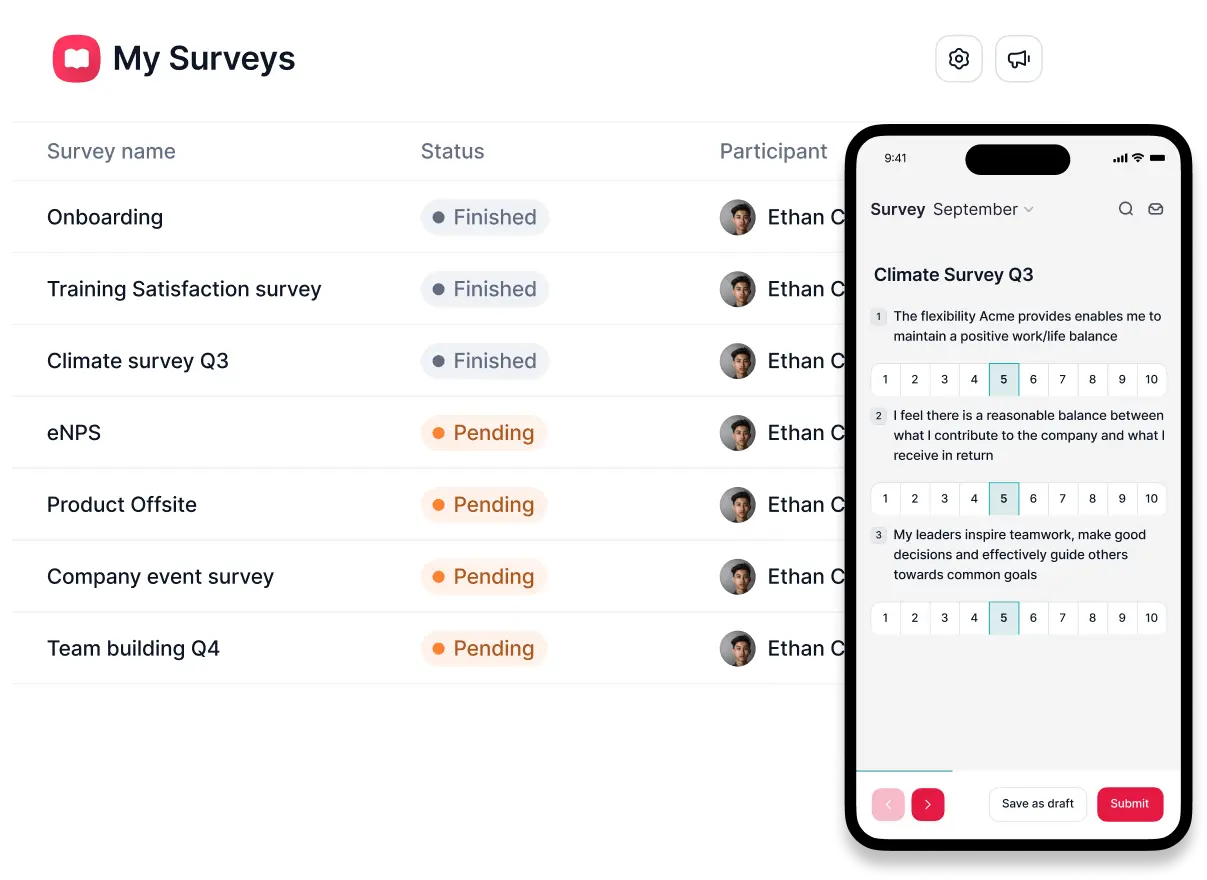
Why are anonymous employee surveys crucial for employee engagement?
Anonymous employee surveys are one of the most reliable ways to understand how people truly feel about their work. Not just what they say in meetings. Not just what managers assume. But what employees actually experience day to day.
When employees feel safe to speak honestly, you uncover issues earlier. You also discover what is working well. Both matter.
Without this type of insight, engagement strategies often rely on guesswork or the loudest voices in the room. That can lead to missed problems, wasted budget, and rising turnover. Even the UK Government conducts regular surveys with Civil Service workers. Read their methodology here.
Let’s look at the most common pain points anonymous employee surveys help solve.
1. Tackling the lack of trust in surveys
The biggest barrier to honest feedback is simple: people do not trust that surveys are truly anonymous.
Employees worry that:
- Their answers are tied to their email address
- HR can trace responses through the system
- Their manager will recognise their writing style
- Negative feedback could affect their career
These fears are stronger in small teams or during sensitive moments, such as restructures or leadership changes.
Anonymous employee survey software helps rebuild trust by separating personal data from survey responses. HR teams can configure permissions so that:
- No names or emails are attached to answers
- Results are only shown in aggregated form
- Reports only appear once a minimum number of responses is reached
This prevents managers from guessing which answer came from whom. It also gives HR clear guidelines on what can and cannot be accessed.
When you communicate these privacy settings clearly to employees, participation increases. Over time, as people see that nothing negative happens after they share honest feedback, confidence in the system grows.
Trust leads to better data. Better data leads to better decisions.
2. Protecting morale through visible follow-through
Filling out an employee engagement survey takes time and emotional energy. Employees may share frustrations about workload, communication, or leadership. If nothing changes afterwards, morale can drop even further.
This is where many organisations fail. They collect feedback. They present high-level results. Then daily pressures take over, and they never take action. Employees notice this and become frustrated.
When concerns are ignored, surveys start to feel pointless. Response rates fall and future feedback becomes shallow or sarcastic. The whole process loses its credibility. Anonymous employee survey software helps close this loop.
Centralised dashboards highlight priority areas. Managers can track action plans. HR can monitor whether certain engagement scores improve after changes are implemented.
For example:
- When employees raise concerns about unclear goals, managers can improve objective-setting and communication.
- If workload is a recurring theme, leaders can review team capacity or adjust deadlines.
- In case recognition scores are low, companies can introduce structured appreciation practices.
Follow-up surveys then measure whether these changes made a difference. Over time, employees see a pattern: feedback leads to action. That consistency strengthens engagement and reinforces psychological safety.
3. Making data easier to understand and act on
Another major challenge is analysis.
Large surveys can generate hundreds of comments and dozens of metrics. Without structure, managers can feel overwhelmed. They may focus on a few obvious comments and miss deeper patterns.
Anonymous employee survey software centralises results in one place. Instead of juggling spreadsheets, screenshots, and email exports, HR teams can see:
- Engagement trends over time
- Department-level comparisons
- Recurring themes in comments
- Participation rates
Clear summaries make it easier to prioritise. Leaders can identify which issues have the strongest impact on overall engagement and retention.
Tools like Factorial are designed to simplify this process. Instead of drowning in data, managers get organised insights that highlight where attention is needed most. That means less time interpreting charts and more time having meaningful conversations with teams.
4. Supporting hybrid and remote teams
Engagement is harder to read when teams are not physically together.
In traditional office settings, managers could sense when morale dropped. Body language, hallway conversations, and informal chats provided signals. With hybrid and remote teams, those signals are weaker or disappear entirely.
Anonymous employee surveys fill this gap.
They give every employee an equal voice, regardless of location. Remote workers can share concerns about isolation or communication barriers. Office-based staff can highlight issues with coordination or unclear expectations between locations.
By combining survey data with insights from employee engagement interviews and performance reviews, organisations gain a more complete view of how different teams experience work.
This structured listening approach is especially important in the UK, where flexible work expectations remain high and competition for talent is strong.
When trust is protected, action is visible, and data is clear, anonymous employee surveys become more than a compliance exercise. They become a core driver of engagement and performance.
Top anonymous employee survey tools in 2026
There are many platforms that promise anonymous feedback. However, not all anonymous employee surveys are built the same way. Some tools focus heavily on advanced analytics. Others prioritise simplicity or continuous pulse feedback. Some integrate with wider HR systems, while others operate as standalone engagement platforms.
Below are four well-known tools used by UK businesses and global organisations: Factorial, Culture Amp, EngageSoft, and Workleap. Each supports anonymous employee surveys, but they differ in approach, complexity, and pricing.
1. Factorial
Factorial is an all-in-one business management platform designed for small and mid-sized businesses with built in functions for employee surveys. In addition to core HR features such as time tracking, document management, and performance reviews, it includes built-in tools for anonymous employee surveys and engagement tracking.
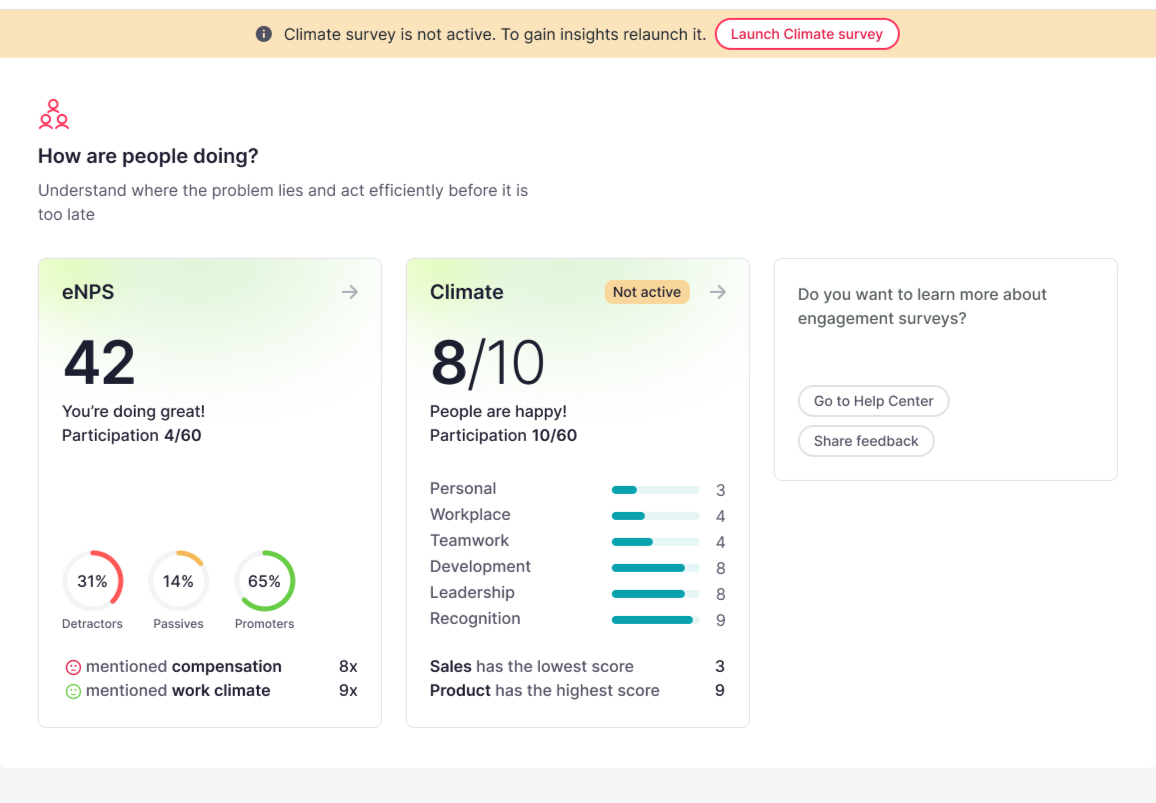
This integrated structure is one of its biggest strengths. Instead of running surveys in isolation, HR teams can connect feedback directly to performance data, turnover trends, and absenteeism. That makes it easier to move from insight to action.
Key features:
- Configurable anonymity settings with minimum response thresholds
- Employee engagement survey templates and pulse surveys
- Centralised dashboards with team-level insights
- Integration with performance reviews and employee engagement interviews
- Role-based permissions for data visibility
HR teams can control exactly who sees what. Managers receive aggregated results without access to identifying details. This helps build trust while keeping insights practical and usable.
Pros:
- All-in-one HR and engagement solution
- User-friendly interface
- Strong fit for UK small and mid-sized companies
- Easier connection between survey data and action plans
Cons:
- May offer fewer advanced analytics features than enterprise-focused platforms
- Very large multinational companies may need deeper custom survey design
Price:
Starts at £5.40 per month, per user
Factorial is particularly attractive for businesses that want anonymous employee surveys without adding another disconnected system to their tech stack.
2. Culture Amp
Culture Amp is a specialist employee experience platform focused heavily on engagement and people analytics. It is known for research-backed survey templates and strong benchmarking capabilities.
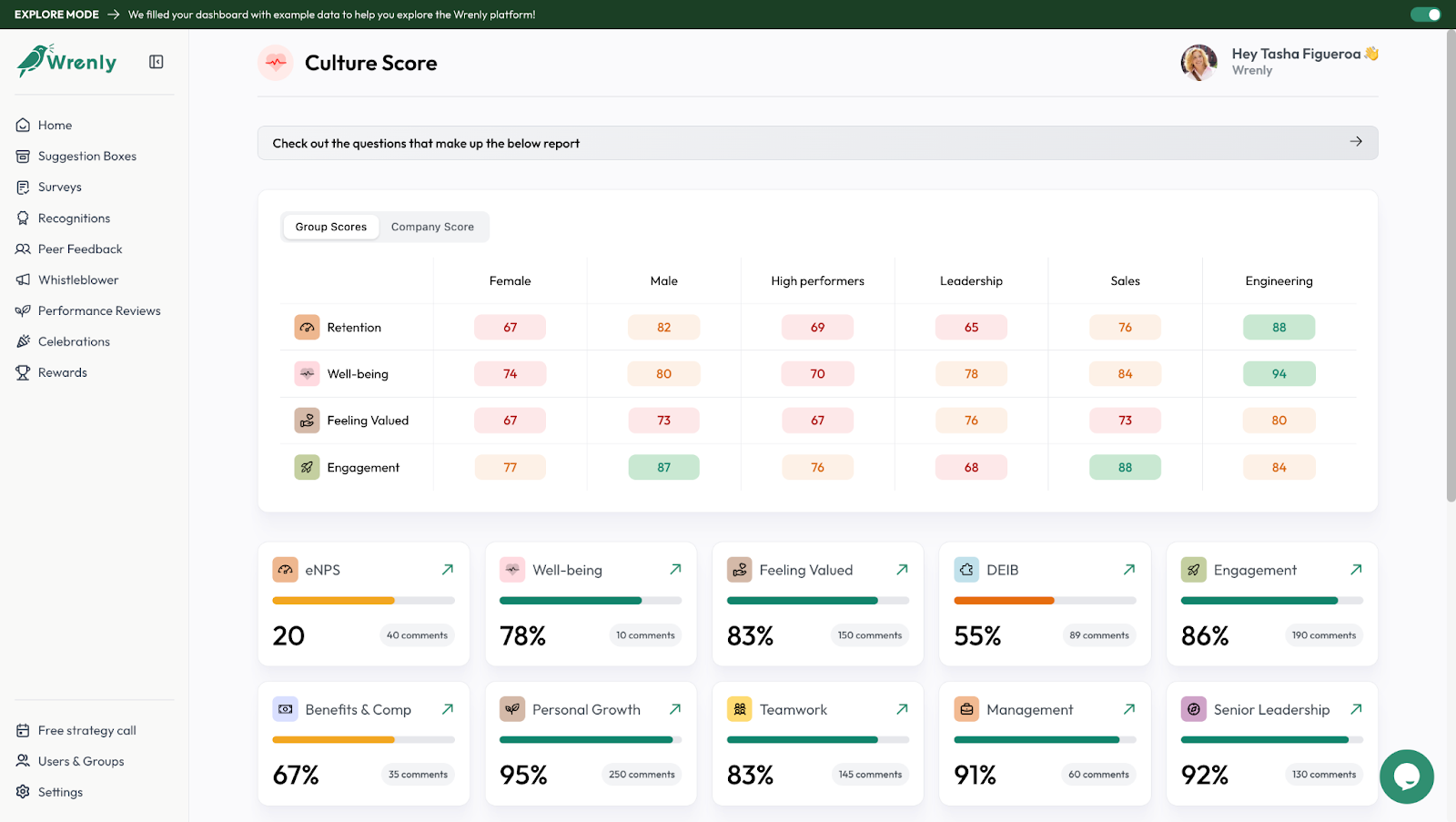
Organisations that want deep insights into engagement drivers often choose Culture Amp for its analytical depth.
Key features:
- Research-based employee engagement survey templates
- Pulse, lifecycle, onboarding, and exit surveys
- Driver analysis to identify what most impacts engagement
- Benchmark comparisons across industries
- Robust anonymity protections and segmentation controls
The platform allows HR teams to segment results by department, location, or demographic group, while maintaining anonymity safeguards.
Pros:
- Advanced analytics and benchmarking
- Strong guidance on survey design
- Suitable for complex, global organisations
Cons:
- Higher price point
- Steeper learning curve for smaller HR teams
- Often requires annual contracts
Price:
Custom pricing based on company size and selected modules. Typically positioned at the higher end of the market.
Culture Amp is ideal for organisations that want deep data analysis and benchmarking across large populations.
3. EngageSoft
EngageSoft represents a category of mid-market engagement tools focused on simplicity and accessibility. It is designed for organisations that want structured anonymous employee surveys without heavy enterprise complexity.
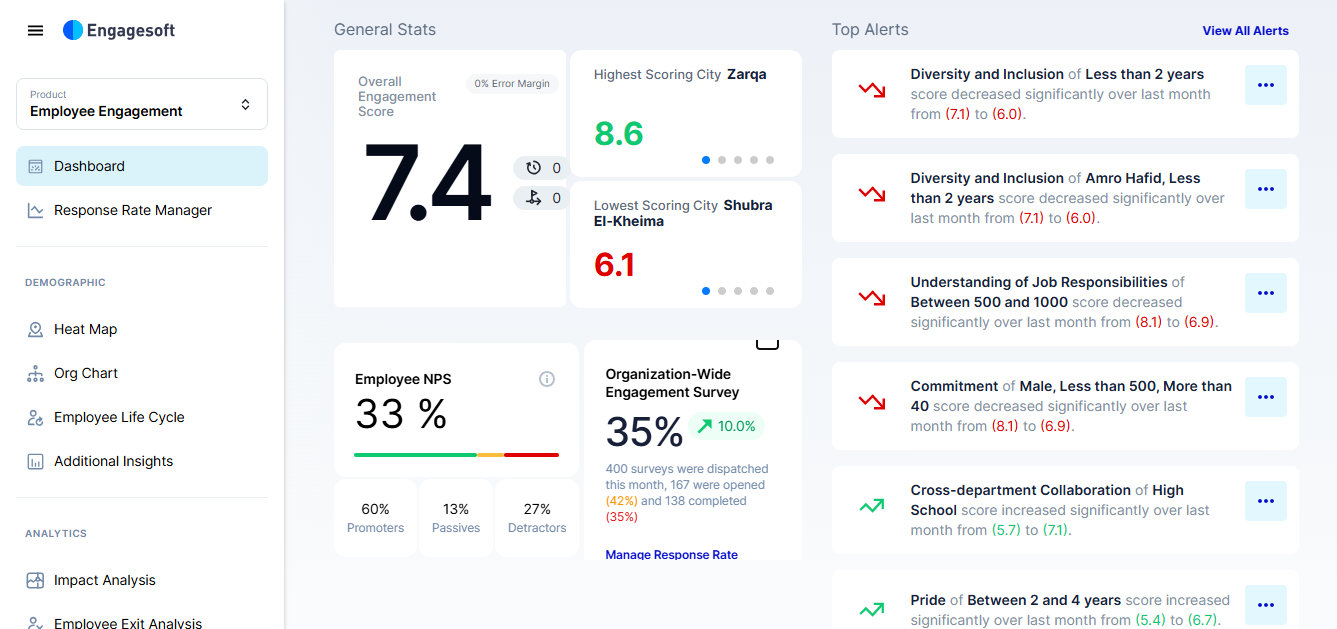
The emphasis is on quick setup and clear reporting.
Key features:
- Employee engagement survey and pulse surveys
- Simple dashboards with clear engagement scores
- Automated reminders to improve response rates
- Configurable anonymity rules and reporting access
Managers receive practical summaries rather than highly technical analytics. This helps smaller HR teams move faster.
Pros:
- Easy implementation
- Intuitive interface
- Strong anonymity controls
- Accessible pricing structure
Cons:
- Fewer advanced analytics capabilities
- May have limited integrations compared to larger platforms
Price:
Tiered subscription model based on employee count.
4. Workleap
Workleap, known for its strong pulse survey approach, focuses on continuous listening rather than annual surveys alone. It is particularly popular among teams that want frequent check-ins and lightweight feedback cycles.
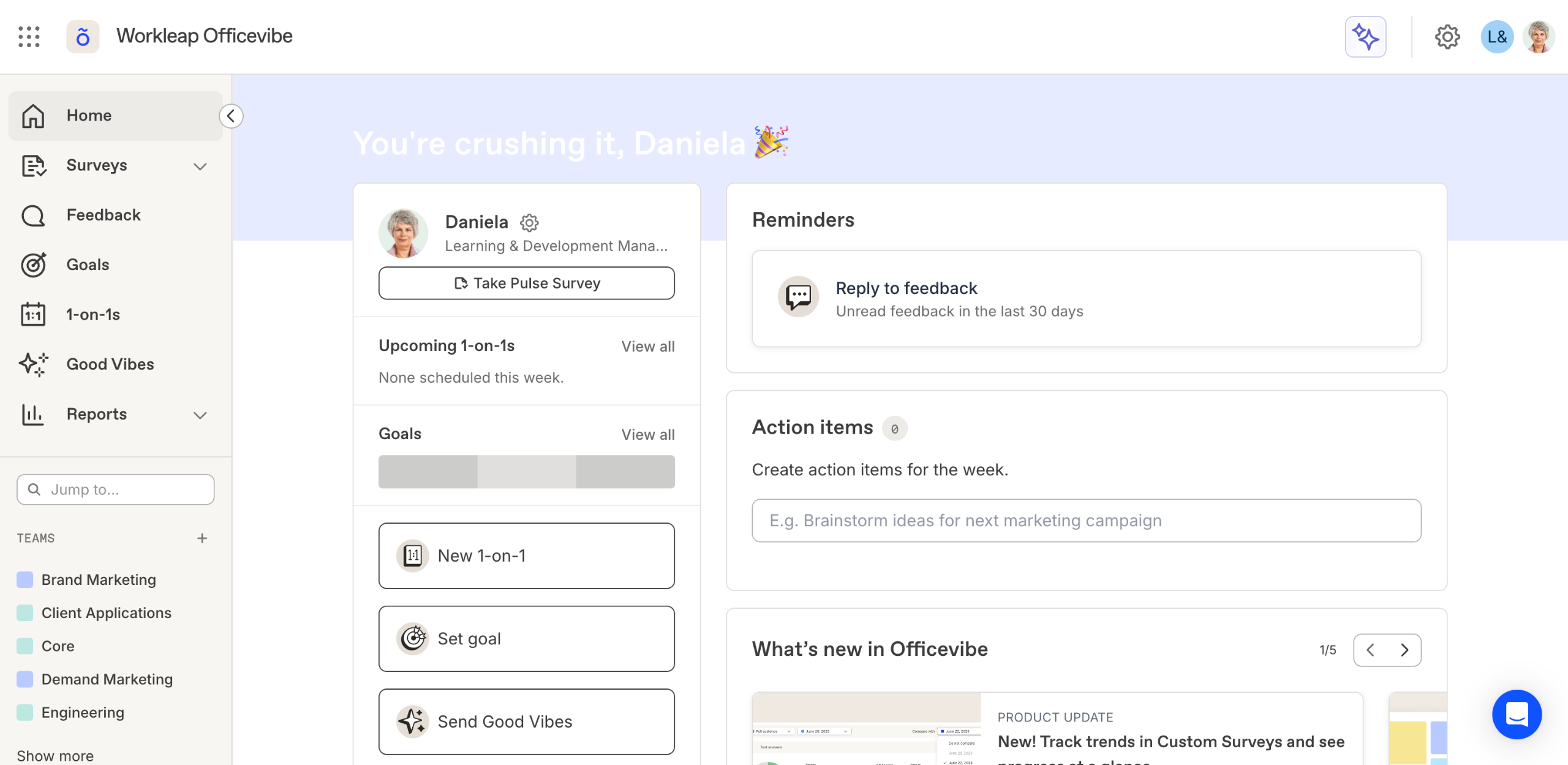
Anonymous feedback is central to its design.
Key features:
- Recurring pulse surveys and eNPS tracking
- Manager-friendly dashboards
- Suggested actions based on survey results
- Feedback and recognition tools
- Anonymity safeguards with team-level reporting
- Workleap encourages ongoing conversations between managers and employees. Instead of waiting for an annual employee engagement survey, teams receive regular insights that can guide weekly or monthly discussions.
Pros:
- Strong focus on continuous feedback
- Simple, clear manager insights
- Well-suited for hybrid and remote teams
Cons:
- Less comprehensive HR functionality than all-in-one systems
- May offer fewer advanced analytics options
Price:
Per-user subscription pricing with multiple plan tiers.
Workleap works well for companies that prioritise frequent pulse surveys and manager-led engagement conversations.
Comparison of top anonymous employee survey tools
Below is a simplified comparison to help you quickly evaluate which platform may fit your needs.
| Platform | Best for | Key highlight | Price positioning |
|---|---|---|---|
| Factorial | Small and mid-sized UK businesses | All-in-one HR platform with integrated anonymous surveys | Mid-range, scalable tiers |
| Culture Amp | Data-driven global organisations | Deep analytics and industry benchmarking | Higher, enterprise-focused |
| EngageSoft | Mid-sized companies seeking simplicity | Easy setup and clear, practical reporting | Accessible, tiered pricing |
| Workleap | Teams wanting frequent pulse feedback | Continuous listening with manager-focused dashboards | Mid-range per-user plans |
Gathering employee engagement insights with Factorial
Anonymous employee surveys only work if they lead to action. Factorial helps you close that gap.
You can configure clear anonymity rules, so no names or emails are attached to responses and results only appear in aggregated form. This builds trust and improves participation.
Because surveys sit inside the same system as performance reviews and HR data, insights from an employee engagement survey can directly shape employee engagement interviews, team goals, and manager follow-ups. Dashboards highlight key themes, making it easier to act quickly across office-based, hybrid and remote teams.
For UK businesses that want simple, secure, and actionable anonymous employee surveys, Factorial offers a practical all-in-one solution.
If you are ready to turn honest feedback into measurable engagement gains, book a demo with Factorial and see how it works in practice.