Tracking employee hours shouldn’t be confusing or stressful, yet many teams and business owners still spend too many hours fixing errors in timesheets and following up with people missing clock-ins. Broken, disjointed systems are a major cause of time wasted. Time that could be spent on more strategic tasks. Outdated timesheet software and swipe cards can easily lead to mistakes or forgotten entries. More organisations are turning to biometric time and attendance devices which means everyone can rest easy that work is being done and accounted for come payday.
📌 Need to manage your team’s hours? Download our free monthly time tracking template.
What are biometric time and attendance devices?
Biometric time and attendance devices are part of a system that verifies employees using something unique to them, such as a fingerprint, face scan, iris, or voice pattern. When you switch to one of these systems, instead of having to enter a code or carry a card around all day, employees can clock in and out with a quick biometric check. It’s fast and secure, and–if security is also a requirement–difficult to fake when implemented correctly.
Connect and store biometric data in an HR and business management platform like Factorial, and that data can flow straight into digital timesheet and attendance records, and even payroll. This is an efficient way to reduce manual work. It improves accuracy and helps UK businesses stay compliant with working time and record-keeping rules.
Biometric time and attendance devices are systems that record employee working hours by verifying a person’s unique physical or behavioural traits. Instead of relying on passwords, swipe cards, or paper records, these devices use biometric data to confirm someone’s identity before logging their time.
Once the identity of the person trying to clock in is verified, the device records the exact time of clock-in or clock-out and sends that data to the system. In many UK workplaces, this helps support compliance with the Working Time Regulations and keeps accurate records of hours worked, breaks, and overtime.
How do biometric time and attendance devices work?
Although the technology may sound complex, the process is straightforward:
- The employee approaches the device.
- They scan a fingerprint, look into a camera, or speak a short phrase.
- The system records the biometric data and converts it into an encrypted digital template.
- That template is matched against the employee’s stored record.
- If it matches, the system records the clock-in or clock-out instantly.
Importantly, the best biometric systems do not need to store images of fingerprints or faces. Instead, they store encrypted templates (mathematical representations) that are designed so they cannot easily be reverse-engineered into the original biometric trait.
Because the data comes directly from the individual, it significantly reduces time fraud and instances of employees clocking in for one another. For employers, that means more accurate payroll and fewer disputes.
What are the 4 types of biometrics?
There are four main types of biometric technology used in time and attendance systems:
Fingerprint recognition
This is one of the most common methods. The device scans the unique patterns of ridges and valleys on a person’s finger to confirm their identity. It is fast, reliable, and widely used in offices, warehouses, and factories.
Facial recognition
Facial recognition uses a camera to analyse key facial features and match them to a stored template. It is contactless and often preferred in workplaces where hygiene is a concern or where large teams need to clock in quickly.
Voice recognition
This method identifies employees based on unique vocal characteristics. The employee speaks a set phrase, and the system verifies their identity. It can be useful in certain environments, though background noise may affect accuracy.
Iris or retina recognition
Less common in everyday workplaces but highly secure, this technology scans the unique patterns in a person’s eye. It is typically used in high-security environments rather than standard office settings.
Fingerprint and facial recognition are the most widely adopted options due to accuracy and because they are easy to use.
Biometric time and attendance benefits
For many UK employers, accurate time tracking is not just about payroll. It affects compliance, workforce planning, and overall business performance. Biometric time and attendance devices help solve common issues that traditional systems struggle with.
Here are the main benefits.
Accurate time tracking
Manual timesheets and PIN-based systems leave room for human error. Employees forget to clock in or enter the wrong code and often round their hours up or down.
Biometric systems remove that uncertainty. Because the system verifies the individual before recording time, each entry is tied directly to the right employee. This reduces payroll discrepancies and limits disputes about hours worked.
For businesses with shift work, overtime, or multiple sites, that accuracy is a real differentiator.
Fewer instances of time fraud
With swipe cards or PINs, employees can easily clock in for one another, a common form of time fraud at workplaces.
With biometric time and attendance devices, it is far harder. Since fingerprints, faces, and voice patterns are unique, one person cannot easily clock in on behalf of someone else. This increases accountability and helps ensure employees are paid only for the hours they actually work.
Stronger compliance with regulations in the UK
Under the UK Working Time Regulations, employers must keep accurate records of hours worked, including overtime and rest periods.
Biometric systems automatically create secure, time-stamped records. This makes it easier to demonstrate compliance during inspections or in the event of a dispute. Having clear, auditable data can help protect businesses from legal risk and potential fines.
More efficiency processes for HR and payroll
Manually reviewing timesheets, correcting errors, and calculating overtime takes time. Biometric systems automate most of this process.
When integrated with an HR platform, clock-in data flows directly into digital timesheets and payroll. Overtime, night shifts, and holiday pay can often be calculated automatically. HR teams spend less time on admin and more time on strategic work.
Easier to integrate with payroll and scheduling
The best biometric time and attendance devices do not operate isolated from the rest of your system. They connect with payroll software, HR systems, and scheduling tools.
This means:
- Hours worked can sync automatically with payroll.
- Absences and lateness can be visible in near real time.
- Managers can plan shifts based on accurate attendance data.
Businesses can manage everything in one place instead of juggling spreadsheets and separate systems.
Are biometric time and attendance devices compliant with privacy regulations in the UK?
Under UK GDPR, biometric data used to identify someone is classified as special category (sensitive) data. Employers must therefore process it lawfully and carefully.
To comply, organisations should:
- Establish a lawful basis and meet an Article 9 condition
- Conduct a Data Protection Impact Assessment (DPIA)
- Clearly inform employees how their data is used
- Store data securely with restricted access
- Collect only what is necessary and retain it only as long as needed
Privacy concerns are valid, particularly around storage and misuse of sensitive data. Choosing a secure provider is essential. Many modern systems use encrypted biometric templates rather than storing raw fingerprints or facial images, reducing risk.
With strong security measures and transparent communication, employers can balance efficiency with employee trust.
If you are not ready to take the leap, but need to start tracking immediately, try this free time and attendance template.
Top 5 best biometric time and attendance devices
Choosing the right biometric time and attendance devices depends on your company size, industry, and compliance needs. Below are five platforms used by businesses internationally.
1. Factorial
Best for: SMEs and growing businesses that want an all-in-one HR solution
Biometric features: Fingerprint and facial recognition using compatible hardware, mobile time tracking
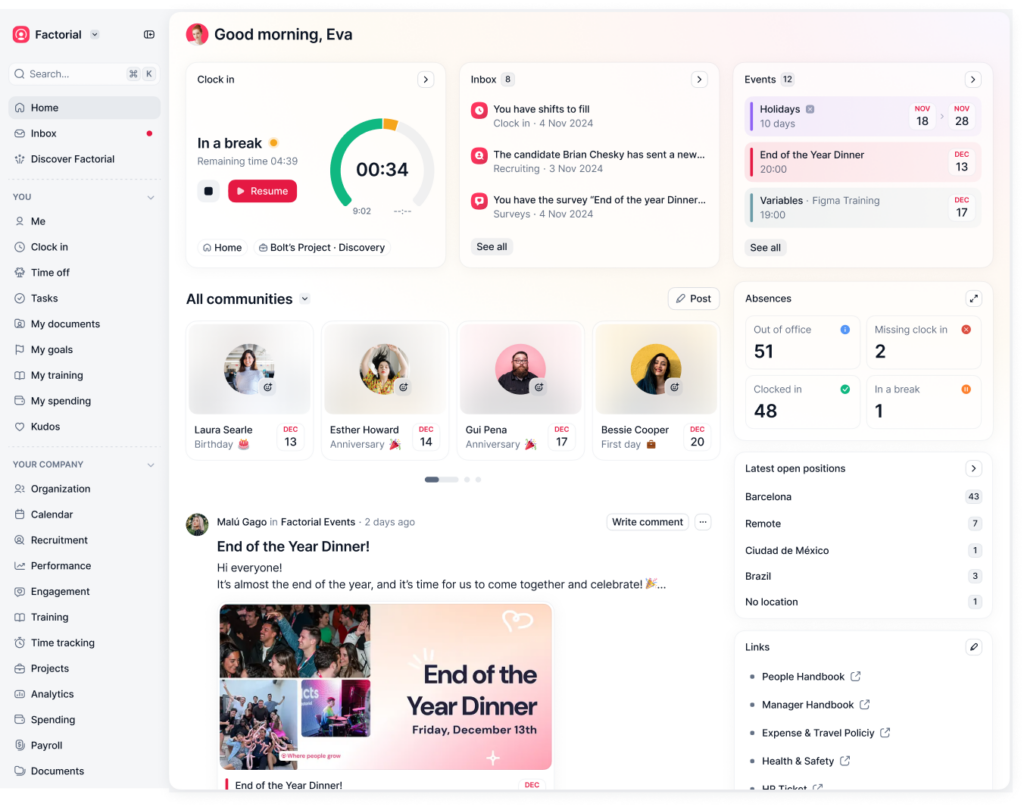
Factorial integrates with payroll and HR.
Factorial is more than a time clocking system. It’s a complete business management platform that includes time and attendance software with shift planning, leave management, and payroll integration. Biometric data is collected through devices compatible with the system that can sync directly with the platform, updating timesheets in real time.
Key features:
- Real-time attendance tracking
- Overtime and break management
- Payroll integration
- Visual calendars and reporting
- GDPR-compliant data security
Pros:
- All-in-one business management solution
- Compliance and encryption standards
- Scales as your team grows
Cons:
- Requires third-party hardware for biometric clock-ins
- May have more features than small teams can make full use of
Pricing: Starts at £5.40 per month, per user. Custom pricing based on company size. Requires compatible hardware.
2. ClockedIn
Best for: Small to mid-sized UK businesses
Biometric features: Facial recognition
ClockedIn integrates with payroll/HR.
ClockedIn is a simple, tablet-based facial recognition software. It is designed to be easy to use, particularly for retail, hospitality, and service businesses.
Key features:
- Facial recognition clock-in
- GPS tracking
- Overtime calculation
- Payroll export
Pros:
- Simple setup
- Contactless clock-in
- Good for shift-based teams
Cons:
- Fewer HR features
- Limited customisation compared to full HR platforms
Pricing: £2.39 per user per month
3. Jibble
Best for: Remote and hybrid teams
Biometric features: Facial recognition
Integrates with payroll/HR
Jibble has facial recognition time tracking through mobile and desktop devices. It suits remote teams who need flexible but secure clock-ins.
Key features:
- AI-powered facial recognition
- Mobile and desktop time tracking
- Timesheet automation
- Integrations with payroll systems
Pros:
- Strong for remote work
- Easy to use
Cons:
- Advanced features require paid plans
Pricing: Free basic plan with paid plans available per user per month.
4. Buddy Punch
Best for: Businesses wanting simple attendance tracking
Biometric features: Facial recognition via webcam
Buddy Punch integrates with payroll/HR.
Buddy Punch offers webcam-based facial recognition for clock-ins. It is straightforward and suited to businesses that want minimal hardware investment.
Key features:
- Facial recognition
- GPS tracking
- Overtime management
- Payroll exports
Pros:
- Easy to implement
- Strong reporting tools
Cons:
- Fewer HR functions
- Primarily focused on time tracking
Pricing: Monthly subscription per user.
5. NCheck
Best for: High-security environments
Biometric features: Facial recognition, fingerprint, iris scanning
NCheck has limited integration with payroll/HR.
NCheck specialises in advanced biometric identification. It supports multiple biometric methods and is often used where higher security standards are required.
Key features:
- Multi-biometric authentication
- High-accuracy facial recognition
- Access control capabilities
Pros:
- Highly secure
- Multiple biometric options
- Suitable for regulated industries
Cons:
- More technical setup
- Not a full HR platform
- Teams may require additional integrations
Pricing: Custom pricing depending on setup and scale.
Biometric time and attendance device comparison chart
| Platform | Best for | Highlight | Biometric features | Integration with payroll/HR |
| Factorial | SMEs & growing businesses | All-in-one HR + time tracking | Fingerprint, facial (via hardware), mobile | Yes |
| ClockedIn | Shift-based teams | Tablet facial recognition | Facial recognition | Yes |
| Jibble | Remote & hybrid teams | AI facial recognition | Facial recognition | Yes |
| Buddy Punch | Small businesses | Webcam facial clock-ins | Facial recognition | Yes |
| NCheck | High-security environments | Multi-biometric authentication | Facial, fingerprint, iris | Limited |
Accurately & safely track employee hours with Factorial
Biometric time and attendance devices are powerful on their own, but when they connect to a full HR and business management system, they become even more useful.
Factorial combines biometric time tracking with payroll, leave management, shift planning, and reporting in one central platform. Instead of using separate tools for attendance and HR, everything works together. Request a demo of Factorial to see exactly how it can support your organisation.
Biometric time and attendance tracking FAQs
What is the main drawback of biometric time and attendance devices?
The main drawback can be privacy and data protection concerns. Because biometric data is special category personal data, employers must comply with UK GDPR and ensure that the data is encrypted and stored securely, and only used for legitimate purposes.
What is the most secure form of biometrics?
Iris and retina recognition are generally considered among the most secure because the patterns in the eye are highly unique and difficult to replicate. This means high accuracy in tracking systems. However, they are less common in everyday workplaces due to a higher cost and not being very practical to implement.
Which is safer: password or biometric time and attendance devices?
In many cases, biometric time and attendance devices are safer than passwords or PIN codes, because passwords can be shared or guessed. Biometric traits are unique to each individual so they cannot easily be duplicated.