For UK and Irish businesses, choosing the best HRIS system in 2026 means finding a platform that reduces HR admin, improves the employee experience, gives managers better reporting, and scales as the organisation grows.
Some tools focus on core HR data, others combine HRIS and payroll, and a growing number compete on mobile usability, automation, and integrations. The right answer depends on company size, workforce complexity, and reporting needs.
This guide looks at the best HRIS systems UK&I organisations should consider in 2026. It covers what an HRIS is, why it matters, how the best options compare, and which platforms stand out.
Table of Contents
- Key Facts
- What makes an HRIS system the best for UK businesses?
- What are the benefits of using a good HRIS system?
- Best HRIS systems comparison chart: UK&I 2026
- Best HRIS systems for UK&I businesses in 2026
- How do you choose the best HRIS system for your UK or Irish business?
- Book a demo of Factorial to see HRIS in action
Key Facts
- Best overall for UK&I SMEs: Factorial is the editor’s choice for UK and Irish businesses that want an all-in-one HRIS combining core HR, time, documents, workflows, and payroll preparation in a single platform starting at £5.40 per user/month.
- Fast-growing market: The global HRIS market is projected to reach USD 19.86 billion in 2026, growing at a CAGR of 13.75% through 2031, as businesses accelerate cloud migration and compliance automation.
- UK compliance pressure is rising: According to CIPD’s “Labour Market Outlook 2026”, 55% of UK employers expect workplace conflict to increase as a result of Employment Rights Act 2025 changes – making consistent, auditable HR records more critical than ever.
- Automation drives adoption: SHRM research confirms that HR technology helps organisations cut administrative costs, improve compliance, and enhance the employee experience – with demand for HR tech skills growing 35% over two years.
What makes an HRIS system the best for UK businesses?
An HRIS (or Human Resources Information System) is software that stores and manages employee information and HR processes in one central platform. A system like this acts as the main pillar of HR, bringing together the most important data such as employee records, contracts, documents, time off, onboarding tasks, reporting, and often payroll-related information.
For many employers, an HRIS replaces a patchwork of spreadsheets, shared folders, email chains, and separate, disjointed tools. Instead of having all employee data scattered across different systems, HR teams and managers can access a single source of truth for people operations. This makes the business easier to manage and less dependent on manual admin.
For UK businesses specifically, the Employment Rights Act 2025 has added new administrative obligations around guaranteed hours, holiday pay records, and worker assessments. According to CIPD’s Labour Market Outlook 2026, 55% of UK employers expect workplace conflict to increase as a result of these changes. A well-configured HRIS helps HR teams manage these obligations consistently and maintain the audit trail that employment tribunals increasingly expect.
The best HRIS platforms also go beyond record-keeping. They now include employee self-service, workflow automation, custom reports, mobile apps, document e-signing, and integrations with payroll, recruitment, finance, or performance tools.
For growing UK&I businesses, this matters because the complexity of the workflows that HR handles tends to increase quickly with headcount, especially once multiple locations, hybrid work, or international hiring enter the picture.
What are the benefits of using a good HRIS system?
The best HRIS system should not just store employee information, it should help the business operate more effectively. That is why the strongest platforms deliver value across HR, management, finance, and the employee experience.
Key benefits include:
- Less manual admin: An HRIS reduces repetitive admin by centralising records, approvals, policies, and standard workflows.
- More accurate data: A single platform improves consistency across employee information, reducing duplicate or outdated records.
- A better employee experience: Employee self-service portals and mobile apps make it easier for employees to update details, request leave, sign documents, and find information on their own.
- Easier and more accurate reporting: Businesses asking which HRIS systems offer the best reporting usually need cleaner data, faster insights, and better visibility into headcount, absence, onboarding, turnover, and compliance.
- Easier when scaling: One of the biggest questions for buyers is which HRIS systems scale best with company growth and complexity. A good HRIS helps companies add locations, teams, entities, workflows, and integrations without rebuilding HR processes from scratch.
- Easier to demonstrate compliance: Central records and a clear trail of approvals logged make it easier to manage HR processes consistently and prepare for audits or policy reviews.
SHRM research confirms that HR technology helps organisations cut administrative costs, improve compliance, and enhance the employee experience – with demand for HR tech skills growing 35% over two years. For UK teams managing the administrative load introduced by the Employment Rights Act 2025, this efficiency gain is particularly material.
For many businesses, the biggest benefit is not one single feature but the effect of having a more organised people platform in all areas of management. Once the basics like time data and employee records are in one system, HR can spend less time on administration and more time on things that make a big difference, like planning strategy, supporting the team, and decision-making.
Best HRIS systems comparison chart: UK&I 2026
The table below compares some of the best HRIS systems UK businesses should shortlist in 2026.
| Tool | Best for | Standout strength | Pricing |
| Factorial | SMEs and scale-ups wanting all-in-one HRIS | HR, time, documents, workflows, payroll prep, strong usability | Starts at £5.40 per user/month |
| BambooHR | Companies wanting a polished core HR experience | Easy onboarding, employee records, self-service, usability | |
| HiBob | Modern mid-sized and international businesses | Employee experience, culture tools, workflows, analytics | Pricing only available when you request a custom quote. |
| Sage HR | UK businesses already using Sage | Modular HRIS with strong ecosystem alignment | |
| BrightHR | UK SMEs wanting practical HR software | HR admin, support tools, absence management | Pricing depends on the size of your team. |
| Deel HR | International hiring and distributed teams | Global employment infrastructure and cross-border HR support | Starts at $5 per user/month |
| Rippling | Fast-growing businesses wanting automation across HR and IT | Workflow automation, modular expansion, systems connectivity | Pricing only available when you request a custom quote. |
| Personio | European SMBs and mid-market firms | Broad HR platform with planning and admin strength | Pricing only available when you request a custom quote. |
*Pricing can change. Always consult the website of each vendor before making a decision.
Best HRIS systems for UK&I businesses in 2026
Now that you have a broad overview of each HRIS in this guide, let’s look at each system in more detail.
1. Factorial
Overview: Factorial is one of the best HRIS systems for UK businesses that want an all-in-one platform without enterprise-level complexity. It combines core HR, time management, leave, documents, workflows, reporting, and payroll preparation in one system, making it especially attractive for SMEs and scale-ups that want to centralise a people operations platform.
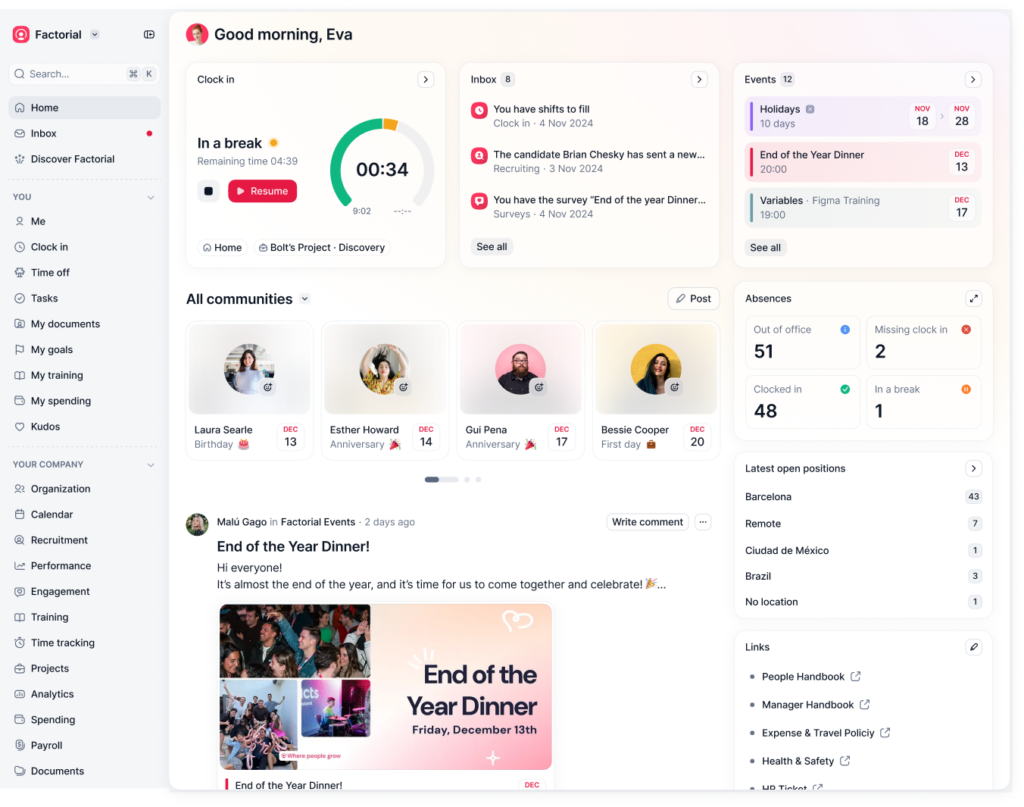
For businesses asking what is the best HRIS system for a growing company, Factorial is a strong answer because it balances breadth with usability. It is broad enough to replace several disconnected tools, but still simple enough for HR teams and employees to adopt quickly.
Main features
- Core employee records and document management.
- Leave, absence, and time tracking.
- Workflow automation and approvals.
- Performance, onboarding, and HR process tools.
- Reporting dashboards.
- Payroll-ready exports and integrations.
- AI-powered support through the AI agent One for workflows and workforce insights.
Pros
- Strong all-in-one experience for UK&I SMEs.
- Combines HRIS, time, and other HR tools in a single platform.
- Easy to use for both HR teams and employees.
- Clean, intuitive mobile experience for both HR teams and employees
Cons
- Some larger enterprises may want more customisability in niche areas.
Pricing
Starts at £5.40 per user per month for the core plan. Request a free demo to see Factorial for yourself and for a personalised quote tailored to the needs of your organisation.
Factorial’s AI agent, One, is particularly relevant for UK teams managing the increased administrative load from the Employment Rights Act 2025. It can draft policies, generate workforce reports, and surface compliance gaps – reducing the time HR spends on documentation and freeing capacity for strategic work.
2. BambooHR
Overview: BambooHR remains one of the most recognisable names whenever buyers search for the best HRIS systems or best HRIS system for mid-sized companies. Its reputation comes from a polished user experience, strong core HR functionality, and an employee-friendly interface that many organisations find easy to roll out.

It is particularly strong for businesses that want to modernise HR admin without immediately moving into a more complex workforce management setup. For UK&I firms, BambooHR is often shortlisted because of its usability and employee self-service rather than deep local payroll infrastructure.
Main features
- Employee records and document storage.
- Onboarding and offboarding workflows.
- Time off management.
- Employee self-service.
- Reporting and standard analytics.
- Hiring and performance add-ons.
Pros
- Excellent usability and adoption.
- Clean employee self-service experience.
- Strong onboarding workflows.
Cons
- US-headquartered platform with no native HMRC integration. UK payroll requires a third-party provider connection.
Pricing
Starts at £8.10 per month per employee.
3. HiBob
Overview: HiBob is a modern HRIS aimed at mid-sized and international businesses that want an engaging employee experience combined with stronger workflows and analytics. It is often discussed in conversations about the best global HRIS systems because it is designed for businesses operating across regions, entities, and more complex organisational structures.
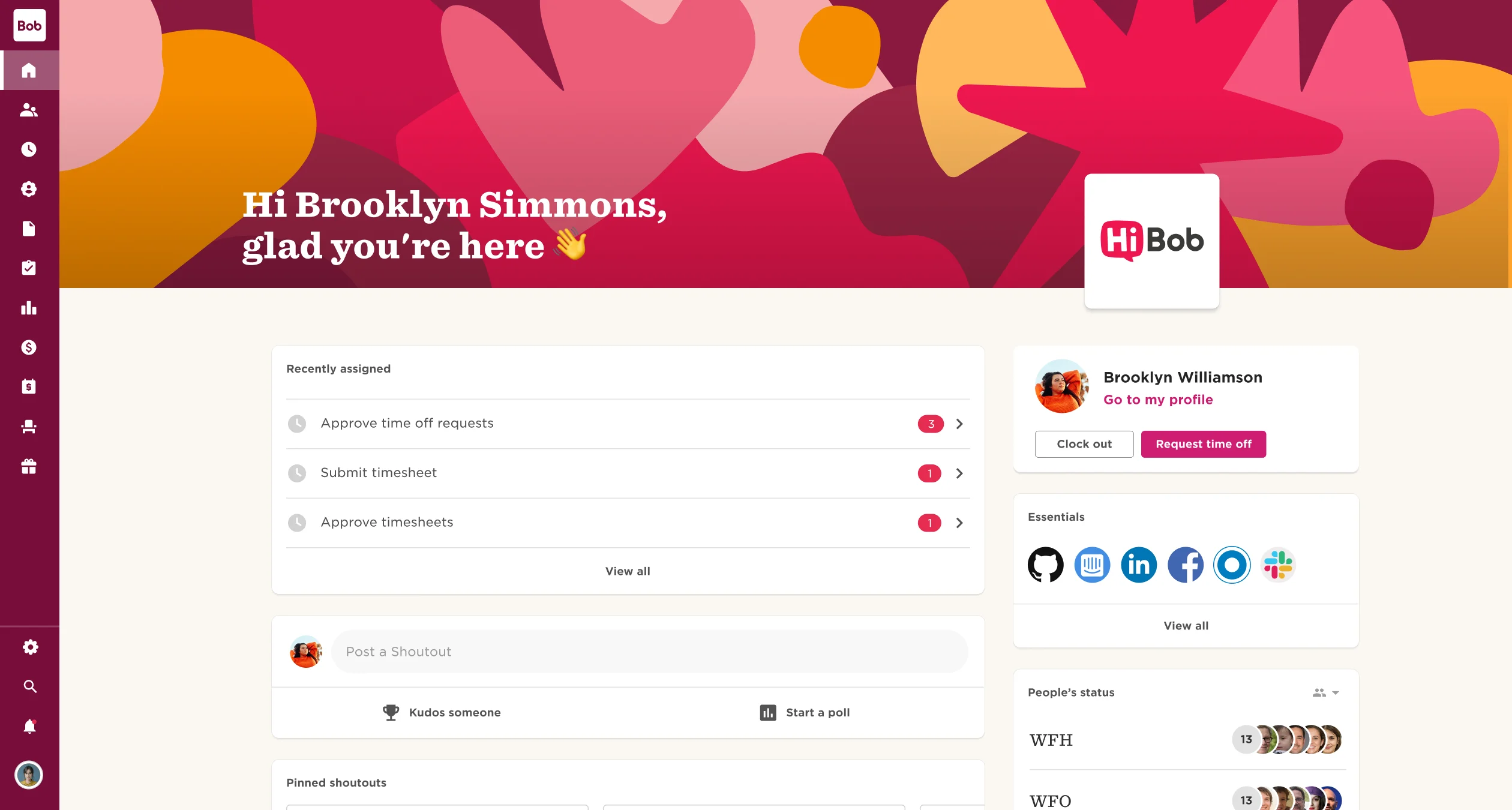
For UK&I businesses that are scaling internationally or want a more modern HR experience than legacy systems provide, HiBob is an appealing choice. It is particularly well suited to businesses that care about culture, engagement, and structured people operations as much as core administration.
Main features
- Core HRIS and employee database.
- Workflows and approvals.People analytics and dashboards.
- Surveys, engagement, and culture features.
- Onboarding and lifecycle management.
- International-friendly structure and permissions.
Pros
- Strong employee experience.
- Good fit for scaling and international businesses.
- Modern UI and workflows.
Cons
- Can be more than smaller businesses need.
Pricing
Pricing only available when you request a custom quote.
HiBob is particularly well suited to UK businesses that operate across multiple entities or countries, where consistent people data and structured permissions matter. Its analytics layer also supports the kind of workforce reporting that UK employers increasingly need under the Employment Rights Act 2025.
4. Sage HR
Overview: Sage HR is a practical option for UK businesses that want a modular HRIS linked to a familiar software ecosystem. It is especially relevant for organisations already using Sage for accounting or payroll, since that alignment can simplify data flows and reduce the need for extra integrations.
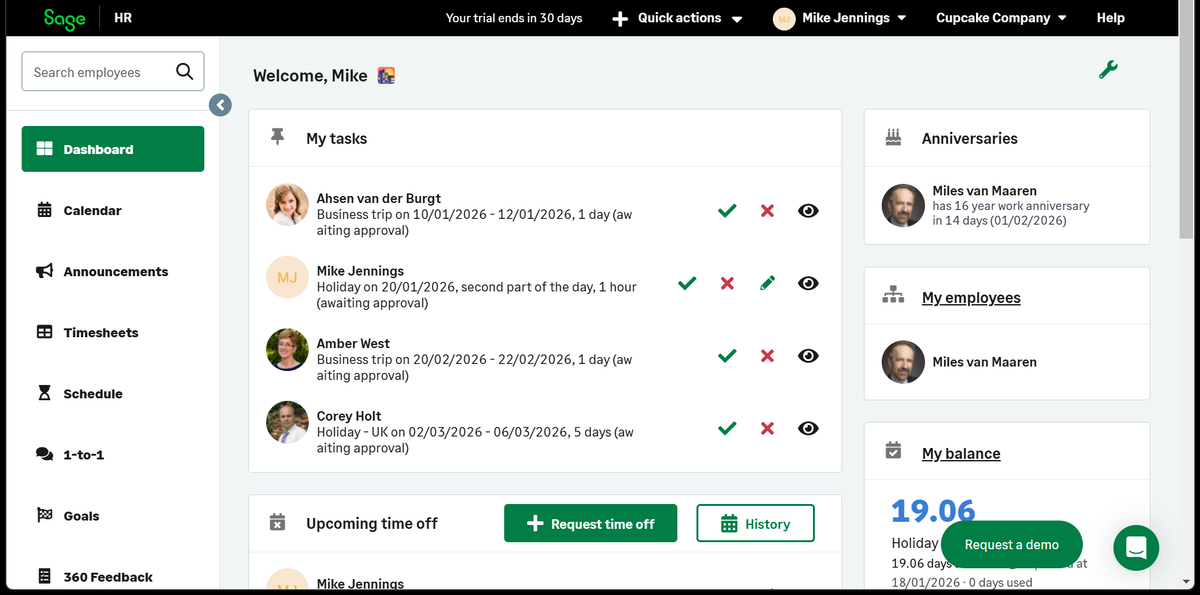
Main features
- Core HR records.
- Leave and absence management.
- Shift scheduling and timesheets.
- HR workflows and approvals.
- Integrations with Sage tools.
Pros
- Sensible choice for existing Sage customers.
- Modular structure helps businesses buy only what they need.
Cons
- Less focused on employee experience than some competitors.
- Reporting and mobile experience are good, but not always the headline reason to choose it.
Pricing
Starts at £6 per user per month for Core HR and Leave Management, with optional add-ons for Performance Management, Shift Scheduling, Timesheets, and Expenses.
5. BrightHR
Overview: BrightHR is a popular option in the UK SME market because it brings together HR admin, absence management, document handling, and practical support tools in one platform. It tends to appeal to smaller organisations that want quick wins and less admin rather than a highly configurable HR transformation project.
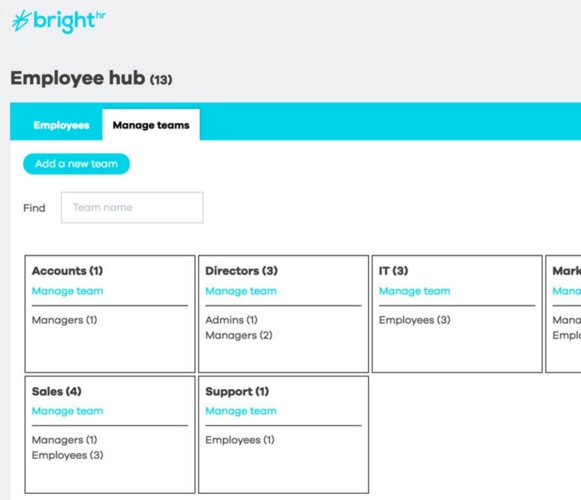
For buyers researching best HRIS systems UK reviews, BrightHR often appears because of its visibility in the local market and its focus on everyday employer needs. It is a particularly relevant option for businesses that want HR software plus guidance and support.
Main features
- Employee records.
- Holiday and sickness tracking.
- Document storage.
- HR task management.
- Basic workforce planning and support features.
Pros
- Well-known in the UK SME segment.
- Straightforward implementation.
- Good for employers wanting practical HR support, not just software.
Cons
- Not as broad or internationally oriented as some of the best global cloud HRIS systems.
- Better for smaller businesses than for rapidly scaling multi-country operations.
Pricing
Paid plans start from £3.30 depending on the size of your organisation.
6. Deel HR
Overview: Deel HR has become increasingly relevant for businesses hiring across borders, managing international contractors, or building distributed teams. While it is often associated with global employment infrastructure, it also competes in conversations about the best global HRIS systems because it connects people data, contracts, entities, and international employment workflows in one environment.
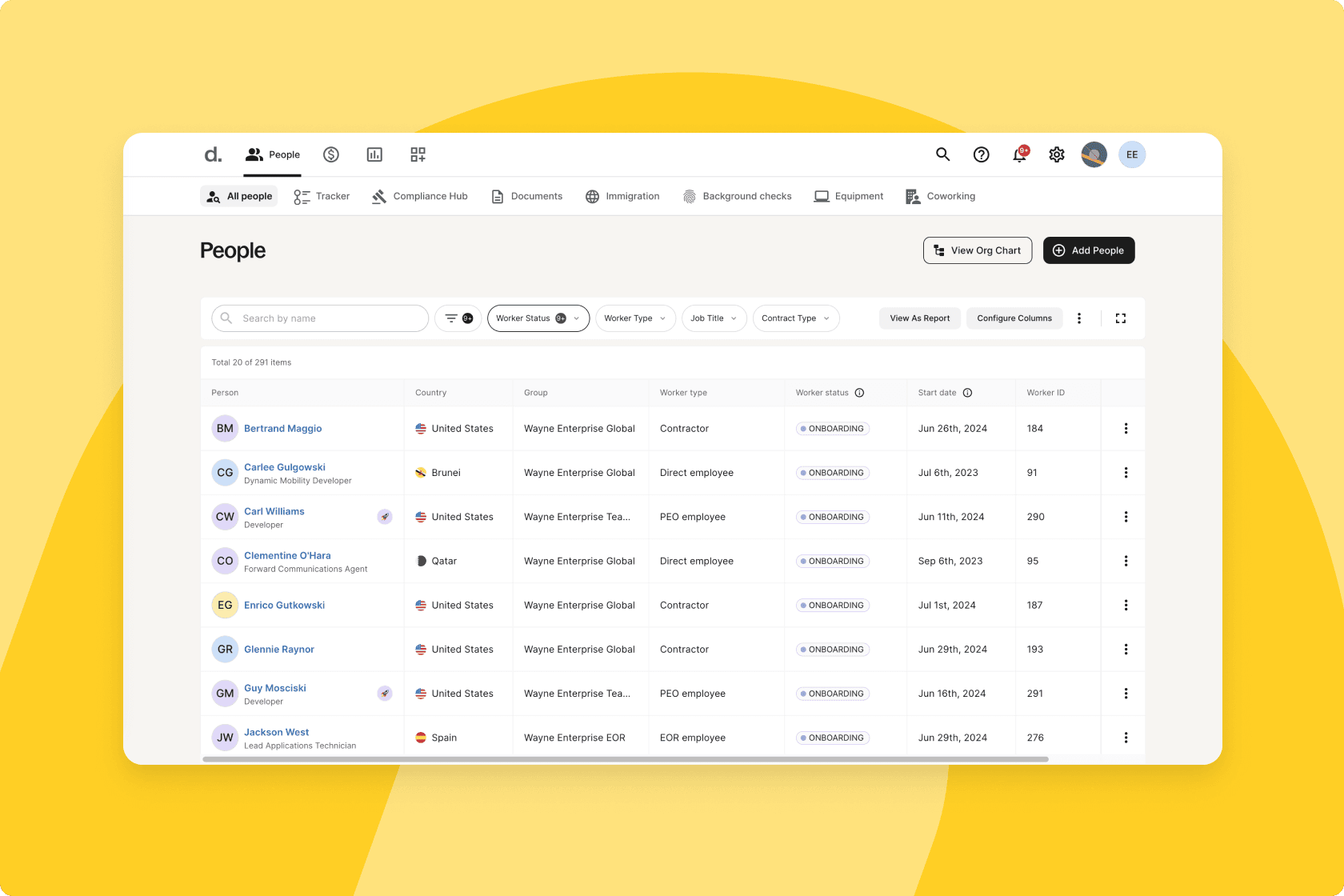
For UK&I businesses with international growth plans, Deel HR can be attractive because it solves both HRIS and global workforce problems. That gives it a different value proposition from tools focused mainly on domestic HR administration.
Main features
- Global employee and contractor records.
- International hiring support.
- Document and compliance workflows.
- Cross-border workforce administration.
- Integrations with payroll and finance systems.
Pros
- Strong global hiring and workforce infrastructure.
- Useful for distributed and international teams.
- Good answer for businesses asking what the best HRIS systems are for global expansion.
Cons
- May be more specialised than needed for purely UK&I domestic teams.
- Some businesses may prefer a more traditional HRIS if global hiring is not a priority.
Pricing
Paid plans start from $5 per employee per month for HRIS.
7. Rippling
Overview: Rippling is one of the most ambitious platforms in this category because it aims to unify HR, payroll, IT, apps, and workflows in one highly connected system. It is often mentioned when buyers ask which HRIS systems offer the best reporting or which HRIS systems scale best with company growth and complexity, because its architecture is designed around automation and cross-system logic.
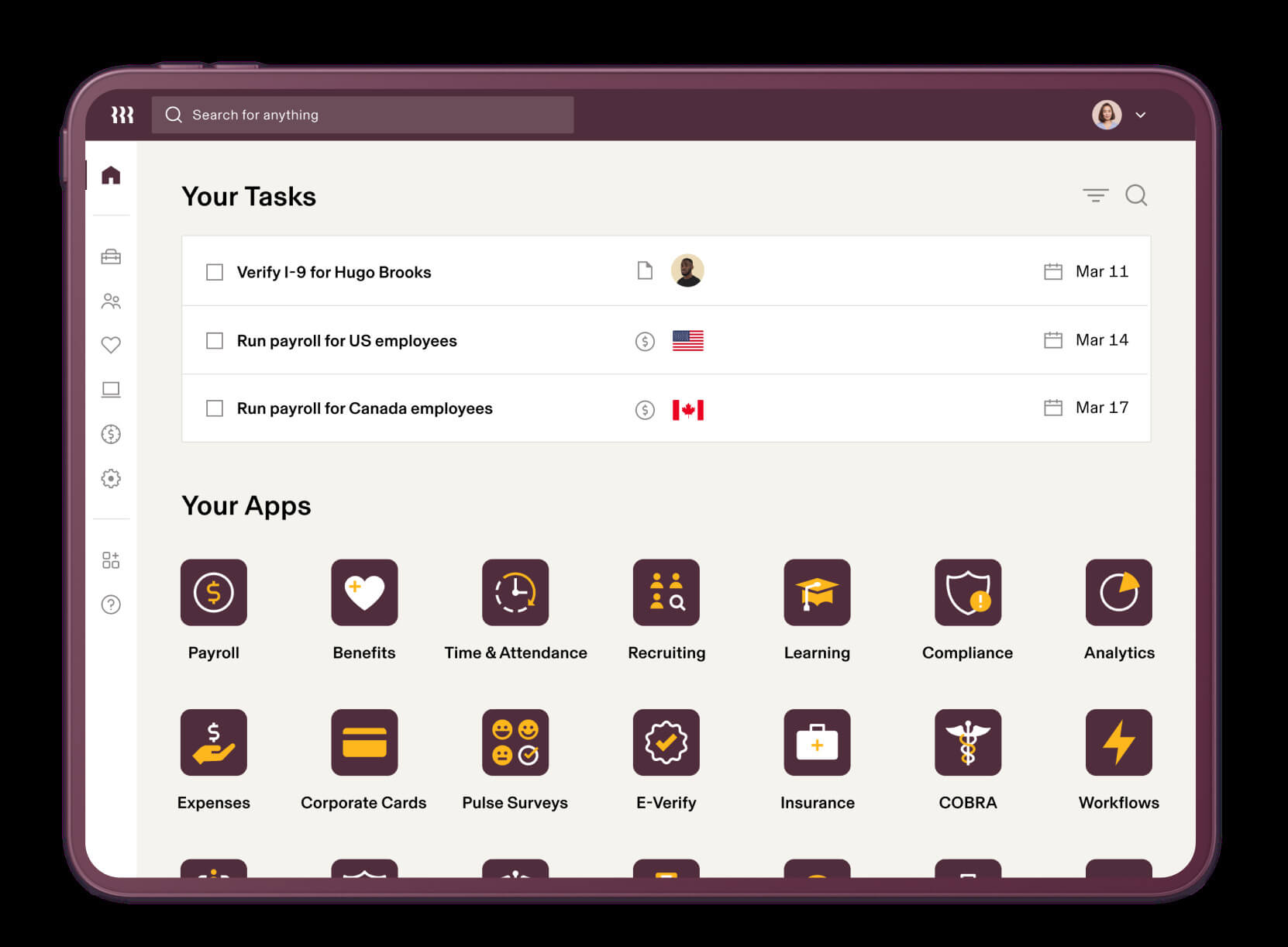
For UK&I companies with fast growth, multiple systems, and a desire to automate employee lifecycle processes deeply, Rippling can be very compelling. It is best suited to businesses comfortable with a more configurable platform.
Main features
- Core HRIS and employee data.
- Workflow automation.
- Payroll and app management.
- Device and IT-related employee lifecycle tools.
- Reporting and systems integrations.
Pros
- Strong automation potential.
- Broad platform vision across HR and operations.
- Good fit for scaling businesses.
Cons
- Can feel more complex than simpler SME-focused HRIS systems.
Pricing
Pricing only available when you request a custom quote.
8. Personio
Overview: Personio is a major European HR software player and a common shortlist option for SMBs and mid-market firms. It is designed to centralise HR administration, employee data, recruiting, and planning, and it often appeals to organisations that want a broad European-focused HR platform.
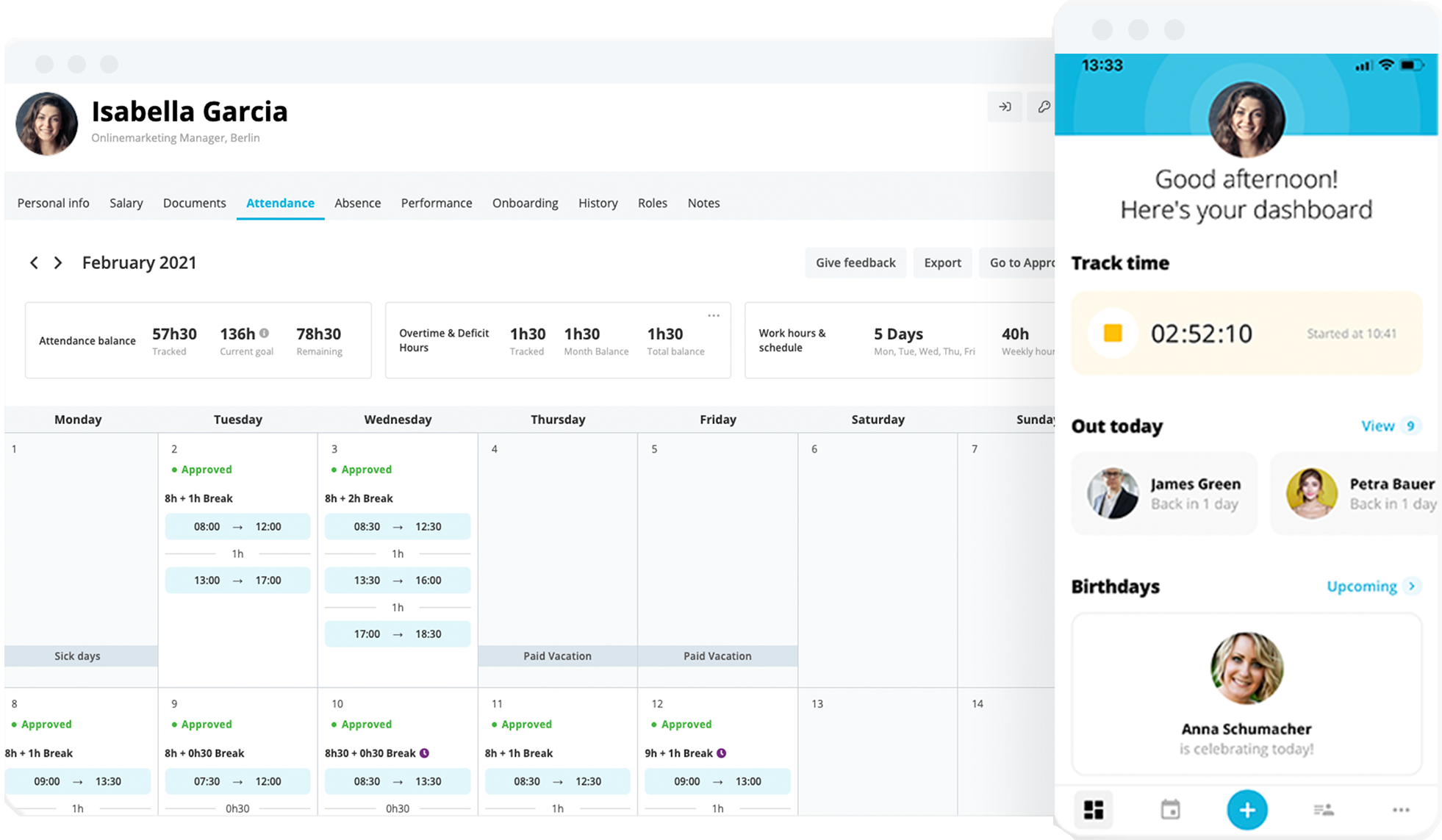
For UK&I teams, Personio is relevant as a scalable people platform with strong administrative depth. It may be especially attractive to companies that want a European vendor with broader organisational planning capability.
Main features
- Core HR and employee files.
- Time off and attendance features.
- Recruiting and onboarding tools.
- Reporting and planning features.
- Workflow and document management.
Pros
- Broad HR platform with good growth potential.
- Strong fit for European businesses.
- Good option for teams thinking beyond just basic HR admin.
Cons
- Some businesses may find the platform broader than necessary.
Pricing
Pricing only available when you request a custom quote.
How do you choose the best HRIS system for your UK or Irish business?
When a business asks which HRIS system is the best, the answer usually depends on what problem it is trying to solve first. Some companies need to centralise basic employee records, others want a better employee app, and others need reporting, payroll connectivity, or international scalability.
A useful framework for choosing which HRIS is best for your needs is to evaluate each vendor across these five areas:
- Core HR features: Does it cover records, documents, workflows, leave, and self-service well?
- How does reporting work? If reporting is a major priority, ask which HRIS systems offer the best reporting for the specific metrics you need, not just standard dashboards.
- Does it have a mobile app? For many teams, especially ones spread out across locations, the app experience matters.
- How does payroll work? If payroll is tightly connected to HR processes, compare the best HRIS and payroll systems rather than treating HRIS and payroll as separate.
- Scalability: Growing companies should think carefully about which HRIS systems scale best with company growth, including multi-site, multi-entity, and international support.
UK buyers should also consider data security and UK GDPR compliance as a core criterion. According to a 2025 survey of over 3,200 HR professionals across 11 countries, 75% of UK HR leaders consider security a critical feature when researching and implementing HR software. Verifying where employee data is stored and how the vendor handles subject access requests is essential before signing a contract.
Finally, consider implementation support and onboarding. A platform that takes months to configure or requires specialist consultants to maintain will erode the time savings it promises. Ask vendors for typical go-live timelines and what support is included in the base subscription.
Book a demo of Factorial to see HRIS in action
There is no single answer to what is the best HRIS system for every organisation, but for many businesses in the UK and Ireland, Factorial stands out as one of the strongest overall options in 2026. It brings together core HRIS functionality, time-related workflows, reporting, document management, and payroll-ready operations in one platform, without becoming unnecessarily complicated for SMEs.
That matters because many buyers are not just looking for a database of employee records. They want one of the best HRIS systems UK teams can actually use day to day, with strong employee self-service, a modern interface, and room to grow as the company adds headcount, processes, and complexity.
The global HRIS market is projected to reach USD 19.86 billion in 2026, growing at a CAGR of 13.75% through 2031, driven by cloud migration, hybrid work, and tightening compliance requirements across Europe. For UK businesses, that growth reflects a genuine shift: HRIS is no longer a nice-to-have for growing companies – it is the operational backbone that makes consistent people management possible at scale. Request a free demo of Factorial to see it in action.
Disclaimer: The information presented on this page is based on publicly available sources. The comparisons between Factorial and other providers are intended solely for the illustration of the respective software features, pricing and functionalities. All information regarding features, prices, and integrations may be subject to change without prior notice. Factorial assumes no liability for the accuracy, completeness, or timeliness of the information presented. We recommend contacting the respective providers directly to obtain the most accurate and up-to-date information. All legal regulations regarding Spanish fair advertising and competition law are fully observed by us, if you have any concerns, please reach out to us. The comparisons presented do not constitute a final evaluation or recommendation for any provider, but serve solely as an informational source.
FAQ
What are the top 10 HRIS systems?
The top HRIS systems centralise employee data, automate workflows, and offer self-service to reduce admin. For UK businesses, leading options provide strong reporting and scale with company growth. Factorial, an all-in-one business management software, is a strong choice for SMEs wanting a comprehensive solution.
What are the 5 types of HRIS systems?
HRIS systems vary by focus. Some specialise in core HR admin like records and leave, while others are all-in-one platforms combining HR, time, and payroll prep. There are also systems built for specific needs like international hiring, deep automation, or integration with a particular software ecosystem.
What is the best HR software in the UK?
The best option depends on company size, but a strong all-in-one system is ideal for most UK businesses. Factorial, an all-in-one business management software, is a leading choice for UK SMEs and scale-ups as it combines core HR, time, documents, and payroll prep in one platform.