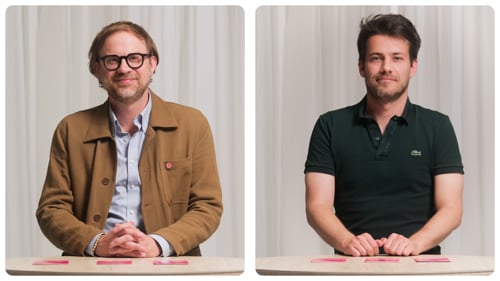
Transcription
Question three.In high-responsibility environments such as aviation or management, which performance factor is still too often underestimated today?
A: well-being, B: the power of the collective in performance, C: daily mental preparation, D: the Joker.
I'll go back to A: well-being, because I think it's the most important.
I love the collective, but I'll choose answer A:well-being — with two particular notions:self-knowledge and vulnerability.
Well-being — Patrick, you trained me in a two-day training on management and pressure management.
I think at the heart of your training is the topic of well-being.
I know you love acronyms and I remember one acronym you explained to me back then, that has stayed with me and that I use.
I try to apply it.It's the DESK method for conflict management and feedback.
I had an experience at one of my first companies where I received feedback that was very hard for me to hear.
I was told: You're hypersensitive.And it was difficult to get over — with quite a harsh judgment because it's a negative judgment.
And through learning about myself, I try to turn my humanness into my strength.
And my hypersensitivity, for me, is one of the most important tools I have to be a good manager and a good professional.
Because it's my quality as a human being.And as a hypersensitive person, I'm also going to be empathetic, and I'm going to read other people's feelings.
And just you, as a person, telling me: You are human.
Because the truth is, you don't leave your humanity at home.
Your humanity comes to work with you every day.When you have a problem, it will show up: some days your dog has died, and you're at work anyway.
And that human side is going to be there.And of course, that's my card — well-being — because I think we should all be more human in organizations.
We are completely in sync on that topic.What I can add is that the major evolution we had in the pilot competency model came in the wake of a trauma:the Rio-Paris accident.
There was a real piece of work done there.I was one of the project leads who worked on the pilot training component.
And in fact, we went from a competency rating model of 110 criteria — which is very technical — to a competency model that we could perhaps revisit — which is easy to remember — with a number of competencies that are nine core competencies.
So five soft skills out of four more technical competencies,even though we consider piloting to be a very technical profession.
We're actually talking about a majority of soft skills.
But the major innovation in this work is that the core of the competency model is self-knowledge.
I personally prefer to speak of self-management.It's truly this human dimension — if I want to have the energy to produce the competencies needed for an activity,in service of that activity — I myself need to be well.
Yes, I need to be well myself.This dimension of self-knowledge, of self-management,is central to the skill dimension that will put me in relation with others — so communication, relationship, etc. — with my activity,with my organization.
All of that then requires a whole body of work on what makes a quality relationship.
Knowing that there is a study that began 85 years ago at Harvard.
There's a book that synthesizes this study called The Good Life,which is incredibly interesting.
This study shows that health — mental health in particular — and health in general:the number one lever of health — before money, before anything medical, let's say — is the quality of relationships,the quality of connection.
The debate is over.Thank you very much for all your answers.
That was really great. Thank you both.Thank you — it was really lovely. See you soon.
So — did I get the DESK method right?It was perfect. You've even made it your own.
I haven't dropped the method in seven years.