Did you know that a quarter of UK workers plan to move jobs in 2026, and that only 12% of employees say their company does onboarding well? A structured employee onboarding process is one of the most powerful tools available to change both of those numbers.
Table of Contents
- Key Facts: Employee Onboarding Process
- What Is the Employee Onboarding Process, and Why Do You Need One?
- How Do You Design an Effective HR Onboarding Process?
- Tips for Creating an Employee Onboarding Process Plan
- First day of work
- The First Week
- What Should a 30-60-90 Day Onboarding Plan Include?
- How Does Remote and Hybrid Onboarding Work?
- Completing the Onboarding Process
Key Facts: Employee Onboarding Process
- What it is: The employee onboarding process is the structured programme an employer uses to integrate a new hire into their role, team, and organisation– covering legal compliance, cultural orientation, and performance enablement from day one.
- The retention impact: Employees who experience great onboarding are 69% more likely to stay with a company for at least three years.
- The scale of the problem: Only 12% of employees say their organisation does a great job of onboarding– meaning 88% of new starters feel their experience was inadequate.
- The cost of getting it wrong: UK staff turnover costs businesses an average of £30,614 per departure– a figure that a well-designed onboarding process directly reduces.
The first few days, weeks, and months are crucial to forming a good working relationship between an employee and the company. Many of the fundamental steps required for the onboarding process are often overlooked. For this reason, we’ve put together some key steps, practical tips, and important information to guarantee a successful onboarding.

What Is the Employee Onboarding Process, and Why Do You Need One?
The process of onboarding, also referred to as employee induction, details a plan of action that is designed by the company to help their new employees effectively adapt to their role and corresponding duties. New hire integration is central to this process.
The duration of the employee onboarding process can last anywhere from 45 days to one year, depending on the characteristics of the job and the skills of the new worker.
The new employee must know:
- Where they will perform their duties
- The means of work
- The habits of the company and the company culture
The process of onboarding has many benefits for companies just as much as for their workers. Here are some of them:
-
- Reduces future hiring costs: The better the onboarding, the less likely you’ll have new employees abandon their roles early on. As a result, a company will not need to spend money on another round of recruitment and onboarding.
- Improves employee retention: The chances of highly skilled workers leaving their job are reduced. Invest in proper employee training to make sure your employees stay in the company.
- Increases productivity: Happier workers are more productive. Take the time to nurture a healthy work environment to increase employee engagement.
- Quicker adaptation: Workers who receive more guidance integrating into the company will adapt better and be more successful. Your onboarding process helps them build a solid foundation and be able to hit the ground running.
- Greater identification with the brand: Encouraging employees to become more involved in the company activities results in a greater investment in the company, its values, and the brand as a whole.
- Builds stronger workplace relationships: Onboarding new employees and welcoming them to the team by introducing them early on to their co-workers naturally facilitates teamwork.
- Improved company image: Integrating recent arrivals with an onboarding plan does a favour to the company. This action puts forward the impression that the company is concerned about its employees from day one.
How Do You Design an Effective HR Onboarding Process?
Developing a strong employee onboarding plan is a key responsibility of the HR department. Your main role early on is to help the new hire settle into their work environment. This means providing them with resources, explaining different workflows, and other practical office knowledge. The new employee onboarding process should be tailored to each role and department, helping newcomers understand the company and team responsibilities.
If you are curious to learn more about how to design an effective onboarding process, continue reading. We will guide and teach you about what should be included in your welcome plan for employees, but first, you need to understand one thing.
Tips for Creating an Employee Onboarding Process Plan
Before selecting the ideal candidate to cover the job vacancy, you must first create an employee onboarding process plan and decide the actions that you will take, starting with how you plan to communicate with the employee. All of these initial steps are essential to ensure a pleasant professional experience while establishing healthy connections between the company and the new worker.
As you go through the next section, you can create your own employee onboarding process checklist, based on your company requirements, from the information below.
Before Hiring: Analysis
In the initial phase, your company must be clear about its values, mission, culture, and business strategy, so that you can communicate this information to the new employees. You should also gather information about the functions required of each role and the internal and external references with which the new worker will have a direct relationship. Also, before beginning the hiring process, make sure you don’t make these recruitment mistakes.
Pre-Onboarding Process
This period includes the moment from when the selected candidate receives their offer until they are officially hired. As pre-onboarding is the duty of the human resources department, your responsibilities at this stage will be as follows:
1. Collection of Documents
In the UK, the required documents for onboarding include the following:
- National Insurance (NI) number
- Right to work documentation: UK employers are legally required to verify every new hire’s right to work before employment begins, using the Home Office online share code service, a manual document check, or a digital identity verification check through an Identity Service Provider (IDSP). Failure to complete this check before the start date removes the employer’s statutory excuse against civil penalties.
- Supporting documents: although not required by social security, some companies may request additional documents such as a criminal record check.
2. HMRC Registration and PAYE Setup
- Register the new employee with HMRC before their first payday by adding them to your payroll software and submitting a Full Payment Submission (FPS) through Real Time Information (RTI).
- Collect a P45 or HMRC Starter Checklist: If the new hire cannot provide a P45 from their previous employer, they must complete the HMRC Starter Checklist (which replaced the P46 in 2026). This document determines the correct tax code and National Insurance deductions from day one.
- Issue a written statement of employment particulars on or before the first day of employment. Under Section 1 of the Employment Rights Act 1996, this is a day-one right for both employees and workers. Failure to provide it can result in a tribunal awarding two to four weeks’ pay as compensation.
- Enrol eligible employees in a workplace pension in line with auto-enrolment obligations under the Pensions Act 2008.
3. Communication with the future worker
For an onboarding process to be effective, it is important to maintain constant communication with future employees. At times, it is common for workers to receive other offers while they are waiting to enter their position in a company. This is why it is essential to maintain communication. Without proper follow-up, the new employee may back out if they receive a better offer.
Take advantage of the first few days following the signing of the offer letter to provide your new member with a proper welcome. Use this time to explain to them what their functions will be, the type of contract they will have, and what they will be required to do in their role.
4. Collecting employee contact details
The other details you can ask of your future employee are those which will be reflected in the contract:
- Level of studies
- Nationality
- Address
The employee must communicate to the company any modification or change to their address. In the case that the employee leaves, you will need the most up-to-date information to contact them with.

First day of work
Welcome
Organising a welcome session for your new employee is the first thing you should arrange. The proper welcome will ensure the new employee feels comfortable and well received by the company. You can organise the welcome in several ways. Some of these may include: recording a welcome video, carrying out group activities, presenting the new member to their co-workers, etc. Giving a gift to new staff is also a great way to make them feel welcome.
Collection of Information
Fundamentally, every onboarding plan for employees includes a collection of the employee’s basic data. This is an essential part of the hire paperwork and is separate from payroll data sent to HMRC.
Where the new employee cannot provide a P45 from their previous employer, they must complete the HMRC Starter Checklist. This document enables the employer to apply the correct PAYE tax code and National Insurance deductions from the first payday.
At this stage, you can also request a bank account where you can pay the employee’s salary. Requesting an email is also beneficial so you can send them their payslip.

Signing the contract
After you have collected all the required data, you must sign the original contract with the employee in writing. Although you may have a verbal contract in place, and this does hold legal validity, it is not advisable to rely solely on this. Having only a verbal contract does not provide any legal certainty for either party. Verbal contracts leave many things unregulated, such as the trial period, which, if not specified in writing, holds no weight.
Furthermore, ensure you have at least two signed copies of the contract — one for the company and one for the employee. Under the Employment Rights Act 1996, the written statement of employment particulars must be issued on or before day one of employment. Failing to provide this document is a statutory breach and can increase compensation awards in tribunal proceedings.
- Fixed-term contracts – In the UK, these are governed by the Fixed-term Employees (Prevention of Less Favourable Treatment) Regulations 2002 and must be documented in writing.
- Permanent contracts – These do not require a prescribed format beyond the written statement of particulars required under the Employment Rights Act 1996.
Note: To take advantage of a benefit, employees must provide the necessary documentation to prove the legitimacy of their disability or to verify their eligibility to access a specific benefit.
Many companies often overlook these minor yet important contract details. However, they are details you must include when designing a good onboarding plan.
Tools for the job
Although not required by law, you must provide the employee with the means required to perform the job: i.e. car, mobile phone, computer, etc. Also, you must provide access and passwords to the systems the employee will be required to use.
Management of Third-Party Data
If you are sharing employee data with third parties, each employee must sign a third-party waiver that confirms they are aware their data will be shared.
The employee data you collect will most often be kept for internal use. However, you may also need to send it to third parties. An example of this would include times when you need to request advice from an advisory. This situation happens when a company needs to carry out communications to administrators or external companies they will work with.
Data Protection
The new employee must be provided training on data protection. This is vitally important if they have access to a third-party database, such as customer data. If there is an information leak, the company could be sanctioned. Due to this, the worker must sign a paper that indicates that they have participated in the proper data protection training programme so that the company can be exempt from blame.
UK GDPR and Data Protection Obligations
Onboarding activates immediate data protection obligations under the UK General Data Protection Regulation (UK GDPR) and the Data Protection Act 2018. Employers must identify a lawful basis for processing each category of employee data, provide a privacy notice to the new hire, and ensure that any data shared with third parties (such as payroll bureaus or occupational health providers) is covered by a data processing agreement. Regulatory scrutiny frequently focuses on onboarding because it is where systemic weaknesses in data governance first appear.
Workplace Risk Prevention & Health Surveillance
When onboarding new employees, workers must receive training on how to prevent workplace accidents. Also, you must provide the worker with the necessary personal protective equipment if required by the role. You must have the employee sign something that confirms they have received the proper training. If someone comes to inspect, this documentation will be requested.
Also, depending on the sector of work (i.e. construction, power plants), you may be required to offer medical examinations to your workers. Workers can refuse to have the medicals conducted. However, they must sign a refusal letter, so they cannot later claim the company hasn’t fulfilled their duty.
Workplace Procedures
When you design an onboarding plan for your employees, keep in mind that some legal regulations require you to operate in a certain way. For example, under the Working Time Regulations 1998, UK employers are required to keep adequate records to demonstrate compliance with the 48-hour average weekly working time limit. Many organisations use a digital time-tracking system to meet this obligation and provide employees with clear guidance on the process during onboarding.
If the country you are working in requires employees to clock in and out, it is necessary to inform employees of the time-tracking system so they are aware of the procedure they must follow.
Let’s talk about surveillance!
Special care must be taken if the worker will be under surveillance during their shift. If this is the case, the employee must sign a waiver to allow the company the right to record.
Confidential Information
Otherwise known as sensitive business information or trade secrets, which are essentially the intellectual property of the company. If an employee is required to know any confidential company information (i.e. a plan for a certain product, how to attract customers, etc.) this may be indicated in the contract. The employee must sign and confirm that they will not be sharing any company-sensitive information. Any individual sharing company information without consent could face penalties.
As you can see, many steps must be followed during the first day to ensure the process of onboarding runs smoothly and doesn’t become too intense or overwhelming. The company must facilitate the hassle-free adaptation of the employee into their new environment.
The First Week
Once the first day is complete, the employer should always follow up with the employee. A follow-up fairly early on is a good idea and allows you to evaluate whether the employee feels comfortable in their work environment.
Here are some additional things you can do as an HR manager to help the new employee along.
Assign a mentor
One of the best ways to help your new employees transition into the workplace is by assigning them a mentor. This mentor can guide them as they learn their tasks so that eventually, they can perform them fully on their own.
Periodic meetings
Make time to meet with your new employee every 15 to 20 days. This is a great time to check in with your employees and determine whether they require anything to help them out. Following the initial 90 days, a review should be set up to evaluate the performance and adjustment of the employee to their environment, other team members, and their role as a whole.
What Should a 30-60-90 Day Onboarding Plan Include?
A structured 30-60-90 day onboarding plan gives new hires clear milestones and gives HR teams measurable checkpoints. An effective induction contributes to overall employee experience and longer-term engagement. The structure of that induction matters as much as its content.
- Days 1–30 (Foundation): Complete all legal and compliance requirements (right to work, written statement, HMRC registration, UK GDPR training, health and safety induction). Introduce the new hire to their team, assign a buddy or mentor, and set clear role expectations. New hire integration is critical in this stage.
- Days 31–60 (Integration): Begin role-specific training. Schedule regular one-to-ones with the line manager. Assess whether the new hire has the tools, access, and information needed to perform independently.
- Days 61–90 (Performance): Conduct a formal 90-day review to evaluate performance, cultural fit, and wellbeing. Discuss career development pathways and set objectives for the next quarter. Collect structured feedback on the onboarding experience itself.
Research shows that organisations with strong onboarding programmes improve new hire retention by 82% and productivity by over 70%, according to the Brandon Hall Group. Extending onboarding beyond the first week and treating it as a 90-day programme rather than a single-day event is the most effective structural change most UK employers can make.
How Does Remote and Hybrid Onboarding Work?
With hybrid working now embedded across UK organisations, onboarding must account for new starters who may not be in the office on day one– or at all. The same legal obligations apply regardless of working location: right to work checks, written statements, and UK GDPR compliance must all be completed before or on the first day of employment.
For remote and hybrid new hires, consider the following adjustments to your standard onboarding process:
- Send equipment, access credentials, and a welcome pack before the start date so the new hire can begin work without delay.
- Schedule a video call welcome session with the team on day one — do not rely solely on email communication.
- Use your HR software to automate document collection, e-signature of contracts, and compliance training delivery, so nothing falls through the gaps when the new hire is not on-site.
- Assign a remote buddy who can answer informal questions and help the new hire build relationships across the team.
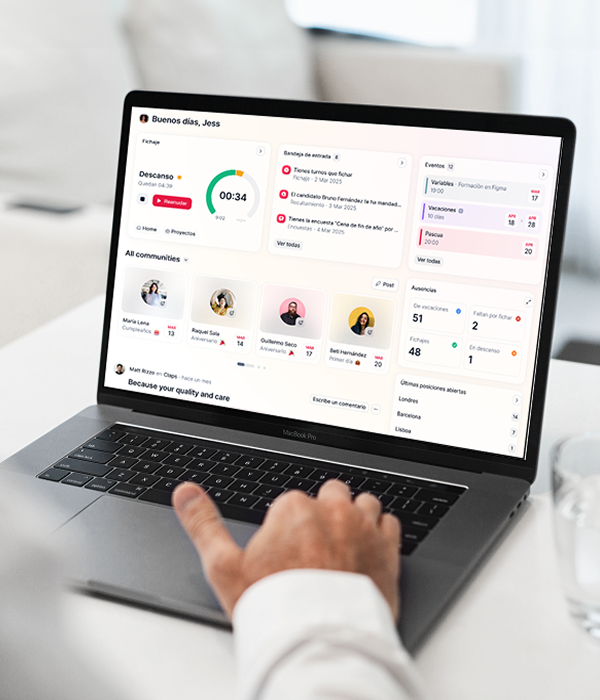
Factorial’s onboarding module allows HR teams to create customised onboarding workflows, assign tasks to managers and new hires, and track completion of every compliance step– whether the new starter is in the office or working remotely. A comprehensive employee onboarding system is essential for managing both in-person and remote onboarding efficiently.
How Can HR Software Streamline Employee Onboarding?
Managing the onboarding process manually often leads to disconnected email chains, endless spreadsheets, and a fragmented experience for your new talent. This is where modern HR technology changes the game. A comprehensive employee onboarding system is essential for managing both in-person and remote onboarding efficiently, transforming administrative chaos into a structured, welcoming process.
Factorial’s dedicated onboarding module allows HR teams to digitise, automate, and scale this crucial business operation. Here is how implementing the right software streamlines the entire workflow:
-
Customised Onboarding Workflows: Every role requires a unique approach. HR software allows you to build tailored, repeatable sequences that guide new hires through their first days, weeks, or months smoothly, ensuring they receive the exact information they need without cognitive overload.
-
Automated Task Assignment: Eliminate manual reminders and back-and-forth tracking. The platform automatically assigns relevant tasks to managers, IT teams, and new hires alike. From setting up system access and provisioning hardware to scheduling welcome calls, everyone knows exactly what they need to do.
-
Flawless Tracking and Compliance: Maintain complete visibility over the onboarding lifecycle from a single dashboard. HR managers can track the completion of every compliance step – such as collecting tax info, uploading right-to-work documentation, and securing digital signatures on employment contracts – reducing compliance risks and avoiding costly errors.
-
Consistent Distributed Onboarding: Whether your new starter is arriving at the head office or logging in remotely from home, their experience remains seamless. Self-service employee portals give remote workers immediate, secure access to company policies, training modules, and task roadmaps, keeping them engaged and connected from day one.
By replacing repetitive administrative friction with intelligent automation, HR departments can step away from paperwork and focus on what truly matters: making an exceptional first impression that drives long-term employee retention.
Want to eliminate the admin and upgrade your onboarding experience? Book a personalised demo with the Factorial team today to see how our platform can support your growing business.
Completing the Onboarding Process
Once the new hire has fully integrated into their role and the culture of the organisation, the formal onboarding programme is complete. At this point, it is good practice to conduct a structured exit survey of the onboarding experience itself — not just a performance review.
In conclusion, the process of onboarding has substantial benefits for both the company and the worker. Most importantly, a proper HR onboarding of employees helps build a solid relationship between the two and builds lasting bonds. It is crucial to have a process of onboarding in place so that you can ensure your new employees adapt well. Furthermore, this will help them establish a good foundation for working within their position, which will result in more overall productivity for the company.
FAQs
What is the onboarding process for an employee?
The employee onboarding process is a structured plan to help new hires adapt to their role and the company culture. It covers everything from pre-arrival paperwork and first-day welcomes to role-specific training and regular check-ins, ensuring a smooth and successful integration into the team.
What are the 4 phases of onboarding?
The four key phases of onboarding are pre-onboarding (from offer acceptance to the first day), orientation (the first day welcome and administrative tasks), role-specific training (the first week and beyond), and ongoing integration (continued support and performance check-ins to ensure long-term success).
What are the top three keys to a successful onboarding program?
The three keys to a successful onboarding program are clear communication, effective training, and ongoing support. This involves setting clear expectations, providing the necessary tools and role-specific training, and scheduling regular check-ins to help the new hire integrate into the company culture.
What are the 5 C’s of successful onboarding?
The 5 C’s of successful onboarding are Compliance, Clarification, Confidence, Connection, and Culture. This framework ensures new hires understand legal requirements, are clear on their role, feel confident in their abilities, build relationships with colleagues, and understand the company’s values.
What is the 30 60 90 onboarding rule?
The 30-60-90 day plan is a framework that sets specific goals for a new employee’s first three months. It structures the learning process, from understanding the role (first 30 days) to contributing independently (60 days) and taking initiative (90 days), and can be managed with all-in-one business management software like Factorial.