A study found that 71% of managers said that meetings are unproductive and inefficient, which begs the question: Why should any manager dedicate time to one-on-one meetings with each of their team?
It turns out that for many successful managers, one-on-ones are the number one way to find out what kind of problems their team is facing. In fact, a well-organised one-to-one meeting can be the most effective tool when it comes to things like building trust, boosting job satisfaction, and promoting employee growth.
But like any kind of meeting, well organised is key. It is all too easy to mismanage and lose precious time. And when it comes to structuring these meetings, most managers don’t know where to start, which is likely the reason the majority of managers find their meetings unproductive. This article will help you have purposeful and well-structured one-on-ones that fit your and your team’s needs.
Table of Contents
- What is a one-on-one?
- Purpose of one-on-one meetings
- What is a manager’s primary role in a one-to-one meeting?
- What is the role of an employee in a one-on-one meeting?
- How frequently should one-to-one meetings be held?
- How long should your check-in meeting last?
- Where should a one-on-one meeting take place?
- How to conduct a 1:1 meeting
- What is the best way to structure a one-on-one meeting?
- 1 on 1 questions
- 1:1 conversation examples
- One-on-one meeting template
- One-on-one manager tips
- Key takeaways for effective one-to-one meetings
What is a one-on-one?
Also known as one-to-one meetings, or 1:1 meetings, one-on-ones are regular check-ins, confidential meetings between an employee and their manager, in which they discuss work-related problems, professional development, and their objectives and goals. Managers typically hold one-on-one meetings with employees who directly report to them, although they may occasionally exist between employees and their coaches or mentors.

Purpose of one-on-one meetings
One-to-one meetings are one of the most effective ways for managers to communicate with and synchronise their team. For UK businesses, they are a cornerstone of effective people management. Here are some of the key reasons why successful managers swear by them:
Facilitate internal communication
It is quite possible that team members may notice patterns and detect potential problems that need to be addressed. Too often, employees lack the right platform to voice their observations. As a result, these issues run the risk of never being heard, impacting other departments or even the organisation as a whole.
This feeling of mutuality and openness is something that makes one-on-ones unique. It creates a space that is ideal for exchanging, sharing, and moving ideas.
Develop leadership qualities
Aside from simply easing communication, one-on-ones allow team members to teach their supervisors something new. Like workplace mentorship programmes, information in 1:1 meetings is shared in a way that promotes horizontal communication and benefits everyone in the long term.
Increase productivity
One-on-ones definitely pay off at the end of the day. Groves points out that 1.5 hours spent in a one-on-one meeting can enhance the quality of 80 hours of work. Having a clear outline before the meeting begins can ensure that this hour and a half is spent in the best way possible.
Additionally, one-on-one meetings give both managers and direct reports a designated space for all of their daily questions and concerns, which can dramatically reduce the number of continual interruptions. Not only does this help with time management, but it also promotes autonomy.
Reduce staff turnover
When it comes to employee resignation and unsuccessful hires, the attention is usually turned to recruitment strategies, small business hiring, and compensation strategies. However, very little is discussed about the most important factor in retaining employees: managers that listen to their employees’ needs.
In a one-on-one meeting, managers can get a pulse on the job satisfaction of their employees and a “general feel” for how they are adapting to the company culture, managing their workload, etc. By doing so, they can prevent future talent loss and work-related frustrations from occurring.
What is a manager's primary role in a one-to-one meeting?
Although the manager’s exact role in one-to-ones is up for debate, most experts agree that the focus should be on the employee, rather than the manager.
This means that your top priority as a manager should be listening to what the employee has to say.
Technology entrepreneur and venture capitalist, Ben Horowitz, states that “the manager should do 10% of the talking and 90% of the listening.” Even if it doesn’t boil down to this exact statistic, the primary role of the manager is to facilitate the employee’s expression of ideas and problems.
For managers with more introverted team members, this can be easier said than done. In these situations, managers need to be especially careful not to force employees to talk but to ask plenty of questions and try to get to the root of pertinent issues.
All in all, the manager’s role should be about learning, coaching, and building trust in their one-on-one meetings. Employee feedback should also be encouraged, so staff feel enabled to prepare constructive feedback in advance of meetings.
What is the role of an employee in a one-on-one meeting?
On the other hand, employees should see one-on-ones as an opportunity to share sentiments, pitch ideas, and have influential conversations with managers.
Not all major decisions are made based on the observations of senior-level employees. And one-on-one meetings are the perfect opportunity for employees to share findings and really impact the way that managers and company leaders move forward.
However, employees should come to the meeting prepared and ready to take an active role. In order to get the most out of a one-on-one meeting, employees should:
- Proactively track KPIs and record observations.
- Ask targeted questions about performance, technical problems, and team goals.
- Direct managers on how to offer their support.
Often, managers want to help employees reach their goals, but don’t know exactly where to start. A one-on-one meeting is a wonderful way for employees to communicate their concerns and needs and guide managers to better understand.

How frequently should one-to-one meetings be held?
Most of the time, one-on-ones are scheduled either on a weekly or biweekly basis. Although the frequency may change depending on a few factors:
- The level of experience that an employee has with a specific task. This is not the same as job experience and age. Supervisors can take a more “hands-off” approach to 1:1 meetings if employees are more experienced with a specific task or responsibility.
- The pace of the working environment. If working in a fast-paced environment, it may be necessary to hold weekly meetings. Other types of working conditions, such as those conducive to research-based activities, might require fewer meetings.
If you are unsure about how often to have one-on-ones with a new direct report, it is probably best to plan for weekly meetings for the initial 2-3 months.
As a rule of thumb, it is a good idea to schedule your meetings on a rolling basis, rather than having a rigid time frame. If things get busy and you are running short on time, it is better to reschedule than go through the meeting feeling rushed.
How long should your check-in meeting last?
Generally speaking, one-on-one meetings normally last anywhere from 1 to 1.5 hours and should not be shorter than 45 minutes. Conducting a one-on-one in less than that time frame might not allow team members to discuss important issues in-depth and may not fulfil the purpose of having the meeting in the first place.
As with frequency, it is best to place flexibility at the forefront whilst deciding how long meetings should last. To start with, give your meetings a general 1-1.5 hour time frame. You can adjust future meetings based on how many and what kind of issues need to be discussed.
Where should a one-on-one meeting take place?
Although it might seem like a minute detail, the location of the meetings is actually an important element to consider. If in person, in the team member’s office or space. This is because managers can learn quite a lot from stepping into a team member’s office space and observing their working environment.
Also, conducting the meeting in the team member’s comfort zone might also help them to feel more at ease and more open to sharing what’s on their mind.
Remote one-on-one meetings
With hybrid and remote work now standard practice in the UK, effective one-to-ones are more critical than ever. However, there should be a system in place to organise information and compensate for the distance. A good idea is for managers and direct reports to regularly exchange notes after every meeting.
How to conduct a 1:1 meeting
Before the one-on-one meeting
Before a 1:1 takes place, both manager and team member should know:
- How the meeting will run (meeting agenda)
- What topics will be discussed
- What needs to be accomplished
If conducting a one-on-one meeting for the first time, it is a good idea to send direct reports an email outlining their expectations and the purpose of the meeting. (employmenthero.com) Otherwise, employees might feel intimidated or as if the meetings are due to poor performance. Making sure that everyone is on the same page ahead of time can really help the meetings to stay positive and productive.
During the one-on-one meeting
To get the most out of your one-on-one, make sure that the following bases are covered during the meeting:
- Problems and changes that have occurred since the previous meeting. This includes global issues that affect the entire company. For example, organisational issues, hiring problems, and plans.
- KPIs and other figures that reflect an employee’s roles and responsibilities. This means that before the meeting even begins, employees should already know which KPIs they are responsible for and have a system in place to monitor and draw observations.
- Potential problems that should be on the supervisor’s radar. When a team member has doubts or a feeling that something is wrong, they should bring it up during their 1:1.
- Questions both for managers and employees. When asking questions, note that the focus should always be on the employee. This is their chance to share and give feedback.
After the one-on-one meeting:
Once the meeting is over:
- Share notes and written agreements. A common problem that supervisors and team members face is that information is lost after a meeting ends. Notes also help both manager and direct reports process all of the information discussed during the meeting. Having a written account of all of the conclusions and key points that were discussed prevents progress from being thrown out the window and ensures you have documented action points for future reference.
- Ask for meeting feedback. This is especially important after first-time one-on-one meetings. When asking for suggestions, it is best to do so immediately after the meeting has taken place.
- Think about next week’s session. Be sure to note topics that were left out or those that needed to be discussed more in-depth.
Using a dedicated performance management tool can simplify this process significantly. For example, Factorial’s performance management software allows both managers and employees to set agendas, share notes, and track action points from one-to-ones directly within the platform. This creates a clear, shared record of discussions and commitments, ensuring nothing gets lost and making follow-up smooth.
What is the best way to structure a one-on-one meeting?
I have two one-on-ones weekly with my team. My team is a five-person team, so not everyone reports directly to me. We’ve created a structure where managers have someone underneath, so they also feel they can have a sense of management.
—Andrea Carlon, Business Development Director at Lano
I always ask how you are at the beginning and if they need something from me or if they feel stuck on something and if I can help them in some way. Those are the basic questions.
—Mireia Barón, People Manager at Factorial
I start by asking “how are you?” We talk about how the employee is doing, then talk about their worries. And sometimes there are more things to talk about. Things that they need help with, things that might go wrong. Then sometimes I will ask their opinion on something because I would like their feedback.
—Jonathan Centeno, Growth Enablement Manager at Factorial
3 Ways to structure a one-on-one
One-on-ones do not work with a one-size-fits-all approach.
Although there are different ways of structuring meetings, both employees and managers should feel a sense of ownership. Here are some of the most common ways that managers choose to organise meetings.
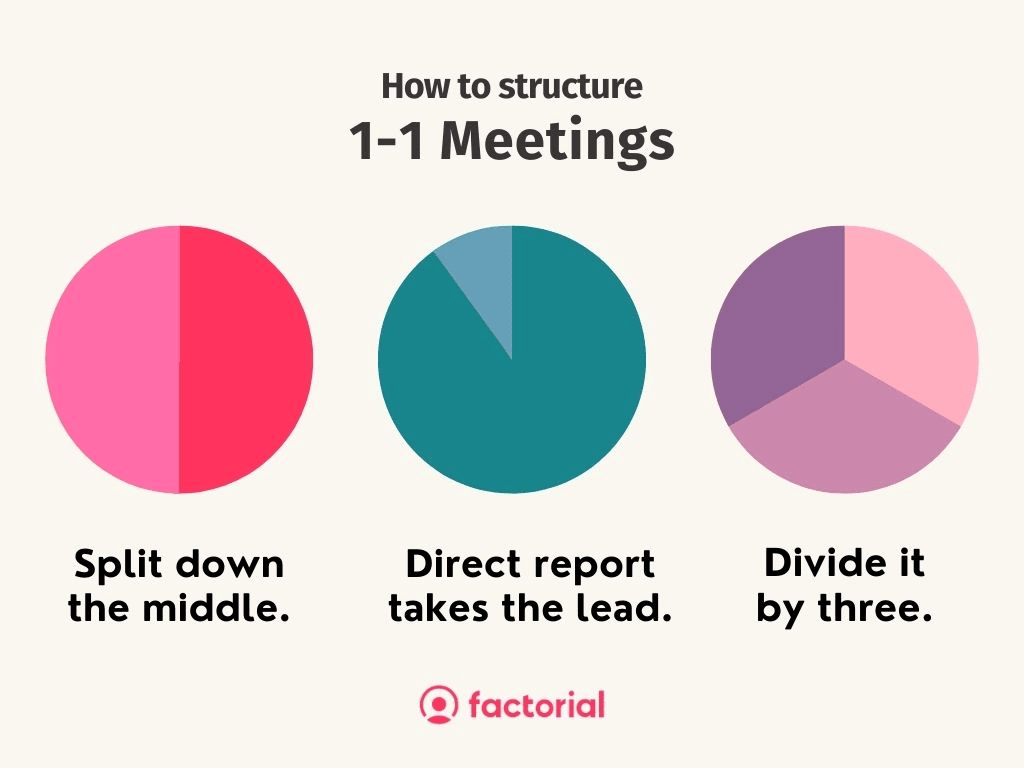
- Split down the middle. With this model, all responsibilities are split evenly between managers and their direct reports. This means that both are given the same amount of time to discuss important topics, ask questions, and give feedback.
- Divide it by 3. ⅓ of the time for direct reports, ⅓ of the time for managers, and ⅓ of the time for future plans and goals.
- Direct reports taking the lead. This is the most suggested way to organise a one-on-one meeting. With this particular model, managers could have varying degrees of organisational responsibility. For example, they might set overall guidelines or decide which topics should be discussed first. But ultimately, it is up to the direct reports to direct the meeting.
1 on 1 questions
Meetings can become routine and there may be little overall progress and outcomes. As mentioned before, it is extremely important for these meetings to be targeted and with clear goals. The questions and discussions that take place should ideally be consistent with these objectives.
What are good questions to ask employees in one-on-one meetings?
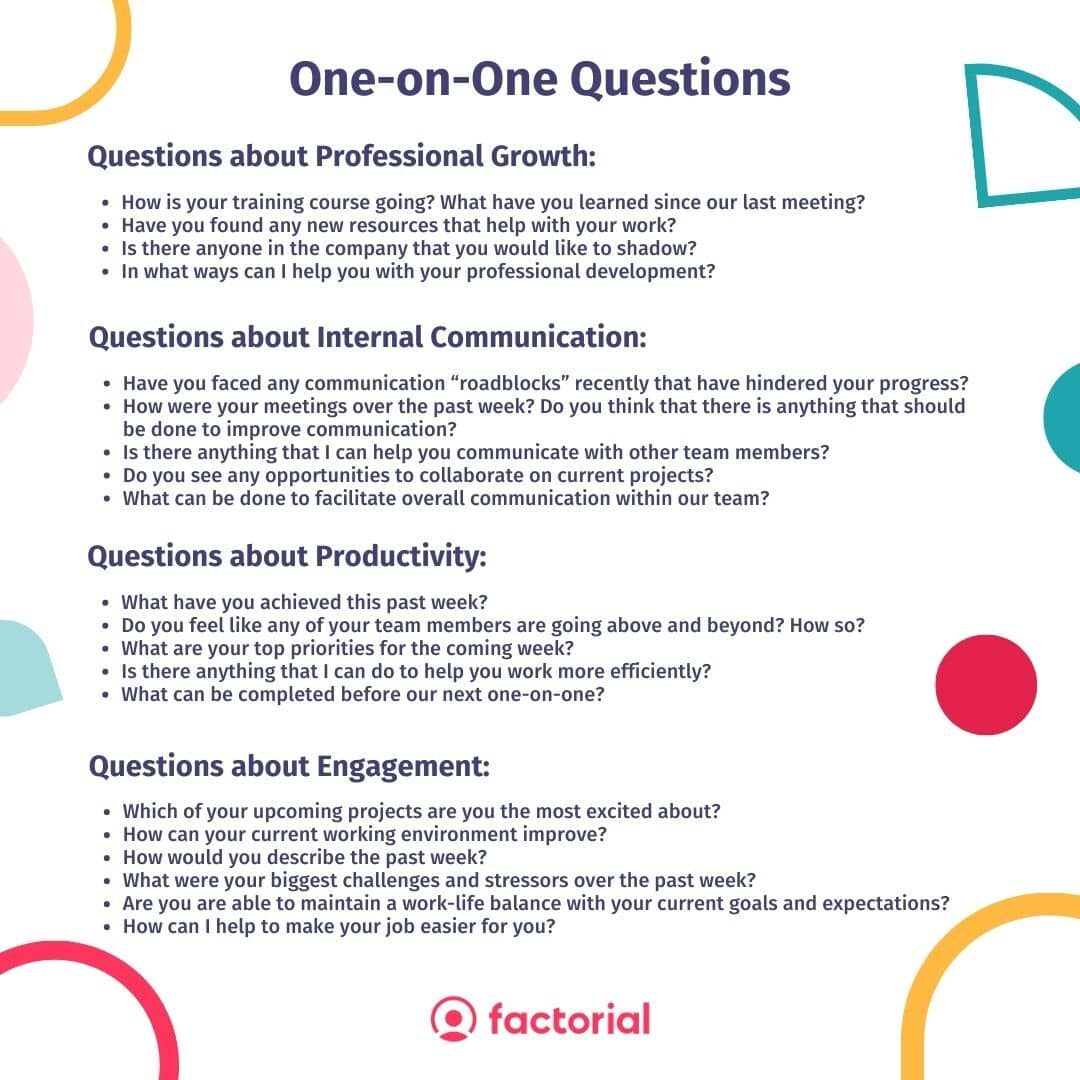
Questions about wellbeing and workload
- How are you feeling about your current work-life balance?
- What part of your work is most energising, and what part is most draining?
- Is your current workload manageable? Are there any tasks we should consider de-prioritising?
1-to-1 questions to ask managers:
- What do you think about my progress on the X project?
- Do you know of any training programmes and/or resources that could help me bridge my skills gaps?
- What is the number one skill that I should work to improve before our next meeting?
- Could you help me to better communicate with the X department?
Questions about feedback and career development
- What is one thing I could do differently that would have the biggest impact on my performance?
- How does my work contribute to the team’s wider goals for this quarter?
- Are there any upcoming projects or training opportunities that align with my development goals?
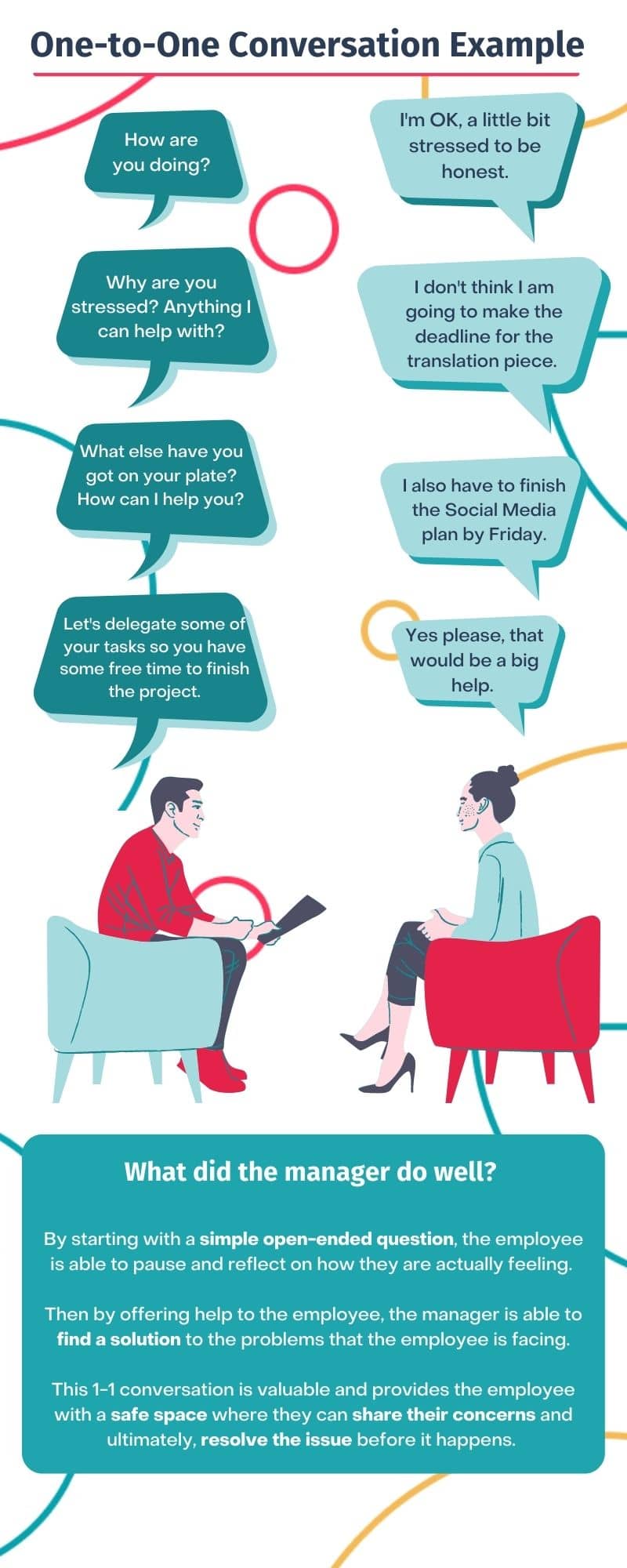
1:1 conversation examples:
One-on-one meeting template
The best way to outline meeting goals and expectations is with a one-on-one meeting template. Factorial’s one-on-one template will help you to stay prepared and organised. In this template, you will find:
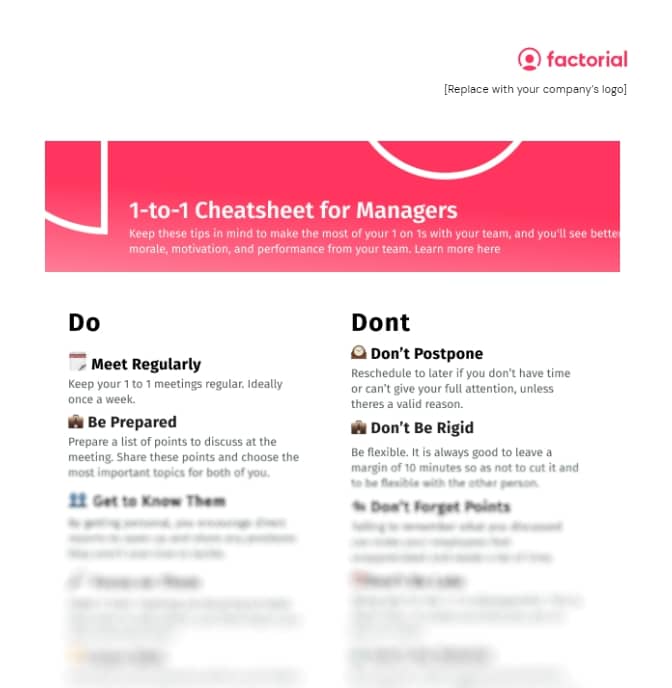
1-1 Cheatsheet for managers
This “cheatsheet” is the perfect reference for managers trying to improve their one-on-one practices. In the document, you will find all of the dos and don’ts clearly outlined. Check out the sneak peek below to get an idea.
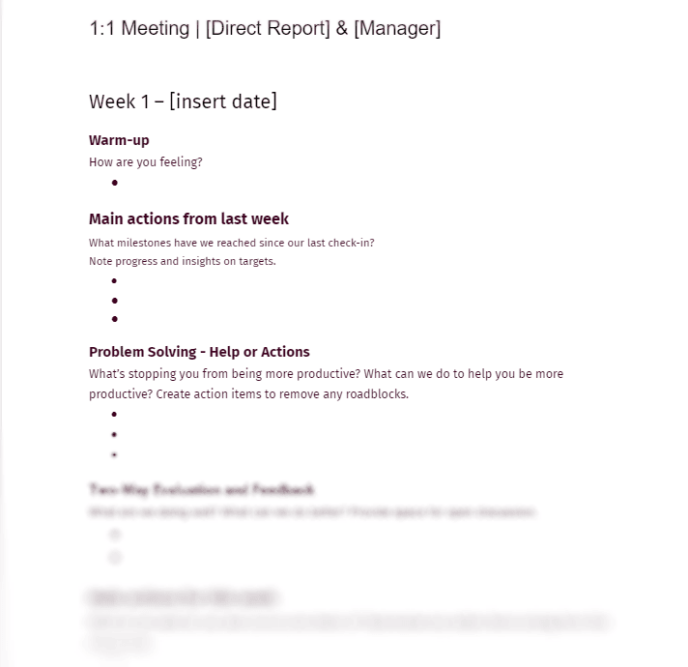
One-on-one planning template
This template will help you to structure your meetings in the most effective way. Before every meeting begins, simply ask your direct reports to fill out the template. That way, you can have targeted discussions, stay on the same page, and easily pinpoint trouble areas ahead of time.
Questions for employees
Before having a one-on-one meeting, it is a good idea for managers to have 3-5 extra questions prepared. This question list will give you a good jumping-off point before any meeting begins.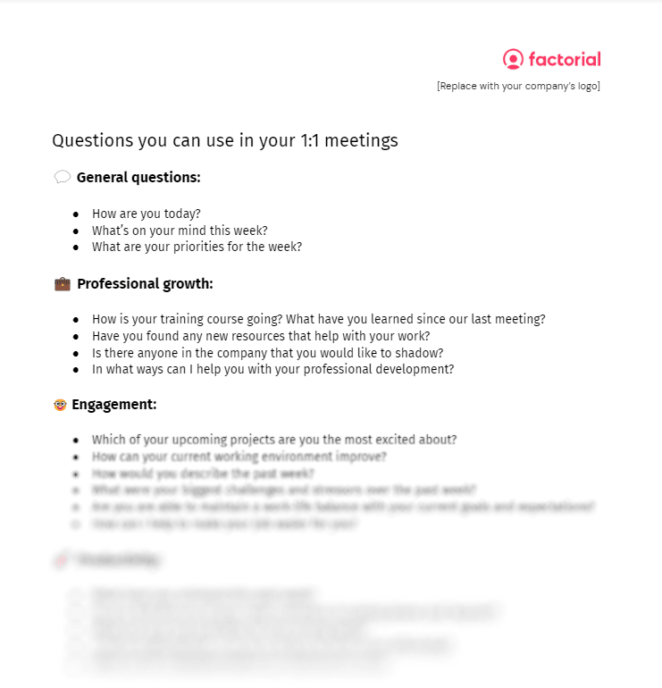
One-on-one manager tips
Organisational tips for managers
- Ask direct reports to outline the meeting ahead of time. Practically speaking, it might not be the best use of a supervisor’s time to create an outline for every one of their one-on-ones. Having an outline also promotes efficiency, organisation, and productivity. Both parties will know which key points need to be addressed and how much time needs to be devoted to each subject.
- Everyone should take notes. Although it might seem simple, writing down notes plays a big role in the overall effectiveness of 1:1s. Firstly, it gives formality to decisions that were made and it helps to cultivate a sense of commitment. Andy Grove describes notetaking as “a written handshake.” Also, the act of writing helps both supervisor and team members stay present during the meeting. The act of writing notes allows for both parties to stay on task and stick to the outlined plans.
- Show actions and progress. Aside from giving and receiving feedback, it is important for both managers and direct reports to show how they have acted upon what was said during previous meetings. In what ways have comments and discussions led to observable differences?
Conversational tips for managers
- Start off with an icebreaker. This will help to establish a rapport and make direct reports feel comfortable from the beginning. Icebreakers don’t have to be complicated. Anything like “do you have any exciting plans coming up” will work out fine. As part of a wellbeing check-in, starting your meeting with a simple question about how the employee is feeling is recommended.
- Spend more time listening than talking. Asking plenty of questions to direct reports is a great way to help them share more about any given topic. Active listening will help you to gain confidence and show that you are really invested in your direct report’s professional well-being.
- Don’t shy away from heart-to-heart conversations. The best way to get shy direct reports to open up is by sharing your own problems and concerns. Keep in mind that it isn’t always easy to get people to open up. Some direct reports might be more introverted and shy than others. However, don’t give up! As the meetings progress and comfort levels change, there will be more opportunities to build trust.
Key takeaways for effective one-to-one meetings
One-on-one meetings can be a great way to motivate your team and dramatically improve internal communication. If all else fails, be sure to consider the following before your next meeting:
- Allow enough time for the meeting to take place. It is better to postpone than to rush through your time together.
- Have a clear outline and meeting structure beforehand. Make sure that everyone is on the same page before starting.
- Start with something funny or conversational to help loosen things up.
- Make sure the employee is front and centre. Remove yourself from any possible distractions.
- Ask plenty of questions and give their answers your full attention.
- Take all concerns seriously.
Last but not least, remember that building a trusting work relationship is the best possible outcome when it comes to one-on-ones. Taking the time to listen to your employees will make these meetings really pay off.

FAQ
Is it 121 or 1 to 1?
There are several accepted terms. One-on-one meetings are also known as 121s, 1:1s, or one-to-ones. All are dedicated meetings between two people, most commonly an employee and their manager. They are used to connect on work, career development, and growth.
How do you write a one-to-one meeting?
To prepare for a one-to-one, both participants should create and share an agenda with talking points in advance. During and after the meeting, take shared notes to track action items and decisions. Using an all-in-one business management software like Factorial can help you manage templates, agendas, and notes for all your 1:1s.
What is a good agenda for a 1:1 meeting?
A simple and effective agenda dedicates time for the employee, time for the manager, and time to discuss the future (e.g., 10 minutes for each). The most important part is the employee’s section; they should be encouraged to lead the conversation, even if it means adjusting the manager’s planned topics.
What should be discussed in a one-to-one?
Discussions should cover progress on goals and KPIs, any work-related problems or roadblocks, and professional development opportunities. It’s also a dedicated space for both the employee and manager to ask questions, share feedback, and align on future plans and priorities.