Keeping track of the hours your employees work is essential to ensure you are paying them correctly, meeting compliance requirements, and maximising productivity. Thankfully, the days of using manual spreadsheets to keep all this essential information are long gone. In this article, we will take a look at the features and benefits of clocking-in systems and provide five market leaders for you to review.

What is a Clocking-in System?
Clocking-in systems are methods for accurately tracking the time employees spend working. Traditionally, employees used physical terminals to clock in for their shifts and clock out at the end of them. Now, many organisations use cloud-based digital apps that provide greater flexibility when employees work remotely as part of their roles.
Clocking-in systems support UK businesses by:
- ensuring accurate compensation
- monitoring punctuality, attendance and productivity
- supporting compliance with labour laws around breaks and working time regulations
- automatically collecting data and reducing the administrative burden
What to Look for in a Clocking-in System?
When you are considering which clocking-in system to invest in, pay close attention to the following areas:
Ease of Use
Think about who will use your clock-in system. It needs to be intuitive for all employees, and especially those with accessibility needs or limited tech skills. Aim for clean interfaces with minimal steps to clock in and out. A more complex system will take longer to onboard and increase the risk of inaccurate records and complaints.
Reporting & Compliance
For employers based in the UK and Northern Ireland, the system must support compliance with laws such as the Working Time Directive, the National Minimum Wage, Data Protection and Human Rights. Look for features that help track meal and rest breaks, night work, weekly hours cap and overtime rules.
As part of compliance, the system needs to generate accurate reports. Reports on hours worked, breaks, absences, and overtime are essential tools for ensuring compliance with working time regulations and for providing information for PAYE audits and holiday calculations.
Integration with Payroll
One of the key roles a clocking-in system can play is to provide the hours worked information needed to generate payroll reports. It is therefore essential that the system you choose integrates with your payroll system. Integration can be within the same platform or via a software link, and it can be one-way from the system to the provider or bi-directional. Having automatic integration reduces errors from manual data entry, makes payroll more efficient and ensures calculations are accurate and up to date.
Scalability
It’s essential to choosee a clocking-in system thatcano grow with your business to avoid unforeseen additional costs if you have to change systems. Check the number of employees it can handle and whether it can deal with multiple locations and different types of contracts (such as temporary, part-time and zero hours). Future-proofing is a worthwhile approach if you plan to grow, franchise, or add remote teams.
Mobile vs. hardware
The method you chose needs to support your workforce. Mobile systems that can be used on phones or tablets can use GPS to confirm location and support remote or field-based employees. Hardware such as card readers or biometric terminals reduces the risk of people clocking in for someone else or at different locations,, and it works well for fixed sites such as factories or warehouses. Some systems will support both mobile and hardware options.
Anti-Fraud & Data Protection Measures
Whatever system you choose needs to comply with UK GDPR. Employee data, including time data, is legally protected. It should be stored securely (encryption and backups are essential) with role-based access. Likewise, clocking-in systems need to be accurate and minimise the opportunities for people to manipulate information about their working hours. GPS timestamping, biometric options that use fingerprint or facial recognition, and automatic alerts for anomalies such as a shorter shift all help prevent time theft.
Alerts & Notifications
It might sound obvious, but it’s worth checking that the system you are looking at will alert you when people cross an overtime threshold, don’t clock out when they should, or there is an unusual trend in how someone is working. Systems that quickly alert you to potential issues help you mitigate associated risks, including payroll errors and non-agreed overtime.
📌 If you need to simplify your clocking-in and out processes, download this free monthly timesheet template.
Best Clocking-in Systems in 2026 for UK&I Employers
Luckily, in 2026, there are plenty of available options for UK&I employers when it comes to the best clocking-in systems. Choosing the right one for your team is the difficult part. Luckily for you, we’ve compiled a list of the best clocking-in tools for you to implement in 2026.
Factorial
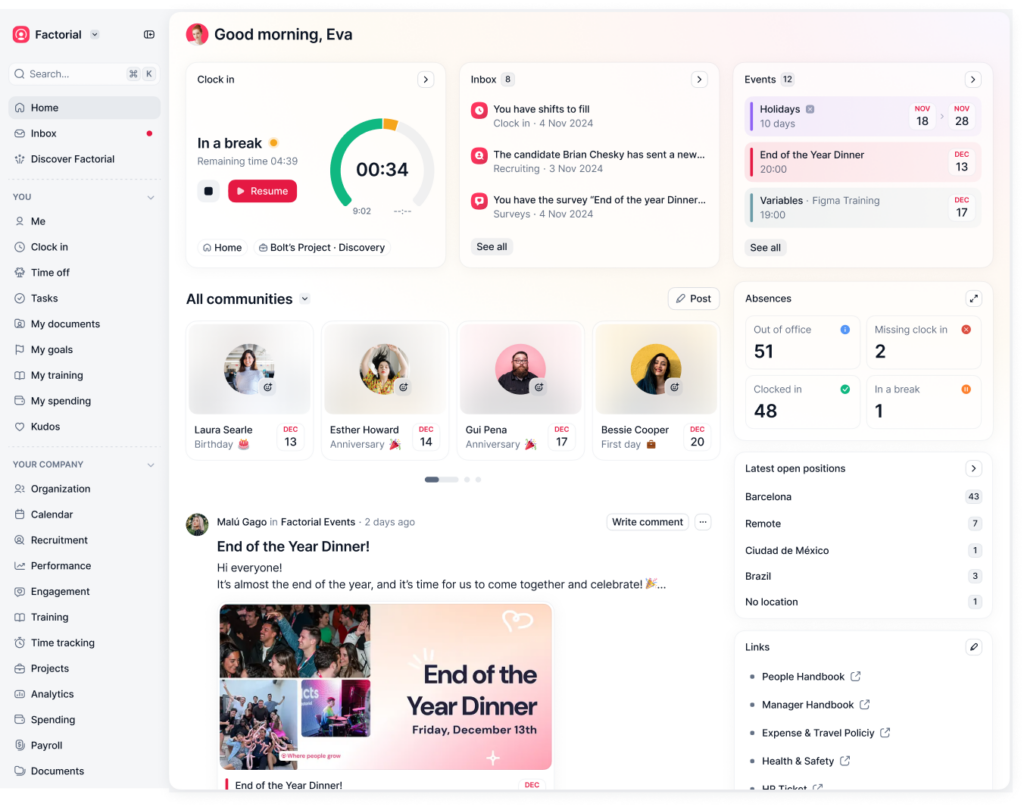
Factorial’s business management software and AI agent is designed specifically to support small and medium-sized businesses that want an integrated clocking in and out system that allows employees to track their time via a number of flexible options. The system includes time and attendance functionality as part of the broader suite of tools to support workforce management, such as secure record keeping, leave and performance management, and learning and development tools.
Best for
- Growing companies looking for a comprehensive all-in-one HR ecosystem with time tracking fully integrated.
Pros
- Supports UK compliance regulations and provides accurate reports.
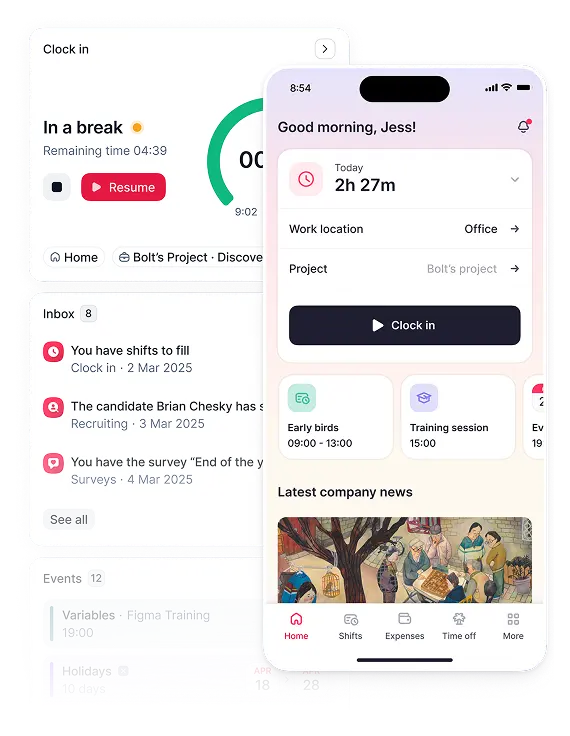
- Flexible options include QR codes, desktop entry, mobile apps and tablet kiosks.
- Integrates HR workflows with time tracking.
Cons
- Additional costs for advanced features.
- Less detailed support for scheduling available.
Price
- Modular, per employee per month pricing structure starts at £5.40.
Deputy
Deputy is a cloud-based workforce management platform that supports clocking in, breaks, leave management, shift scheduling and rota management. It’s popular with shift-based workforces, such as those in retail, hospitality, and healthcare, due to the flexibility it offers. These include mobile apps for phones and a tablet kiosk with facial recognition to prevent employees from touching anything.
Best for
- Flexibility of methods for clocking in, including touchless options.
Pros
- Robust compliance support.
- Multiple options for clocking in, including facial recognition.
- Detailed reporting options.
Cons
- Costs can add up with the different options available.
- A more complex system can make the learning curve steeper.
Price
- Three options: Lite £3.25, Core £4.25, Pro £6 all per user per month.
- 30-day free trial available.
TimeStation
TimeStation is a simple, easy-to-use time tracking and attendance system popular with small to medium-sized businesses. Its system supports employees in clocking in and out easily using mobile devices, tablets, and printed cards, catering to all needs. The cloud-based software provides reports based on real-time data, and uses GPS tagging and offline options to make life as easy as possible for employees to use.
Best for
- Easy to set up and start using immediately
Pros
- Cost-effective.
- Intuitive interface with minimal onboarding required.
- Flexible clocking-in options.
Cons
- Fewer advanced features and more limited reporting tools.
- Harder to use at scale.
Price
- Free plan for up to 10 employees, prices in US dollars from $19.95 per month for 20 employees to $59.95 for 200 employees
- Free trial available
Timely
Timely is cloud-based workforce management tool that uses AI-enabled automatic time capture to track time spent on projects without the need for manual clocking-in and clocking-out. The system also organises the data it receives so that work activities can be allocated to billing, payroll, planning and reporting. By minimising the effort required from employees to complete timesheets, Timely reduces the chance of manual errors while saving time. Intelligent timesheets can be generating accurately, quickly and with completely transparency.
Best for
- Generating accurate timesheets quickly
Pros
- Automatic time capture without needing to actually clock in.
- Privacy-focused tool builds trust.
- Intuitive interface is easy to use.
Cons
- Not a classic clocking-in system.
- Offline capability is limited.
Price
- The Starter plan is $9 per employee per month, Premium is $16, and Unlimited is $22.
- 14-day free trial.
Clockify
A well-known and popular option for time tracking, Clockify has a positive reputation as a free time tracking tool that supports individuals and teams to record their hours via manual entries or timers. It can be used on desktops, mobile apps and as an extension in your browser, making it easy to access, and integrates with billing and finance, communicaton and project management tools.
Best for
- Comprehensive free plan.
Pros
- Good free plan includes unlimited users, projects and basic reporting.
- Flexible reporting options.
- Multi-platform support
Cons
- Less robust in terms of compliance and users ability to manipulate the data.
- Reporting can become overwhelming.
Price
- Free plan, plus Basic $3.99, Standard $5.49, Pro $7.99 and Enterpise $11.99
- Free trials if you are considering upgrading available
Comparison Chart for Clocking-in Systems
| Platform | Key Highlight | Price |
| Factorial | Clocking in system fully integrated into a broader, comprehensive suite of HR products | From £5.40 per employee per month |
| Deputy | Flexible methods for clocking in | From £3.35 per employee per month |
| Timestation | Easy to set up and start using | Free plan then $19.95 for up to 20 employees per month |
| Timely | Speedy and accurate timesheets | From $9 per employee per month |
| Clockify | Free option available | Free, and then from $3.99 per employee per month |
Clocking-in System Types
There are many different types of clocking-in systems, ranging from paper versions to hardware machines to cloud-based applications:
Biometric Systems
These use biological data such as facial recognition, eye scans or fingerprints to confirm that the employee is who they say they are, reducing the chances of ‘buddy punching’ where someone clocks in for another person.
Mobile Apps
Apps on phones or tablets can be used remotely to clock in and out, making them a suitable option for organisations with remote or field-based workers. GPS and georeferencing can be used to improve accuracy. Mobile apps often use QR codes, which an employee scans to log their start and end times.
Web-based Systems
Similar to mobile apps, web-based systems can be used remotely on computers, tablets and phones. These systems can often integrate directly into payroll and scheduling applications too.
RFID/Proximity Card Systems using Kiosks
Radio frequency identification (RFID) is a wireless technology that allows data to be communicated via cards or tags to be received, read and stored. These systems offer a quick, cost-effective method to track employees presence on site.
Punch Cards & Manual Clocks
Considered old-school, traditional systems, these are physical cards that are stamped with the date and time to create a paper record of when an employee is present for work. The paper nature of this method makes it prone to inaccuracy, as it is easier to lose or manipulate.
Choosing the Best Clocking-in System
Choosing the best clocking-in system for your company can be hard. Here’s a quick checklist to guide your thinking and ensure that you don’t forget anything vital.
| Company size and structure | How many employees, what are the different shift patterns and contracts, and what are the growth expectations? |
| Budget and pricing model | What investment is available and what is tge appetite for additional features at extra cost? |
| Workforce location | Where teams work, will they clock in from different locations at different times and what will be the easiest way for them to clock in? |
| Payroll integration | How will the system talk to existing finance and billing operations? |
| UK compliance | Can the system fully support accurate records and store them securely in line with GDPR requirements? |
| Reporting | How easy is it to view data on your team and generate reports? |
| Ease of use | What are the training requirements and customer support, and how intuitive is the interface? |
Using Factorial to Streamline Your Clocking-in
As we’ve seen, tracking attendance is essential for businesses to ensure accurate payroll runs, understand trends in working patterns and absences, and to maxmise productivity within a legally compliant framework.
Factorial’s software ensures that clocking in is simple and efficient for employees, while giving employers a clear, reliable view of how time is being spent across the organisation. Beyond tracking time, Factorial combines attendance data with a centralised employee database, leave management, performance tracking and compliance tools. Added to this, it’s AI-assistant, One, helps you make informed, data-driven decisions, reducing the time spent in administration and allowing mangers and HR to focus on the business objectives.
Clocking-in System FAQs
- Do UK businesses need a clocking-in system?
UK businesses do not legally need a clocking-in system, although it is a legal requirement to keep accurate records of the hours worked, rest breaks, holiday entitlements and pay for the hours worked. Having a reliable clock-in system is one of the most reliable methods to meet these legal obligations.
- How do employee clocking-in systems improve payroll accuracy?
Clocking-in systems improve payroll accuracy because they capture the actual hours that an employee has worked, reduce human error from manual timesheets and prevent fraud. When a clock-in system is integrated with payroll, the data on the number of hours worked is input directly into pay calculations automatically to ensure employees are paid correctly and consistently, reducing the risk of having to make payroll corrections.
- How does a clocking-in system work?
A clock-in system works by recording when an employee starts and finishes work, including breaks. This information can be recorded using a variety of methods (mobile app, desktop brower, tablet kiosks, QR codes and biometric or card readers. The system automatically records the time spent working, flagas any issues or concerns, and generates timesheets and payroll reports for managers.
- What are the benefits of clocking-in systems?
The benefits of a clocking-in system are more accurate timesheets and payroll, better legal compliance, clear visibility over absence and attendance trends, reduced administration time and reliable evidence if any disputes arise. For employees, clocking-in systems can improve trust in the organisation by improving consistency, fairness and accountability in their pay.