Have you already started recruiting using AI? AI recruitment is not just a passing trend. It is transforming the way HR teams are approaching the hiring process. But with AI everywhere now, it feels as if it is becoming a buzzword. Do you actually know how to use this new technology to enhance your team’s hiring process?
In this article, we’ll focus on a highly relevant issue: the use of artificial intelligence in hiring processes by managers and HR managers. We’ll examine how AI can be used and focus on the advantages and disadvantages. Next, we’ll look to the future, trying to identify the challenges that still need to be overcome to fully realise the potential of artificial intelligence, and which software we can rely on.
Key Facts
- AI in Recruitment: AI recruitment uses algorithms to automate and improve hiring tasks, from screening CVs and scheduling interviews to analysing candidate data for suitability.
- UK Adoption Rate: In the UK, 3 in 10 employers are now implementing AI in their recruitment processes, with 43% of large companies using it to conduct interviews.
- Skills Gap Challenge: A significant challenge is the AI skills gap, with a 2026 analysis revealing that 97% of UK businesses report deficiencies in their teams’ AI capabilities, hindering productivity.
- Legal Framework: The UK Government requires that employers ensure AI tools comply with existing laws like the Equality Act 2010 and UK GDPR, as outlined in government guidance on responsible AI.
Table of Contents
- How Can You Use AI in the Recruiting Process?
- What Are the Benefits of Using AI in Recruiting?
- What Are the Disadvantages of Using AI in Recruiting?
- The Challenges of Using Artificial Intelligence in Recruiting
- Factorial’s AI that Simplifies your Recruiting
How Can You Use AI in the Recruiting Process?
Human resources has undergone a radical transformation. With the advent of AI tools, HR teams can now eliminate a significant number of manual tasks, automating processes to save valuable time and effort. In fact, research shows recruiters can save an average of 4.5 hours per week by using AI.
The Journal of Society, Economics, and Management found that, increasingly, HR professionals are taking on a more strategic role. This means they are no longer limited to administrative tasks but play a crucial role in the company’s success. Their transition into having more of a strategic impact means making crucial decisions, such as deciding on how the hiring process will be structured.
We cannot ignore the new technologies that are emerging during this phase of digital transformation. These technologies are enabling new methodologies for human resources management. Additionally, it is necessary to adopt advanced talent management strategies. Throughout recruitment, one goal is to quickly identify the best talent, retain them long-term, and maximise their potential. Fortunately, thanks to AI recruiting tools, it is possible, for example, to:
- Quickly and objectively identify suitable candidates for your company
- Provide highly personalised training to new hires
- Generate AI-written job descriptions
- Publish job descriptions to multiple job boards at the same time
- Centralise candidate communication
- Continuously evaluate performance and satisfaction levels within the company
Bonus: We’ve included a free ebook to help you learn all about AI in HR management. That way, you can use AI not only in your recruitment process, but also in onboarding, performance management, and employee engagement.
How can AI actually improve your Recruitment Workflow?
AI can reduce the time needed for numerous administrative and manual tasks related to candidate sourcing, such as screening CVs, scheduling interviews, and onboarding. All it takes is the right tools and the right prompts for ChatGPT or other AI.
AI’s ability to objectively analyse large volumes of data simplifies a complex task for humans, thus making your workflows much more efficient. A recruiter, no matter how qualified, will never be able to analyse every CV with the same care, objectivity, and efficiency as an AI-based system. This means AI recruiting software can save your team time and effort. Ultimately, this will speed up the screening processes and lead to hiring top talent more quickly than before.
Furthermore, recruiters and HR professionals can be influenced in their decisions by personal biases. Several studies confirm that factors such as facial expression, clothing, eye contact, body language, and presentation can influence interviewers and impact their final decisions.
But be careful. What we’ve said so far shouldn’t lead to hasty conclusions. AI recruiting is certainly not the solution to all problems. It undoubtedly brings advantages, but there are other factors to consider. For example, it’s very important to know how to give AI the correct instructions and specific prompts because the final result could be of poor quality.
What Are the Benefits of Using AI in Recruiting?
There are numerous benefits to implementing AI in the hiring process. Research published in ScienceDirect highlights several key advantages, which are reinforced by UK market observations:
- Time savings: AI-based software and applications automate numerous recruiting processes. For example, they can be used to screen resumes, identify attractive characteristics in profiles, and conduct initial interviews using AI chatbots. In short, AI eliminates much manual and repetitive work.
- Ease of use: The best AI recruiting tools aim to reduce the complexity of processes. This means they are accessible and usable by any recruiter with good digital skills. Hiring managers don’t need to possess particular skills to complete the recruitment process, just understand how to use the platform.
- Greater objectivity in the selection process: AI can help evaluate candidates with complete objectivity. This minimises the risk of the recruiter, even unconsciously, being biased and evaluating the candidate subjectively. Artificial intelligence can therefore provide concrete assistance in ensuring equal opportunities for open positions, even when you use internal recruiting solutions. All of this improves the perception of the company in the eyes of employees, who will be less inclined to believe there is favouritism or bias within the company.
- Improved candidate experience: The role of AI in improving the overall employee experience should not be underestimated. Candidates receive immediate support and efficient systems that make the application process simple and easy. This benefit alone could encourage talent to submit their CVs and choose your organisation over other, less technologically advanced ones.
- Improved employer brand: On the other hand, AI also enhances the image of the employer and the company. The organisation is rightfully positioned among the advanced companies, ready to implement progress and innovation. This characteristic could be a distinguishing feature of the company and help attract a greater number of candidates.
What Are the Disadvantages of Using AI in Recruiting?
Using AI in recruitment processes certainly brings benefits, but it still has its drawbacks. Issues can easily arise, particularly if you lack the right skills or fail to give proper consideration to the assessments produced by AI-powered systems. Understanding the disadvantages that come with using AI tools will help you be a more responsible user. In this way, you can prevent these drawbacks from affecting your hiring process.
ScienceDirect research warns of potential disadvantages that technology can bring to the recruitment process:
- Lack of nuance in judgement: AI-powered candidate analysis must also be evaluated by a qualified recruiter. AI may provide overly blunt assessments, overlooking nuances and details that only an empathetic, emotionally intelligent recruiter can grasp.
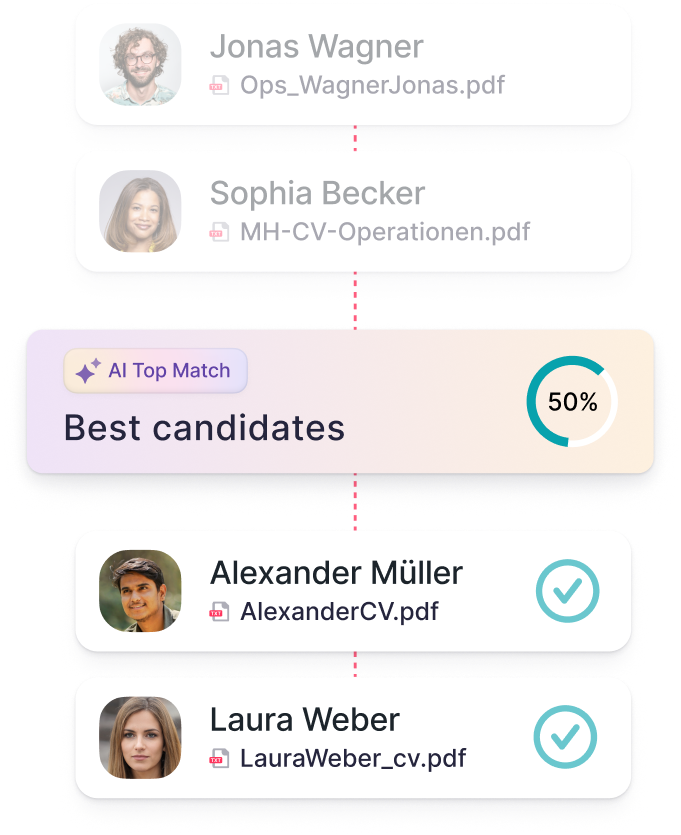
- Incorrectly scoring candidates: Some AI recruiting software may disregard the right candidates or allow top candidates to slip through the cracks. This could prolong the recruitment process and cost you your ideal match, particularly if the AI system doesn’t interpret your candidate preferences correctly.
- Emerging technology: AI recruitment processes are still emerging. Issues such as inaccurate skill assessments and overly rapid assessments that fail to take into account a candidate’s unique circumstances or experiences can arise. This means promising candidates may not advance in your hiring process.
- Data Protection and Legal Compliance: A crucial issue is how AI manages candidate data. According to the UK Government, employers must ensure any AI system complies with the Equality Act 2010 and UK GDPR. This involves conducting a Data Protection Impact Assessment (DPIA) before deployment to mitigate risks. While the EU AI Act is relevant for business in the EU, the UK currently follows its own principles-based regulatory framework.
The Challenges of Using Artificial Intelligence in Recruiting
So far, we’ve highlighted the effectiveness and usefulness of AI recruiting tools and software. However, they must be used with awareness, recognising that they are useful tools but still far from being perfect. These AI tools are most effective when paired with critical thinking skills and an understanding that solely relying on AI is not recommended.
Some current challenges when it comes to using AI recruitment tools are:
- Building trust: The use of AI in recruiting is divisive. Some embrace it, while others are reluctant to adopt it. The real challenge lies in building trust and presenting AI as a collaborative tool, rather than a replacement for people who have carried out these tasks for decades.
- Better candidate understanding: While AI can easily analyse large amounts of data, it struggles to assess a candidate’s experiences, emotions, and overall personality. The current challenge is finding the right balance between AI and human assessment to best understand each candidate’s strengths and weaknesses.
- Costs and training: One point worth noting is the cost of implementing AI and the associated training costs. If technologies continue to develop at a rapid pace, companies may find themselves constantly having to revise their recruiting processes, investing significantly each year in software and training. These represent costs that not all organisations are willing or able to sustain.
- Adding a human touch: When you automate the hiring process, it can be challenging to ensure you add a human touch to the experience, especially with a high volume of candidates. HR professionals need to balance an efficient recruitment workflow while also respecting candidates and approaching the process with empathy.
- Algorithmic Bias: A primary challenge is ensuring fairness. The UK Government highlights that AI models trained on historical data may perpetuate existing biases against protected characteristics, leading to discriminatory outcomes., according to harpermacleod.co.uk If not carefully managed, this can conflict with the Equality Act 2010.
Factorial's AI that Simplifies your Recruiting
If we had to look for a word to describe how to implement AI into recruiting processes, we would choose “balance.” The perfect AI recruitment software would automate and reduce manual tasks while also being fully customisable. HR professionals need an AI recruitment tool that saves time on repetitive tasks while ensuring a smooth and positive candidate experience.
Today’s organisations are tasked with finding a suitable AI recruitment software and implementing their AI tools thoughtfully and carefully. For this reason, choosing the most suitable AI software for recruiting is crucial. Factorial is an all-in-one business software designed to help you implement AI effectively in your company. Its platform respects employee privacy, is non-invasive, and above all, offers truly useful features for successfully implementing AI in the hiring process.
Factorial AI allows you to greatly simplify your hiring process! We’ve got the data to support it:
- 30% reduction in hiring costs
- Save 14 hours of work every week
- 35% increase in efficiency
Thanks to Factorial, you can say goodbye to wasted time reviewing CVs and candidate screening manually. You’ll be able to filter candidates for an initial interview much more easily and connect with talents who truly match the job description. This makes scheduling interviews a breeze, making the recruitment process more efficient.
And that’s not all. With just a few clicks, you can:
- Extract relevant information from CVs and automatically tag them with the appropriate skills and competencies.
- Improve your talent pool and find out who is suitable for a particular open position
- Find the perfect candidates with our semantic search system
- Publish job postings to multiple job boards
- Match with top talent faster than ever
Navigating the UK’s AI Recruitment Landscape
As UK businesses increasingly adopt AI, staying informed about the regulatory environment is crucial. The UK Government states that the government’s pro-innovation, principles-based approach means that while there is no single, overarching AI law yet, existing regulators oversee its use. Organisations should refer to guidance from bodies like the Information Commissioner’s Office (ICO) and the Department for Science, Innovation and Technology (DSIT) to ensure their AI-driven recruitment practices are not only efficient but also fair, transparent, and fully compliant with UK law, as emphasised by SHRM.

FAQ
What is AI recruitment?
AI recruitment uses artificial intelligence to make the hiring process more efficient, cost-effective, and objective. By automating administrative tasks like resume screening and interview scheduling, AI tools help HR teams save time, reduce unconscious bias, and focus on more strategic initiatives.
What is an AI-based recruiter?
An AI-based recruiter is a tool that uses artificial intelligence to automate key hiring functions. It can screen thousands of resumes in minutes, engage candidates via chatbots, schedule interviews, and rank applicants objectively, which significantly speeds up the recruitment process.