Performance management software is crucial for any business that wants to maximise employee performance. For the UK’s dynamic hospitality sector, where high staff turnover poses a challenge and exceptional customer service is necessary, the right tools to track performance and provide feedback are essential. This article analyses the best performance management software for hospitality, focusing on how it helps UK businesses improve efficiency, boost team morale, and reduce staff churn. We will compare three leading options suitable for small to medium-sized hospitality employers.
Table of Contents
- Key Facts
- What is Performance Management Software?
- Best 3 Performance Management Software Options for Hospitality
- Comparison Chart of Performance Management Software
- Simplifying Your Hospitality Performance Management with Factorial
- FAQ
Key Facts
- Performance management software for hospitality helps UK employers simplify reviews, track goals, and gather feedback to improve service quality and reduce turnover.
- The UK hospitality market was valued at approximately £55 billion in 2024 and is a critical part of the national economy, employing 3.5 million people.
- High staff turnover is a major challenge, with rates historically reaching up to 80% annually in the sector, significantly increasing recruitment and training costs.
- A study indicates that companies with effective, continuous performance management processes can reduce employee turnover by up to 30% and increase team productivity by 20%.
What is Performance Management Software?
Performance management software is a digital platform that enables organisations to track and evaluate the performance of individual employees with the overall aim of improving engagement, productivity and efficiency. These solutions are also referred to as employee appraisal software, helping managers and HR teams conduct fair, consistent reviews and feedback sessions.
In a sector such as hospitality, where high staff turnover and a critical customer experience are essential to business success, using performance management software can have a significant impact on an organisation’s overall performance.
Performance management software for hospitality usually includes features such as:
- Scheduling and organising performance reviews
- Collating continuous and 360-degree feedback
- Goal setting and tracking
- Employee engagement surveys
- Tracking training requirements and logging certificates as required
- Visual dashboards to provide insights into employee performance
- Reporting tools
Using software to centralise all these processes supports hospitality businesses in ensuring their staff provide excellent service, which ultimately impacts business success.
How Can Performance Management Be Used in Hospitality?
The hospitality industry, which encompasses a wide range of environments, including bars, restaurants, events, and hotels, is fast-paced. There is often a high turnover of staff, and requirements can vary considerably according to peak hours, busy seasons or scheduled events.
Performance management software can support the hospitality industry within its fast-paced environment in the following ways:
- A centralised system makes it easier for managers to keep track of individual employees and how they are performing.
- The software enables organisations to track how efficiently staff are working at different points, for example, during peak hours.
- Where health and safety training and certification are essential for the business, the software can track and log training for specific employees.
- Automating and regulating the processes involved in managing staff performance makes it easier to identify high-performing employees, reward top talent and identify issues that need resolving.
- Hotel performance metrics, such as guest satisfaction scores and average task completion times during busy shifts, can also be monitored with modern performance management software.
Performance management systems directly address this by helping managers improve staffing based on performance data, ensuring that the most effective team members are recognised and retained during challenging economic periods.

The Benefits of Using Performance Management Software in the Hospitality Industry
- Improves performance: With a centralised system making it easier to keep track of feedback, goals and review cycles, managers can help employees change how they work and increase productivity for the whole business.
- Supports employee engagement: Software that ensures feedback is embedded in the corporate culture and provides tools to survey employees and recognise good work helps improve employee engagement, which leads to better retention rates and increased productivity.
- Provides data for decision-making: A centralised system provides real-time analytics that managers can use to improve their staffing, training and rewards processes.
- Ensures consistency in service quality: For an industry where the customer experience is key to business success, having a system that supports consistency through standardised performance assessments is key.
- Enables staff retention strategies: Modern performance management platforms for hospitality help managers implement proactive staff retention strategies, using continuous feedback loops and employee recognition to lower turnover rates and improve morale.
Real-World Case Study
Understanding the benefits of introducing performance management software to a hospitality business can be best achieved by examining a real-world example, such as the one shared by Empxtrack in their work with the hotel chain Baymont Inns & Suites.
According to Empxtrack, Baymont Inns & Suites faced several challenges, some of which were directly related to performance management, while others were associated with the administration of HR processes.
- Lack of a centralised system for storing employee records.
- The manual tracking of applications was creating delays in hiring new employees.
- Complicated onboarding process.
- Issues managing leave and absence.
- An inefficient performance review system that lacked consistent metrics to assess performance.
By introducing software to centralise and simplify many of the HR processes in the business, Baymont Inns & Suites was able to address all of these challenges. Specifically, in relation to the performance management of employees, introducing an HRIS (Human Resources Information System) ensured transparency, fairness, and consistency in the performance appraisal process. The platform helped managers by automating feedback requests, scheduling performance reviews and tracking training completion. It also ensured that managers set individual goals for employees that aligned with overall company objectives.
Using the performance management software built into the wider HRIS, Baymont Inns & Suites created an effective evaluation system tailored to their requirements. This system enabled managers to address performance challenges and celebrate the success of individual employees promptly and effectively.
Best 3 Performance Management Software Options for Hospitality
When it comes to choosing performance management software, there are many different options available. Some platforms, such as Factorial, include performance management tools within their broader suite of HR support, whereas others, like Lattice, focus specifically on performance management.
When we look at the three best options for performance management software for UK-based organisations, the following functions are considered essential:
- Objectives and key results
- Continuous and 360-degree feedback
- Performance review scheduling
- 1:1 meeting support
- Employee recognition
- Engagement surveys
1. Factorial – Best All-in-One Business Management Solution
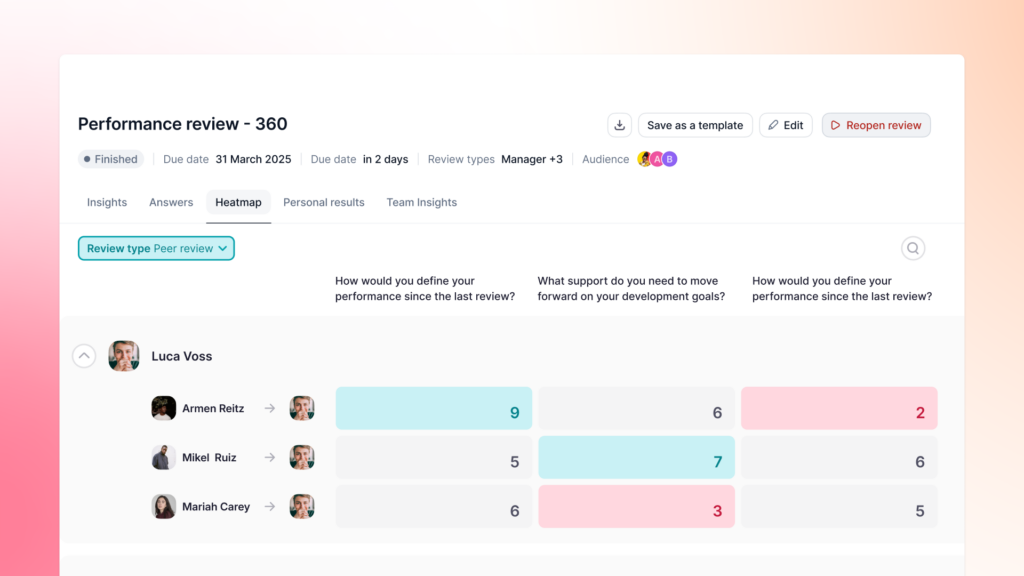
Factorial is a centralised platform that combines a performance management platform with support for HR administration, time tracking, payroll and expense management, and recruitment. It is comprehensive business management software that is ideal for small- to medium-sized hospitality businesses based in the UK, as it supports so many of the essential requirements involved in managing employees in fast-paced environments.
More specifically, Factorial’s performance management software facilitates consistent, transparent and fair feedback loops. It allows managers to create custom templates and personalise performance appraisal workflows. Its continuous feedback loop is well-suited for UK hospitality employers looking to centralise performance management to grow their team, increase employee engagement, and improve UK hospitality compliance.
📌 Don’t forget to download your free eBook that provides practical steps on how to overcome the challenges of the hotel industry.
Factorial’s platform supports businesses in the hospitality industry with their performance management requirements through the following features:
- Goals and OKR (objectives and key results) tracking
- Scheduling and coordinating the performance review cycle
- Tracking feedback and maintaining a continuous feedback loop
- Dashboards that provide performance insights
- Management of training requirements and skills development
Pros:
- Scalable for growing hospitality businesses.
- Includes training support and tracking of certificates.
- Supports UK compliance regulations and UK hospitality compliance needs.
Cons:
- Pricing gets more expensive with increasing headcount.
- Set-up and onboarding can be complex and time-consuming.
Price:
- Free trial available.
- Plans that include Performance Management start from £6.75 per employee per month (billed annually). For detailed and custom quotes, refer to the official Factorial pricing page.
- Plans are available for various businesses and budgets, tailored to the HR needs of the organisation.
2. Lattice
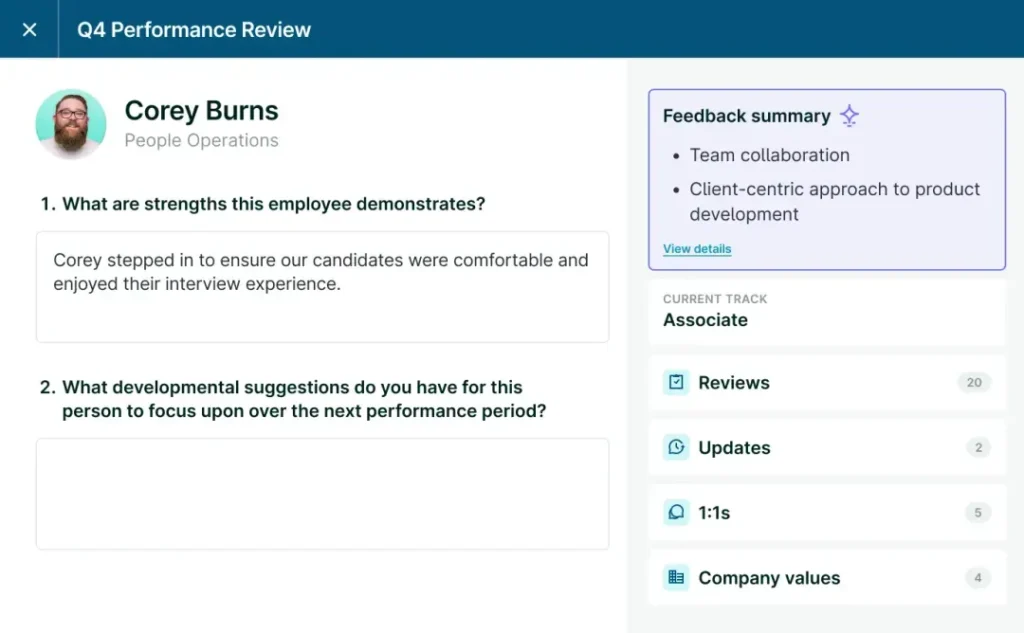
Designed primarily as a performance management tool, Lattice has expanded its functions to include an employee database, time tracking, and payroll. However, the primary focus of the platform is continuous performance management and employee engagement. Lattice has a large number of tools to support a transparent, fair, and strong performance management process, as well as the ability to create surveys, recognise achievements, and keep feedback regular and informal to support improved employee engagement.
The platform features a continuous feedback loop for real-time manager-employee communication, ensuring faster improvements and higher engagement. Lattice is ideal for teams seeking advanced analytics and employee engagement support.
The key features of Lattice’s performance management software include:
- Goal setting, including templates, and tracking.
- Performance review scheduling.
- Facilitation of feedback loops, including continuous feedback and recognition, 360-degree feedback and surveys.
- Dashboards and reports to identify trends, show progress and illustrate engagement metrics.
Pros:
- Designed to support larger teams with strong performance management tools.
- Visually appealing and easy-to-use dashboard.
- Strong focus on employee engagement.
Cons:
- No free trial.
- High cost per user, especially for additional tools for engagement and skills development.
- Integration with broader HR functions is limited compared to other platforms.
Price:
- Lattice’s modular pricing starts at £9 per user, per month for its Performance Management & Goals bundle when billed annually. Additional modules for Engagement or Growth can be added for approximately £3.50 per user, per month each. For current pricing, refer to the official Lattice pricing page.
3. Breathe – Designed for UK SMEs
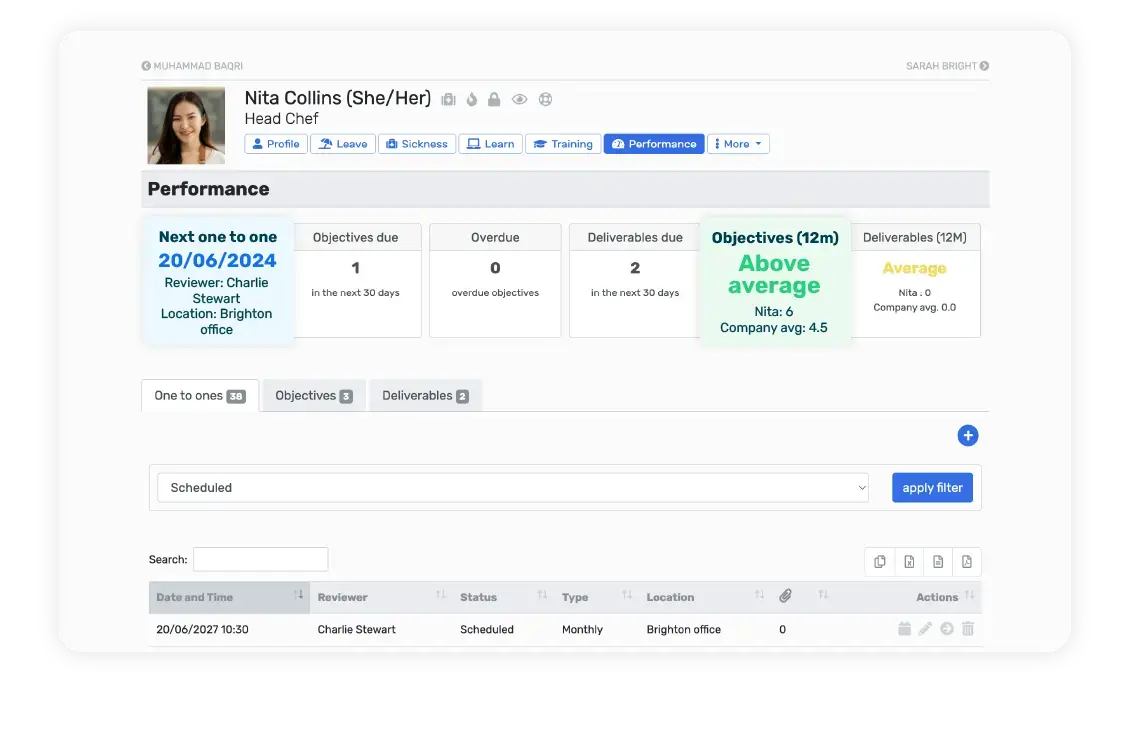
Breathe is a cloud-based HR management system built specifically for UK small and medium-sized businesses. While offering a broad suite of HR tools, its performance management module is straightforward and effective for hospitality employers who need a simple, compliant solution. The platform focuses on core functions like performance reviews, objective tracking, and one-to-one meeting management, all within an intuitive interface.
Key performance management features from Breathe include:
- Centralised performance review scheduling and tracking.
- Goal and objective setting for individuals and teams.
- A dedicated module for logging and managing one-to-one meetings.
- Secure document storage for appraisal forms and feedback.
Pros:
- Specifically designed for the UK market with built-in compliance and UK hospitality compliance needs.
- Simple, user-friendly interface requires minimal training.
- Affordable, transparent pricing based on company size, not per user.
Cons:
- Lacks the advanced analytics and engagement tools of more specialised platforms.
- Limited integration options outside of its own ecosystem.
Price:
- 14-day free trial available.
- Starts from £24 per month for businesses with 1-10 employees.
- Pricing scales in tiers based on total employee count.
Comparison Chart of Performance Management Software
| Software | Performance Reviews | Goal Setting & Tracking | Employee Engagement | Broader HR Integration | Payroll Integration | Best For |
| Factorial | ✅ Full-cycle | ✅ Yes | ✅ Surveys & feedback | ✅ Full HR Suite | ✅ Yes | Growing hospitality SMEs with multiple locations |
| Lattice | ✅ Continuous | ✅ OKRs | ✅ Surveys & analytics | ❌ Limited | ❌ Limited | Multi-location hospitality chains |
| Breathe | ✅ Scheduled | ✅ Yes | ❌ Limited | ✅ Full HR Suite | ✅ Third-party only | UK-based hospitality SMEs needing a simple solution |
Simplifying Your Hospitality Performance Management with Factorial
Factorial is a strong option for hospitality businesses looking for a comprehensive HR solution that will cover their complex performance management needs while also integrating with other aspects of people management, such as time tracking, training and recruitment – all of which are essential for the hospitality sector.
By centralising HR functions along with payroll and performance management, Factorial helps managers to:
- Set and track individual and team goals across different locations and departments.
- Provide employees with a transparent and accountable performance management system.
- Ensure they are compliant with local tax and legal regulations.
- Keep on top of performance review cycles and feedback loops continuously.
- Improve employee engagement, reduce turnover and increase productivity.
Modern HR technology is a key trend in the UK hospitality industry for 2026, as operators seek to improve efficiency and navigate a challenging labour market. An integrated platform like Factorial not only manages performance but also connects it to other critical areas like time tracking and training management, providing a unified view of workforce productivity.

FAQ
What is the best performance management software?
The best choice depends on your business needs, but Factorial is a leading recommendation. As an all-in-one business management software, Factorial combines performance tracking, 360-degree feedback, goal management, and time tracking into a single platform, making it ideal for growing teams.
What are the 5 C’s of performance?
The 5 C’s of performance management generally stand for Clarity, Competence, Commitment, Communication, and Control (or Culture). These core pillars ensure employees understand their goals, possess necessary skills, stay engaged, receive regular feedback, and align with workplace objectives.
What are the 5 best tools for performance management?
Top performance management tools offer features like OKR tracking, continuous feedback, performance reviews, and analytics. Factorial stands out as an all-in-one business management software, providing integrated goal setting, automated appraisal workflows, and custom feedback templates alongside broader operations management.
What are some of the best methods for evaluating hospitality employee performance?
Effective evaluation methods for hospitality include 360-degree feedback from peers and managers, regular 1:1 review sessions, goal and OKR tracking, guest satisfaction metrics, and monitoring training completions. Centralised performance systems help maintain fair, consistent evaluations across busy shifts.