Employee feedback has moved beyond annual appraisals and top-down reviews. UK businesses now need regular, multi-source input to develop their people and stay competitive. A 360 feedback tool collects structured feedback from managers, peers, and direct reports in one place, providing a clear, unbiased view of performance while helping teams understand their strengths, development areas, and impact on others. For UK employers, choosing the right 360-degree feedback system is essential for supporting employee development, improving performance conversations, and aligning teams with business goals while staying compliant with GDPR and UK employment standards.
In this guide, we break down what 360 feedback tools are, why they matter, and which platforms stand out this year. We also compare the best 360 feedback tools on the market, explain what to look for in a 360 feedback software solution, and show how they help run better performance reviews.
Table of Contents
- Key Facts: 360 Feedback Tools UK– TL,DR
- What are 360 feedback tools?
- Why do UK employers need a 360 feedback tool?
- Which are the best 360 feedback tools for UK employers in 2026?
- How do the top 360 feedback tools compare?
- What should UK employers look for in a 360 feedback system?
- Simplifying 360 feedback reviews with Factorial
- 360 feedback tools: frequently asked questions
Key Facts: 360 Feedback Tools UK– TL,DR
- What they are: 360 feedback tools collect structured input from managers, peers, direct reports, and the employee themselves, giving UK businesses a balanced, multi-source view of performance that a single manager review cannot provide.
- Growing market: The global 360-degree feedback software market is projected to reach $1.37 billion in 2026, growing at a CAGR of 10.2% through 2034, according to Fortune Business Insights.
- Engagement gap: Gallup’s State of the Global Workplace 2025 report found that global employee engagement fell to 21% – the sharpest drop since the COVID-19 pandemic – costing an estimated $438 billion in lost productivity.
- Feedback frequency matters: Gallup consistently finds that employees are significantly more likely to be engaged when they receive feedback from their manager several times a week or more, underscoring why structured, regular 360 review cycles are a business priority.
📌 Download your free 360 feedback template to get a complete perspective of your employee’s performance.
What are 360 feedback tools?
A 360 feedback tool is a type of performance management platform that collects feedback about an employee from multiple sources. Instead of feedback coming only from a line manager, it also includes input from peers, direct reports, and sometimes external stakeholders. Most 360 feedback systems also include a self-assessment, so employees can reflect on their own performance.
This multi-source approach, also known as a multi-rater feedback process, is what makes a 360-degree feedback tool different from traditional performance appraisals. It gives a more balanced view of how someone works, communicates, and contributes to the team. Feedback is usually gathered through structured surveys with rating scales and written comments. Many tools allow feedback to be anonymous, which encourages honesty and reduces bias.
360 feedback software is automated so that HR teams can set up review cycles, choose reviewers, send reminders, and analyse results from a single platform. Reports often highlight strengths, development areas, and gaps between self-perception and how others see an employee.
For UK businesses, a 360 feedback system is often part of a continuous performance management process. It may connect with goal setting, talent development plans, and regular check-ins. When used well, it supports fairer appraisals and better conversations, leading to more focused employee growth.

Why do UK employers need a 360 feedback tool?
Managers do not always see how employees work with others on a daily basis. A 360 feedback tool helps by collecting feedback from multiple people, not just one manager.
360 feedback systems support employee development by giving more balanced feedback. Employees understand what they do well and where they need to improve.
Key benefits for employers include:
- Clear insight into employee strengths and development needs
- Balanced performance reviews
- Better conversations between managers and employees
The CIPD’s evidence review on performance feedback confirms that multi-source feedback, when delivered well, is one of the most effective tools for improving individual performance– provided it is structured, timely, and tied to clear development actions.
A 360-degree feedback tool also reduces bias in reviews. Using feedback from several sources helps you make more objective decisions about career paths, pay, and training. This approach helps create a fair work environment and aligns with principles set out in the UK’s Equality Act.
Finally, 360 feedback software helps your team align in the workplace. Your team will understand how their behaviour affects others, which supports trust and accountability, leading to stronger collaboration. Many tools also include GDPR-friendly features, making it safer for UK businesses to manage sensitive feedback.
Harvard Business Review’s landmark analysis of the performance management revolution found that organisations are moving away from once-a-year reviews toward more frequent, development-focused conversations– precisely the model that 360 feedback tools are built to support.
Which are the best 360 feedback tools for UK employers in 2026?
There are many 360 feedback tools on the market, but not all are a good fit for UK employers. The best platforms combine ease of use, strong reporting, GDPR compliance, and flexible review design. Below are five of the best 360 feedback tools UK businesses are using in 2026.
The global 360-degree feedback software market is projected to be worth $1.37 billion in 2026 and reach $2.99 billion by 2034, exhibiting a CAGR of 10.2%. This growth reflects increasing investment in digital HR tools and continuous performance management platforms. This makes it a strong time for UK businesses to evaluate their options.
1. Factorial
Factorial offers a simple and flexible 360 feedback tool as part of its wider performance management platform. It is designed for growing UK businesses that want structured feedback without complex setup or heavy admin work.
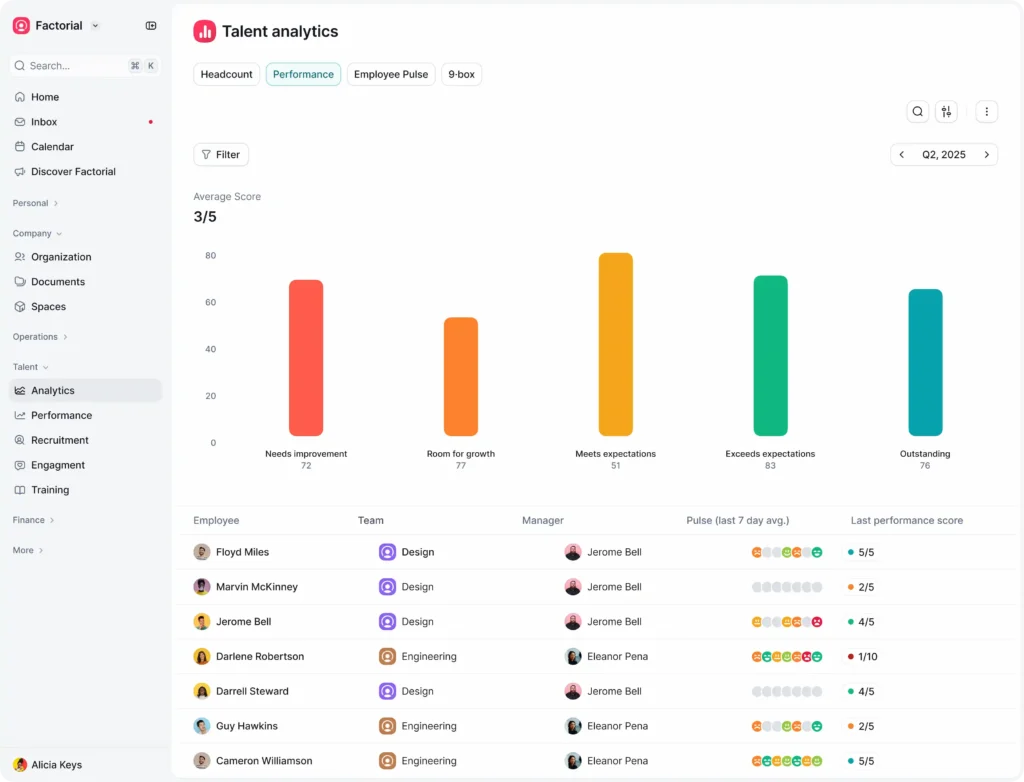
Factorial’s 360 feedback system allows HR teams to collect feedback from managers, peers, and direct reports using custom surveys and automated workflows. Peer feedback can be anonymous, which helps encourage honest and useful input.
Key features
- Customisable review cycles with clear deadlines
- Anonymous peer feedback for more honest responses
- Automated reminders and data collection
- Built-in reporting to identify strengths and development areas
- Full integration with Factorial’s HR, time, and performance tools
Pros
- Easy to use for both HR teams and employees
- Flexible survey design without technical setup
- Strong fit for small to mid-sized UK companies
- All performance data stored in one HR system
Cons
- Interface may feel simple for very large enterprises
- Advanced analytics are more limited than specialist platforms
Factorial’s 360 feedback tool is built directly into its wider performance management platform, meaning feedback data connects automatically to employee records, goal tracking, and development plans. No manual data transfer is required between systems.
Price
Factorial starts at £5.40 per user, per month (see Factorial’s pricing page for current plan details). Pricing depends on company size and selected features, with personalised quotes available upon request. Request a demo to learn more about Factorial!
Factorial is especially well suited for UK employers looking to run consistent 360-degree feedback reviews while keeping performance management simple and connected to other HR processes within a wider business management software.

2. Culture Amp
Culture Amp includes a 360-degree feedback tool within its performance and development suite. It is often chosen by organisations that want structured feedback paired with built-in coaching support and people-science guidance.
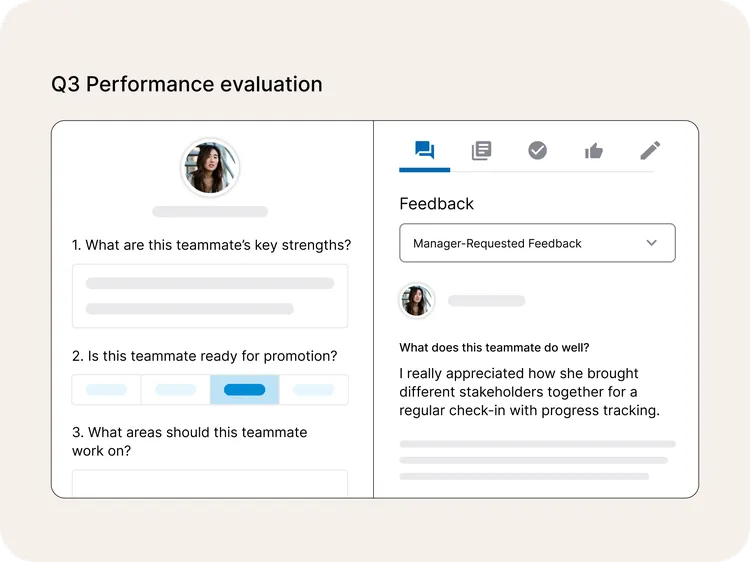
Culture Amp’s 360 feedback system can be run in two ways. Reviews can be employee-driven, where individuals request feedback themselves, or admin-driven, where HR or managers launch review cycles.
A key feature of Culture Amp is the option to assign a coach. The coach can be a manager, HR partner, or trusted colleague who helps the employee understand their feedback and decide on next steps.
Key features
- Employee-led or admin-led 360 feedback cycles
- Built-in templates and guidance for first-time users
- Optional coach support during the feedback process
- Anonymous feedback to encourage honesty
- Integrations with HRIS tools, Slack, Microsoft Teams, and Chrome
- API access for custom integrations
Pros
- Strong learning and coaching focus
- Helpful resources and templates for new users
- Flexible setup for different review styles
Cons
- Sales contact required to access demos
- May feel complex for smaller UK businesses without the need for coaching
Price
Pricing is available upon request directly from Culture Amp. No public pricing is listed on their website (accessed June 2026).
Culture Amp is best suited for organisations that want hands-on support and coaching built into their 360 feedback software.
3. Leapsome
Leapsome is a performance management platform designed to support continuous feedback, goal setting, and structured reviews. Its 360 feedback tool is part of a broader system that focuses on transparency, alignment, and ongoing development.
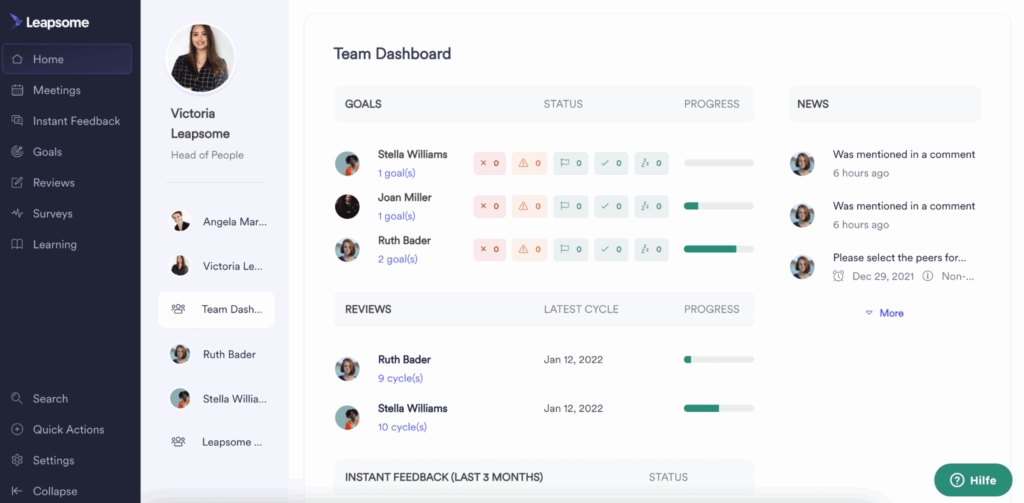
Leapsome allows organisations to collect feedback from managers, peers, and direct reports using custom review cycles and templates. Employees can also complete self-assessments, helping them reflect on their progress and compare their views with feedback from others.
The platform stands out for its focus on linking feedback to goals and development plans. Insights from 360-degree feedback reviews can be used to create clear action points and track improvement over time.
Key features
- Multi-source feedback including self, peer, and manager input
- Customisable review cycles and templates
- Goal setting and tracking linked to feedback
- Continuous feedback outside formal review periods
- Reporting and analytics to identify trends
- Integrations with common HR and productivity tools
Pros
- Strong focus on continuous performance management
- Clear link between feedback, goals, and development
- User-friendly interface that encourages participation
Cons
- Can feel complex for teams wanting simple annual reviews
- Pricing may be higher than basic 360 feedback tools
Price
Pricing is available upon request directly from Leapsome. No public pricing is listed on their website (accessed June 2026).
Leapsome is a good fit for UK employers that want a structured but ongoing approach to performance management, rather than standalone 360 feedback reviews.
4. Zoho People
Zoho People includes a built-in 360 feedback system within its performance management module. It is designed for organisations that want detailed configuration options and strong control over how feedback is collected and reviewed.
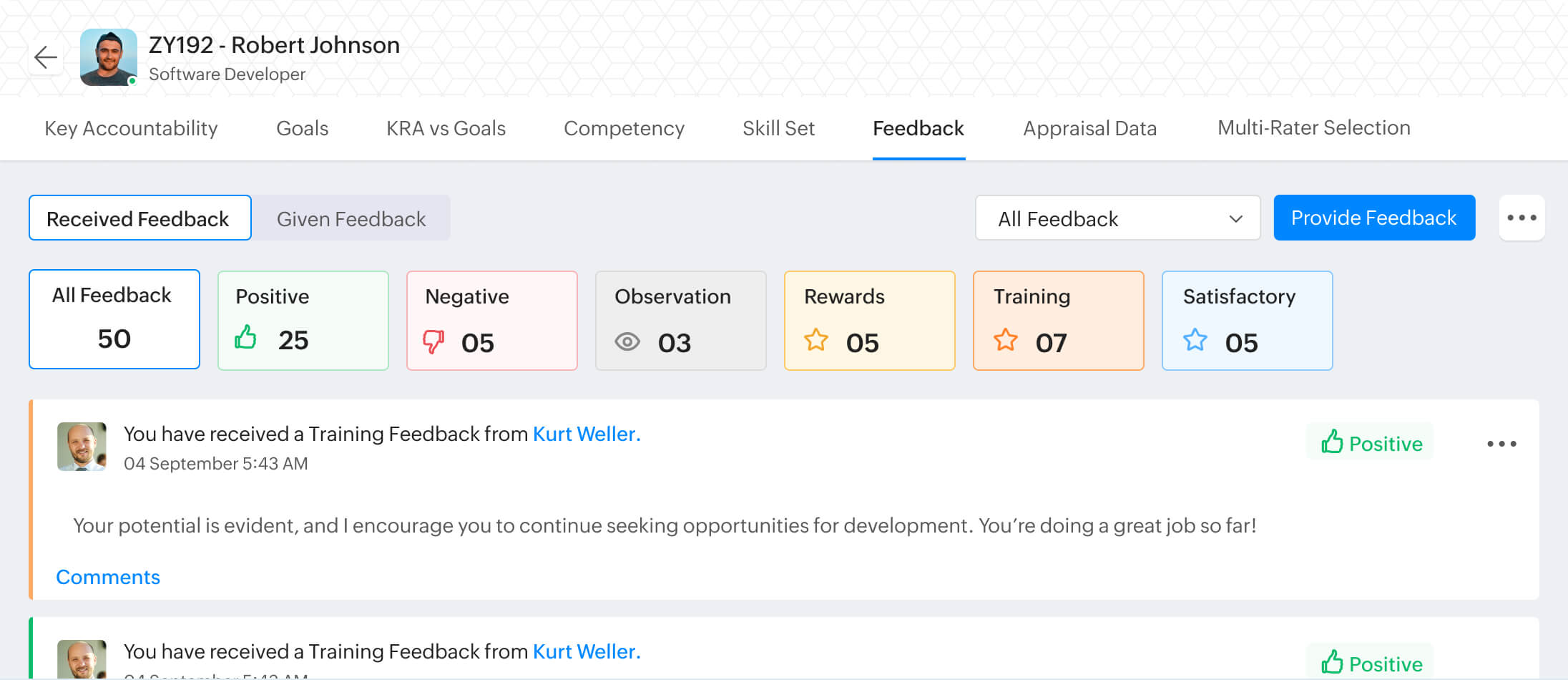
Zoho People allows employers to gather feedback from peers, managers, and direct reports using multi-rater assessments. Feedback can be anonymous, helping employees feel more comfortable sharing honest views. The platform also compares self-ratings with feedback from others, making it easier to spot gaps and development needs.
Key features
- Multi-rater feedback from peers, managers, and subordinates
- Customisable feedback templates for different roles
- Optional anonymous feedback settings
- Integration with appraisal and review cycles
- Visual reports comparing self-assessments with team feedback
- Competency mapping for role-based feedback
Pros
- Highly configurable feedback and review settings
- Strong reporting and visual insights
- Works well for structured appraisal processes
Cons
- Interface can feel complex for new users
- Setup may require more time from HR teams
Price
Pricing varies by plan and module. Details are available on request directly from Zoho People (accessed June 2026).
Zoho People suits UK employers that want a detailed and configurable 360-degree feedback tool, especially those already using other Zoho products.
5. 15Five
15Five is a performance management platform built around continuous feedback and employee development. Its 360-degree feedback tool, known as the Best-Self Review®, focuses on growth, strengths, and future improvement rather than only past performance.
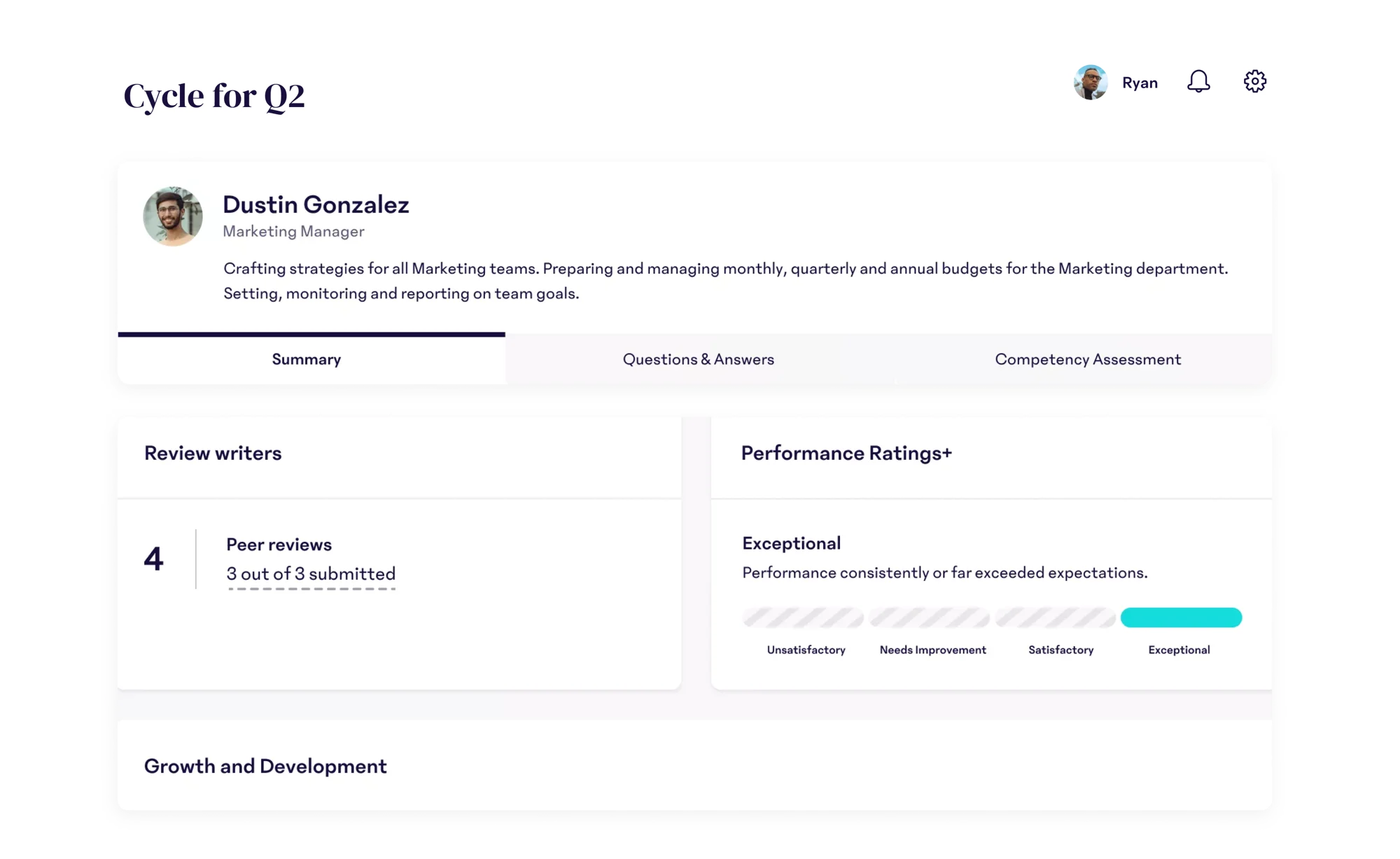
The platform helps managers collect feedback from peers, direct reports, and other stakeholders to support more balanced review conversations. It also encourages regular check-ins, making feedback an ongoing process instead of a once-a-year task.
Key features
- Multi-source feedback from managers, peers, and direct reports
- Framework focused on strengths and growth
- Customisable review cycles and question templates
- Anonymous feedback options for psychological safety
- AI-assisted feedback writing and review support
- Development plans linked to goals and OKRs
Pros
- Strong focus on employee growth and engagement
- Useful tools for reducing bias in reviews
- Encourages continuous feedback, not just annual reviews
Cons
- May feel feature-heavy for small teams
- Less suited to organisations wanting simple review cycles
Price
Pricing is available upon request directly from 15Five. No public pricing is listed on their website (accessed June 2026).
15Five is a good option for UK employers that want to build a culture of regular feedback and development, with 360 feedback software that supports ongoing performance conversations.
How do the top 360 feedback tools compare?
Choosing the right 360 feedback tool is easier when you can see the key differences side by side. The table below compares the leading 360 feedback tools for UK employers based on use case, pricing approach, and standout features.
| Platform | Best for | Price | Key highlight |
|---|---|---|---|
| Factorial | Growing UK businesses wanting simplicity | From £5.40 per user, per month | Easy-to-use 360 feedback built into a full HR system |
| Culture Amp | Coaching-led development and guidance | Pricing on request, free trial available | Built-in coaching support and ready-made templates |
| Leapsome | Continuous performance and goal tracking | Pricing on request | Strong link between feedback, goals, and development |
| Zoho People | Highly configurable appraisal processes | Pricing on request | Detailed customisation and visual reporting |
| 15Five | Ongoing feedback and employee engagement | Pricing on request | Growth-focused Best-Self Review® framework |
This comparison shows that while all platforms offer a 360-degree feedback tool, they differ in complexity, focus, and overall HR coverage. For UK employers, the best choice depends on company size, review frequency, and how closely feedback needs to connect with wider HR processes.
What to consider beyond the feature list
When comparing 360 feedback tools, UK employers should also evaluate three practical factors that rarely appear in feature tables:
- Anonymity controls: Look for platforms that enforce minimum respondent thresholds before revealing individual responses. This protects employees and improves the honesty of feedback.
- Pricing model: Some tools charge per seat (monthly), others per assessment cycle. For businesses running infrequent reviews, a per-assessment model may be more cost-effective.
- AI-assisted features: Several platforms now offer AI-generated feedback summaries and bias-detection tools. These can reduce the time managers spend interpreting results and help surface patterns across teams.
What should UK employers look for in a 360 feedback system?
Not all 360 feedback systems are built the same. To get real value from a 360 feedback tool, UK employers should look beyond basic surveys and focus on features that support fairness, ease of use, and long-term employee development.
Easy-to-use interface
A good 360 feedback tool should be simple for everyone to use, not just HR teams. Employees and reviewers should be able to complete feedback quickly without training or guidance. A clear interface helps increase participation and reduces incomplete or rushed responses.
Customisable surveys and templates
Every organisation is different. The best 360 feedback tools allow employers to customise questions, rating scales, and review cycles. This makes it easier to align feedback with company values, role expectations, and specific skills. Templates are useful, but flexibility is key.
Reporting and analytics
Collecting feedback is only the first step. A strong 360 feedback system should turn data into clear insights. Look for visual reports that highlight strengths, development areas, and gaps between self-assessments and external feedback. These insights help guide meaningful conversations around performance.
Integrations with HR software
360 feedback software works best when it connects with other HR tools. Integration with core HR systems, goal setting, and performance reviews reduces admin work and keeps employee data consistent. This is especially important for growing UK businesses.
GDPR and data protection compliance
Feedback data is sensitive. Any 360-degree feedback tool used in the UK must support GDPR compliance. This includes secure data storage and access controls. It helps set up clear rules around anonymity and data visibility. Choosing a compliant system helps protect both employees and the organisation.
When selecting performance review software for UK teams, GDPR compliance and data residency are non-negotiable.
How often should UK businesses run 360 feedback reviews?
Most UK businesses run 360-degree feedback reviews once or twice a year, often aligned with annual or mid-year performance cycles. Some organisations use lighter, more frequent pulse-style reviews to support ongoing development. The CIPD recommends that performance feedback should be regular, timely, and focused on improvement — not confined to a single annual event. The right frequency depends on company size, review complexity, and how closely feedback connects to goal-setting cycles.
Can 360 feedback tools be used for remote and hybrid teams?
Yes. Because feedback is collected online and does not depend on in-person observation, 360 feedback tools are well suited to remote and hybrid working arrangements. Reviewers can complete surveys at any time, and automated reminders help maintain participation rates across distributed teams. For UK businesses managing hybrid workforces, this makes structured 360 reviews more practical than traditional face-to-face appraisals.
Simplifying 360 feedback reviews with Factorial
Factorial makes it easy for UK businesses to run clear and consistent 360 feedback reviews. HR teams can set up custom review cycles, select reviewers, and automate reminders, reducing manual work.
Anonymous peer feedback encourages honest input, while simple reports help managers understand strengths and development areas. Because Factorial’s 360 feedback tool is built into a wider HR system, feedback connects directly to performance reviews and employee records.
With GDPR-friendly features and a user-friendly interface, Factorial helps UK employers turn 360-degree feedback into practical actions without unnecessary complexity.
Research consistently finds that employees are significantly more likely to be engaged when they receive feedback from their manager several times a week or more. This finding underscores the value of platforms that support continuous, not just annual, feedback cycles.
In case you missed it, take a look at our free 360 performance appraisal template.
FAQ
What is the 360 feedback tool?
A 360-degree feedback tool gives you insight into how others perceive your abilities and behaviour. The process involves gathering confidential feedback from line managers, peers, and direct reports to highlight strengths and identify areas for development.
What is the NHS 360 feedback tool?
While 360-degree feedback is a general HR practice, the UK’s National Health Service (NHS) utilises its own highly specific, formalised version. Often tied to the NHS Leadership Academy and the Healthcare Leadership Model, this tailored tool is widely used across the service for leadership development, staff appraisals, and the mandatory career revalidation of doctors and clinical staff. It measures individuals against specific healthcare leadership behaviours to help them navigate their careers within the NHS infrastructure.
What is the best 360 leadership assessment tool?
The best tools are integrated into a wider performance management system. Factorial, an all-in-one business management software, allows you to create custom review cycles and reports to identify leadership strengths and development areas, connecting feedback directly to employee growth plans.
Is 360 feedback outdated?
No, 360-degree feedback is not outdated. While the methodology has been used for years, modern tools have shifted how feedback is gathered and analysed, making it more efficient and insightful. It remains a valuable process for balanced employee development.
Who to choose for 360 feedback?
To get balanced and useful feedback, select a mix of reviewers, including your manager, peers, and direct reports. Avoid choosing only close colleagues to ensure you receive constructive comments that support your personal development.
What is the best use of 360-degree feedback?
The best use of 360-degree feedback is for employee development. It provides a balanced view of an individual’s strengths and areas for improvement, which helps guide more meaningful performance conversations and focused growth plans.
Disclaimer: The information presented on this page is based on publicly available sources. The comparisons between Factorial and other providers are intended solely for the illustration of the respective software features, pricing and functionalities. All information regarding features, prices, and integrations may be subject to change without prior notice. Factorial assumes no liability for the accuracy, completeness, or timeliness of the information presented. We recommend contacting the respective providers directly to obtain the most accurate and up-to-date information. All legal regulations regarding Spanish fair advertising and competition law are fully observed by us; if you have any concerns, please reach out to us. The comparisons presented do not constitute a final evaluation or recommendation for any provider, but serve solely as an informational source.