Some HR questions are complicated and need to be discussed internally before you give an answer. However, many questions are not. In fact, many HR questions are very simple and repetitive.
“How much annual leave do I have left?” “When is payday?” “Where can I find my payslip?” “How do I change my bank details?” “What does our sickness policy say?”
None of these questions should take too long to answer. Actually, they are usually written down in your company policy, but most people don’t want to read pages of your employee handbook in order find their answer. Answering a question or two won’t take too much of your time, but when you have dozens or hundreds of employees asking them throughout the year, the time adds up and takes your focus away from your actual tasks.
HR teams regularly deal with questions about leave balances, holidays, benefits, bank details, tax information, working hours, passwords, payslips and company policies. Often, the information already exists somewhere in an employee portal, policy document or intranet. The employee either cannot find it or does not know where to look.
For employees, having to hunt through folders or wait for HR can make a simple task frustrating. For you, every routine question takes time away from recruitment, performance, workforce planning and the other work that needs your attention.
This is where Factorial’s AI agent, called One, can help. One connects securely to your company’s information in Factorial, so employees can ask questions in natural language and get answers based on your company’s data. Instead of searching through documents or sending a message to HR, they can ask what they actually want to know.
For HR teams, CEOs and CFOs, One can also help you ask questions about your organisation and get the information you need to support certain strategic decisions. Factorial brings HR, IT and Finance together in one AI business management platform, giving One company context that a general-purpose AI tool or LLM like ChatGPT does not have.
What are HR FAQs?
HR FAQs are the questions employees ask again and again about working at your company. These questions tend to cover a variety of subjects such as annual leave, sickness, pay, benefits, policies, working hours, personal details and internal systems. HR also deals with more complex questions about grievances, performance, contracts and employee rights.
Traditionally, companies have tried to deal with common HR questions by creating an employee handbook, an intranet FAQ page or folders full of policies. Those resources are still important to have so you can share them with employees during their onboarding, for example. The problem that arises later though, is finding the right answer quickly when people actually need something.
An employee might know the annual leave policy exists somewhere, but they still need to find it, work out which rule applies to them and then check their own remaining balance. With an AI agent like One connected to your company information, the experience becomes much simpler. The employee can ask the question directly and get an instant answer. Better yet, One can even start automated workflows, like creating a request to update certain employee information in the employee database and forward it to a manager or the HR team for approval. Features like this save you so much time.
Common HR questions and answers employees ask
The same HR questions tend to come back again and again. We asked 1,000 managers which questions they hear most often, and the pattern was clear.
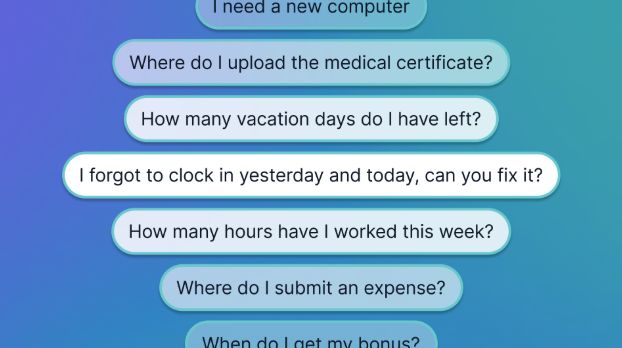
Seven in ten managers said they lose more than an hour every week dealing with these repeat questions. One in five loses more than three hours.
The most common question was about missed clock-ins, with 76% of managers saying they hear some version of “I forgot to clock in, can you fix it?” on repeat. Annual leave comes next. More than half are regularly asked, “How many days of holiday do I have left?”, while 47% hear questions about whether employees can take certain days off.
Other common questions include:
| Common HR question | Managers who hear it repeatedly |
| “I forgot to clock in, can you fix it?” | 76% |
| “How many holiday days do I have left?” | 54% |
| “Can I take these days off?” | 47% |
| “How do I do this in Factorial?” | 46% |
| “Why is my payslip this amount?” | 42% |
| “Who do I ask about this?” | 32% |
| “What’s the company policy on this?” | 23% |
| “How do I submit an expense?” | 18% |
| “What does my contract say about this?” | 12% |
| “Can I work remotely or from abroad?” | 12% |
| “What’s my schedule this week?” | 11% |
| “When is my review?” / “How am I progressing with my goals?” | 11% |
| “What benefits do I have?” | 11% |
| “I need IT help or new equipment” | 11% |
| “What training do I need to complete?” | 10% |
The interesting thing is that most of these questions already have an answer. The holiday balance is recorded. The policy exists. The payslip is there. The process has already been documented. The problem is that somebody still has to find the answer and pass it on.
That is where self-service can really make a big difference. With Factorial One, employees can ask common HR questions directly and get an instant answer from the information already in Factorial. One can also take action when needed, from helping make the most of Factorial features and finding the right contact to submitting a clock-in correction.
Below, we look at some of the most common HR questions in more detail and how you can make them easier for employees to answer.
1. How much annual leave do I have left?
This is one of the clearest examples of an HR question that should be easy to answer. The employee needs two pieces of information: your company’s leave rules and their own current balance. For the official UK rules on statutory holiday entitlement, see UK.GOV.
Your company may provide more leave than the statutory minimum, and an employee’s current balance will depend on leave already taken, booked leave and the rules that apply to them.
With One, an employee could simply ask:
“How many days of annual leave do I have left?”
Instead of asking HR to check the balance for them, they can get the information quickly from the data already held in Factorial.
For more info on annual leave entitlement and how to calculate holidays, check out our article on employee annual leave.
2. When are the bank holidays and company holidays?
Employees often want to know whether the office is closed, whether a particular bank holiday is included in their allowance or which dates they need to book themselves.
The answer depends on your organisation. One company may close between Christmas and New Year. Another may stay open and ask employees to request those days as annual leave.
That can lead to questions such as:
- “Are we closed on the August bank holiday?”
- “Does Christmas Day come out of my holiday allowance?”
- “Which company holidays do we have this year?”
- “Do I need to book 27 December as annual leave?”
Instead of asking HR each time, employees can ask One what rules apply at your company. For more info on dates, regional differences and employee rights, check out our article on UK bank holidays.
3. How do I book, change or cancel time off?
Sometimes the question is not about entitlement at all. The employee knows they have enough leave but cannot remember what to do next or how to manage it.
Who approves the request? Can they edit it after submitting it? What happens if their manager is away? How far in advance do they need to request leave?
These questions are simple enough, but when HR has to answer them, person by person, they become repetitive. One can help employees understand the process using your company’s information, so they can find out what to do without waiting for somebody in HR to reply.
For more info on handling requests and creating a clear process, check out our article on managing employee holidays.
4. When do I get paid, and where is my payslip?
Payroll creates plenty of repeat HR questions:
- “When is payday?”
- “Where can I download my payslip?”
- “Why is my pay different this month?”
- “When will my bonus appear?”
- “Where can I see my deductions?”
- “Who should I contact about a payroll problem?”
Some questions can be answered immediately from information that already exists. A suspected payroll error, on the other hand, may need somebody from HR or Finance to investigate.
The useful part is separating the two. An employee should not need to wait for a member of HR to tell them where their payslip is.
For more info on what employees should see on their payslip and how payslips work in the UK, check out our article on payslip explained.
5. Why has my tax code changed?
Questions about tax are another regular feature of payroll day.
An employee might ask:
- “Why has my tax code changed?”
- “Is this the right tax code?”
- “Who changes my tax code?”
- “Why has more tax come out of my salary?”
- “What do I do if I think my tax code is wrong?”
Some of these questions are about your company’s payroll process. Others need to be dealt with by HMRC. For official guidance on what employers should do when an employee’s tax code changes, HMRC can be helpful.
One can help an employee find the relevant payroll information or understand your company’s process. A question that needs personal tax advice should still receive appropriate attention, and One can forward the employee ticket to the right department.
For more info on what the different codes mean and why they may change, check out our guide to tax codes.
6. How do I change my bank or personal details?
People move house, they change banks, they get married, their emergency contact changes. These events often lead people to ask very simple HR questions:
- “Where do I change my bank details?”
- “How do I update my address?”
- “How do I change my surname?”
- “Where can I change my emergency contact?”
- “Who needs to know that my personal details have changed?”
The instructions may already exist somewhere on a Notion page, but employees are still likely to ask HR if finding them takes longer than sending a quick message. One gives employees another way to find the process. They can ask what they need to do and get an answer based on how your organisation manages the information.
For more info on keeping employee information organised, accurate and secure, check out our guide to HR database software.
7. What benefits do I have?
Benefits can produce a surprising number of variations on the same HR question. An employee might want to know what is available, whether they qualify, how they enrol or what happens when their personal circumstances change.
For example:
- “Do I have private health insurance?”
- “How does our workplace pension work?”
- “Where can I see my benefits?”
- “How do I change my pension contribution?”
- “Who do I contact about a benefit?”
- “I’ve had a baby. Do I need to update anything?”
These are useful questions for company-specific AI.
A general AI chatbot can explain what a workplace pension is. It does not know which benefits your company provides, which policies apply or what internal process an employee needs to follow.
One works with your company’s information, so employees can ask about the benefits and processes that are relevant to them.
For more info on common workplace benefits and how employers can manage them, check out our guide to employee benefits.
8. What is our sickness or absence policy?
People rarely study every HR policy before they need it.
When somebody wakes up ill, they want to know whether they need to phone their manager, send a message, log the absence somewhere or provide a fit note after a certain period.
Questions might include:
- “Who do I tell if I’m off sick?”
- “How do I record sickness?”
- “What is our company sick pay policy?”
- “When do I need a fit note?”
- “Can I take compassionate leave?”
- “What happens if I need emergency leave?”
One can help employees find your company’s process quickly rather than asking them to search for a policy document while they are already dealing with something else.
For more info on employee entitlements, sick pay and what to include in your company policy, check out our guide to sick leave.
9. What does the expenses or travel policy say?
This is where a static FAQ can quickly become awkward.
An employee does not necessarily want to read a long expenses policy to know one thing. All they want is a quick yes or no answer. They want to know:
“Can I claim this £18 taxi?”
Or:
“Do I need approval before booking this hotel?”
Other questions could include:
- “How much can I spend on a meal while travelling?”
- “Can I claim mileage?”
- “Where do I upload my receipt?”
- “Who approves this expense?”
- “How long will reimbursement take?”
One can help employees get to the relevant part of your company policy much faster.
It can also help you give people more consistent answers. Instead of one manager remembering a policy one way and another manager remembering it differently, employees can go back to the company information itself.
For more info on allowable expenses and creating a clear company expense policy, check out our guide to limited company expenses.
10. When is my performance or salary review?
Employees also ask HR about processes that only happen a few times a year:
- “When are performance reviews?”
- “Do I need to complete a self-assessment?”
- “Where do I acknowledge my review?”
- “When are salary reviews?”
- “How does the promotion process work?”
- “What do I need to prepare before my review?”
These questions are easy to forget because employees may only need the answer once or twice a year.
That also makes them good candidates for self-service. Instead of HR answering the same questions every review cycle, an employee can ask One what the process is and what they need to do.
For more info on planning and running your review process, check out our article on salary review.
11. I can’t log in. Who can help?
Sometimes HR becomes the support desk for every employee system.
- “I forgot my password. Can you fix it?”
- “I can’t find my payslip.”
- “I need to complete my review but I can’t get into the portal.”
- “I need to update my details but I don’t know where.”
A technical problem may still need IT to step in. But many questions can be solved by helping the employee find the right instructions, system or person.
This also avoids the usual chain of messages where the employee asks HR, HR forwards the request to IT, IT asks for more information and everybody waits.
For more info on giving employees one place to access documents, HR information and self-service tools, check out our guide to the employee portal.
12. I have a problem with my manager. What should I do?
Some HR questions need human involvement. An employee may ask about bullying, discrimination, harassment, a grievance, a disciplinary matter or something their manager has done.
One can still be useful at the beginning of the process. It can help an employee find your grievance policy, understand how to raise a concern and see which internal process they need to follow.
But a sensitive employee relations issue needs human judgement and proper investigation.
This is important to remember. The purpose of AI in HR is not to keep employees away from HR. It is to remove repetitive administrative work so your team has more time for the situations where employees genuinely need human support.
For more info on recognising inappropriate behaviour and responding to it, check out our article on workplace bullying.
Why answering HR FAQs instantly improves the employee experience
Employee self-service works best when it does not make extra work for anyone involved. Giving somebody access to a folder containing dozens of policies technically gives them access to the answer. It still leaves them with the job of finding the correct document, searching through it and working out which rule applies.
Being able to ask, “Can I carry five days of annual leave into next year?” is a much easier way for people who need help with company information.
Employees get an answer quickly, and they do not have to work out who it is exactly in HR that they need to contact or wait for somebody to reply to a routine question.
For your HR team, the benefit is equally practical. The tenth person who asks about their annual leave balance does not have to create another email, Teams message or Slack ping for somebody to deal with manually.
How Factorial One can reduce repetitive HR questions
A traditional HR FAQ depends on employees knowing that the FAQ or knowledge base exists, remembering where it is and searching it successfully. Yet in practice, people forget.
An employee might have looked up the expense policy six months ago but have no idea where they can find it now. A new starter might know there is an employee handbook but not know which section answers their question. Someone who needs one payslip a year may not remember which menu they used last time.
One changes the way employees reach that information, so they can ask the actual question:
- “Can I claim this expense?”
- “How many holidays do I have left?”
- “When is my performance review?”
- “What do I need to do if I’m off sick tomorrow?”
- “Where can I find my payslip?”
That creates a smoother employee experience and cuts the number of repetitive questions reaching HR. You can learn more about how it works in our article about Factorial’s AI agent.
HR questions leaders can ask about the business
If you are responsible for HR, Finance or the wider business, an AI agent like One can be a gamechanger. You might want to ask certain questions about your workforce or organisation:
- “How many people are off next Friday?”
- “What is our current headcount by department?”
- “Which teams have had the most absence this quarter?”
- “How many approved vacancies are still unfilled?”
- “Which employees still need to complete mandatory training?”
- “Which policies are still waiting for acknowledgement?”
- “How much have we spent on expenses this month?”
- “Which teams are regularly working overtime?”
- “How is actual headcount comparing with our plan?”
You get answers to your questions based on your company data in a secure, safe way. Instead of starting with a spreadsheet or report and trying to find the information yourself, you can start with the exact question you want to ask and get an answer immediately.
Whether you are the CEO, CFO or an HR leader, this can make it easier for you to get the information you need before an important meeting or before you make a big decision without having to spend all of your time pulling data together and cleaning it manually.
Factorial connects HR, IT and Finance in one AI business management platform. One works with that company context, helping you skip the gathering of data from all of your disjointed tools and get to the question you actually need answered.
Get faster answers to HR questions with Factorial One
Employees will always have HR questions. Your HR team does not need to answer every one of them manually. With Factorial One, employees can get quick answers to common questions about HR things like annual leave, policies and everyday processes. At the same time, HR teams and business leaders can use the information in Factorial to ask broader questions about their organisation and support better-informed decisions.
The result is a smoother experience for employees and more time for your HR team to focus on work that needs human judgement, rather than repeating the same answers throughout the week. Want to see what that could look like in your organisation? Book a free demo of Factorial to see One in action and get a personalised quote tailored to your organisation.