Withdrawing an offer of employment is sometimes unavoidable, whether business circumstances change or a candidate fails to meet the conditions of their offer. However, having a job offer withdrawn can be disappointing for the applicant, which makes the process a delicate one for UK employers to manage. In this article, we cover the situations in which a job offer can and cannot be withdrawn, what counts as a valid offer, and the correct process for withdrawing an offer of employment.
Key facts:
- An employer can lawfully withdraw a job offer before it is accepted, and can rescind a conditional offer if the candidate fails to meet its conditions, but withdrawing an accepted unconditional offer is normally a breach of contract.
- From January 2027, employees will need only six months’ continuous service, rather than two years, to bring an unfair dismissal claim under the Employment Rights Act 2025.
- A quarter (27%) of UK employers report new recruits failing to turn up for their first day of work, according to research published in People Management.
- If no notice period is documented, employers must pay at least one week’s statutory minimum notice under Section 86 of the Employment Rights Act 1996.
Need to withdraw a job offer? Check out our letter template for inspiration.

Table of Contents
- Can a Job Offer Be Withdrawn?
- Withdrawing an Offer of Employment
- What Counts as Wrongful Offer Withdrawal?
- How Do You Withdraw an Offer of Employment?
- What Should You Do If Your Job Offer Is Withdrawn?
- Digitise and Simplify Your Recruitment Process with Factorial
- FAQs
Can a Job Offer Be Withdrawn?
Whether a job offer can be withdrawn depends on the circumstances. If a candidate has not yet accepted the job offer, you can retract the offer without any complications. However, the answer is more nuanced if the candidate has already accepted.
If the candidate has accepted the job offer and it is conditional, you can rescind the offer if it later becomes clear that they don’t meet certain criteria. On the other hand, if the candidate has accepted the job offer and it is unconditional, an employer cannot withdraw it, as the employment contract has already begun. More on both of these instances below.
If a job offer is withdrawn once the employment contract is legally binding, this is no longer referred to as an offer withdrawal. This would be defined as a ‘dismissal’ and therefore equates to giving an employee notice of termination. In these instances, employers are legally required to pay the amount that their notice period would have been worth. If this amount hasn’t been documented anywhere, you can use the legal minimum UK notice period of one week under Section 86 of the Employment Rights Act 1996.
| Offer type | When the contract begins | Can an employer withdraw after acceptance? | Compensation owed |
|---|---|---|---|
| Conditional offer | Only once all stated conditions (references, DBS check, right to work) are met | Yes, if a condition is not met | None, since the contract never started |
| Unconditional offer | As soon as the candidate accepts, verbally or in writing | No, doing so is normally treated as a dismissal | At least notice-period pay, per Acas |
Employers should also note that the Employment Rights Act 2025 is reshaping dismissal risk. Acas confirms that from January 2027, employees will need only six months’ continuous service, rather than two years, to bring an unfair dismissal claim. This makes it more important than ever to document the legal basis for withdrawing an offer once employment has begun.
Withdrawing an Offer of Employment
Conditional Job Offer
This is any offer of employment that is dependent on a candidate meeting specific conditions. In other words, the job offer is not final, and the employment contract has not begun until the candidate has passed these background checks. Examples of this might be:
- Reference checks revealing misinformation was given about previous employment, or references aren’t legitimate.
- Criminal record check not coming back clean, which is at odds with the candidate’s application.
- Research into academic history and qualifications not matching information the candidate provided.
- Right to work checks revealing an issue with citizenship or visa type, in line with the Home Office’s employer’s guide to right to work checks.
- Medical history showing a candidate is unfit to fulfil the role.
- DBS check revealing a candidate is unfit for the role.
An offer withdrawal based on any of those reasons is legitimate and means you don’t need to pay any compensation.
Unconditional Job Offer
In some instances, an employer might offer an applicant the job regardless of any criteria being met. This type of employment contract begins from the moment of acceptance. It is legally binding from then on, whether it is verbal or written. For this reason, withdrawing an offer of this kind would be considered a breach of contract.
For employers, the only other possibility here is being transparent with the candidate in the hopes that they will step back. You have every right to speak with the candidate about rescinding the job offer.
Discussing the Decision With the Candidate
Although they don’t have a legal obligation to accept your request, you might be able to mediate your way through the situation. Communicate the honest reasons behind the offer withdrawal. Maybe your company has had budgeting issues or is undergoing an unexpected restructuring. Or maybe the applicant has since displayed behaviour that you’re unsure about.
Whatever the reason, convey that you understand how difficult this might be for them. Perhaps even send an official letter or email detailing this discussion (you can find a template below). Doing so shows that you take the matter seriously, and therefore improves perceptions of your employer brand.

What Counts as Wrongful Offer Withdrawal?
As a result of the Equality Act 2010, there are nine characteristics that are protected in the UK. Put simply, these are qualities that cannot factor into your hiring decisions. These include:
- Age
- Disability
- Gender reassignment
- Marriage and civil partnership
- Pregnancy and maternity
- Race
- Religion or belief
- Sex
- Sexual orientation.
Basing the withdrawal of an offer of employment on any of these characteristics would be discrimination. Doing so is therefore punishable by law.
How Do You Withdraw an Offer of Employment?
You might want to follow up an offer withdrawal with a letter or email. Cementing your conversation in writing avoids potential confusion and could help to clarify any details. It also gives you an opportunity to outline the reasons behind the offer withdrawal and prove that it was not a discriminatory decision. This isn’t just about covering your back. This is about the mental wellbeing of the applicant, your employer brand reputation, and future talent acquisition.
- Confirm the legal basis for withdrawal, whether that is an unmet condition or a lawful dismissal process if employment has already begun.
- Notify the candidate as soon as the decision is made, ideally by phone before following up in writing.
- Put the reasons in writing using a clear, factual letter or email.
- Offer the candidate an opportunity to ask questions or discuss the decision.
- Keep a written record of the offer, its conditions, and the reasons for withdrawal in case of a future tribunal claim.
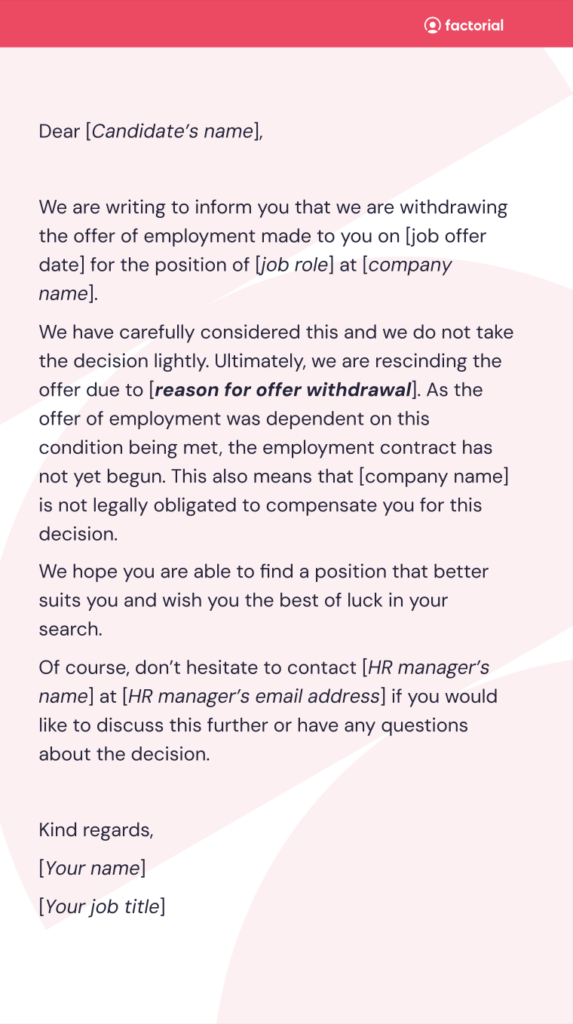
Withdrawing Offer of Employment: Sample Letter
For the times that you might need to unfortunately withdraw a conditional offer of employment, we’ve put together a letter template as a starting point.
Dear [Candidate’s name],
We are writing to inform you that we are withdrawing the offer of employment made to you on [job offer date] for the position of [job role] at [company name].
We have carefully considered this and we do not take the decision lightly. Ultimately, we are rescinding the offer due to [reason for offer withdrawal]. As the offer of employment was dependent on this condition being met, the employment contract has not yet begun. This also means that [company name] is not legally obligated to compensate you for this decision.
We hope you are able to find a position that better suits you and wish you the best of luck in your search.
Of course, don’t hesitate to contact [HR manager’s name] at [HR manager’s email address] if you would like to discuss this further or have any questions about the decision.
Kind regards,
[Your name]
[Your job title]
What Should You Do If Your Job Offer Is Withdrawn?
As a candidate, having your employment offer withdrawn can be understandably frustrating and disappointing. If you don’t believe the employer’s reasoning was fair, or you have any other issues with how the job offer was withdrawn, you have options.
Firstly, you can reach out to the hiring manager to ask for more details about the decision. Why was the job offer withdrawn? Which criteria did you not meet? Can the employer offer you anything else, or at least consider you for future roles?
If you discover that the reason behind the withdrawal was discriminatory, you can take your claim to an employment tribunal. If you are not content with the answers they’ve given for any other reason, you can call the Acas helpline. They will help you understand your options.
Digitise and Simplify your Recruitment Process with Factorial
Factorial’s all-in-one HR software offers a digital solution to the manual processes related to talent acquisition and onboarding. With our platform, you can recruit and nurture employees from the same place in a completely personalised, fast and simple way. Forget outdated spreadsheets, email chains or even sticky notes.
Our software unifies the process for hiring managers and applicants, allowing efficient integration for new employees. This not only increases the satisfaction of new employees in the company but also prepares them better for their role, ensuring increased productivity and greater company success. Creating these better experiences can only improve employer branding and make your company more attractive to top talent in the future.
The entire employee lifecycle stays within Factorial. Our solution allows you to:
- Build a careers page to attract more candidates and improve your recruiting process.
- Improve your employer branding in a few minutes with our custom-generated careers pages and attract more candidates.
- Create tailored application forms.
- Make sure all candidates receive a response to their applications.
- Create personalised job offers, application forms or pipeline steps.
- Centralise and automate your onboarding and offboarding processes.
- Personalise your onboarding to new employees.
- Create structured task flows for new employees.
- Facilitate the exchange of responsibilities between employees throughout the onboarding and offboarding processes.
- Centralise all employee documents and personal information.
FAQs about withdrawing an offer in the UK
Can an employer withdraw their job offer?
Yes, an employer can withdraw a job offer. If the candidate has not yet accepted, it can be retracted without legal complications. If the offer has been accepted, the ability to withdraw it depends on whether the offer was conditional or unconditional.
Is a verbal job offer legally binding in the UK?
Yes, a verbal job offer can be legally binding if it meets the correct criteria. For a verbal offer to be considered legally binding, an offer and acceptance must have occurred, both parties must intend to formalise the relationship (create legal relations), and there must be a mutual exchange of value (consideration).
Do employers have to compensate candidates when an unconditional job offer is withdrawn?
Typically, employers have to provide candidates compensation if the unconditional job offer was already accepted. The amount owed is the equivalent to the pay they would have received during the contractual notice period. If no notice period was specified, then typically candidate’s are owed one week’s pay. It is advisable to consult with an employment lawyer to understand the full picture of your situation and if and how much compensation is owed when a job offer is rescinded.
How does the Equality Act 2010 apply to withdrawing a job offer?
The Equality Act 2010 protects applicants from discrimination based on nine protected characteristics. An employer must not withdraw an offer of employment based on any of these nine characteristics or else it will be considered discrimination and can result in an Employment Tribunal claim.
How do you politely withdraw a job offer?
To withdraw an offer politely, communicate the decision clearly and honestly, ideally over the phone. Follow up with a formal letter or email that explains the reason for the withdrawal, expresses regret for the situation, and wishes the candidate well in their job search.
What happens if my job offer is withdrawn after I hand in notice?
If an unconditional job offer is withdrawn after you’ve accepted and resigned, it may be a breach of contract. You could be entitled to compensation equivalent to the pay for your contractual notice period. It is advisable to seek legal counsel for guidance on your specific situation.
Can I withdraw an offer once accepted?
Yes, but there are legal implications. A conditional offer can be withdrawn if the candidate fails to meet the specified criteria. Withdrawing an unconditional offer is a breach of contract, legally requiring you to pay compensation equivalent to the employee’s notice period.